
A single reference for authors who are preparing, formatting and submitting a manuscript to a UGC Status & Parameters, international publishing practice, transparently peer-reviewed journal: template specifications, citation styles, the review workflow, ethics requirements, DOI and indexing, and author rights. Reading it before you start can save you rounds of avoidable corrections.
This peer-reviewed journal follows UGC's 2025 suggestive parameters.
Getting Started
Treat this documentation as the companion guide to submitting a paper to JMVRA (ISSN 2984-8911), a UGC Status & Parameters journal that follows international publishing practice in its editorial work and gives every published article a permanent Crossref DOI. It spans the whole stretch from a finished manuscript to a paper that is published, indexed and citable.
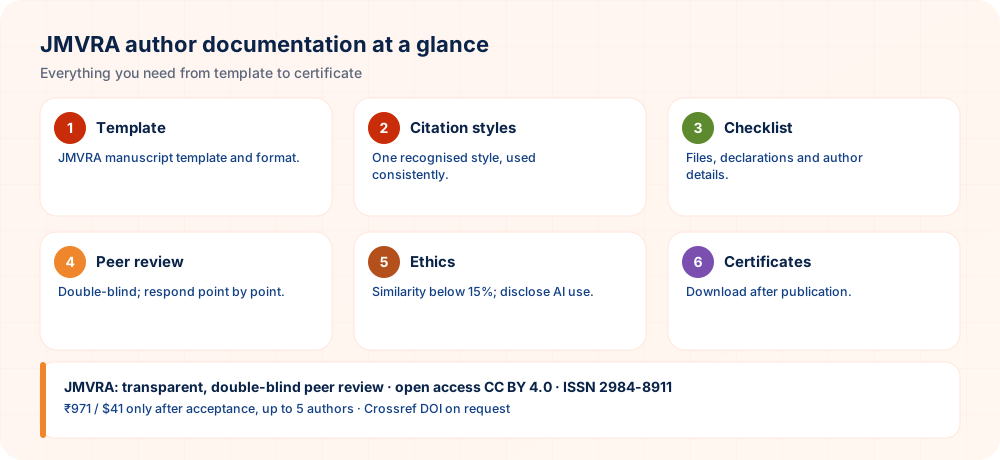
Newcomers to academic publishing should go through sections 1–5 in sequence before submitting. Authors who have published before and only need one detail — a margin size, a threshold or a fee — can use the sidebar or the jump links above to reach it directly.
Further reading: the Indexing & Abstracting page describes what becomes of your metadata once the paper is published, About JMVRA sets out the editorial mission and pricing in full, and How to Publish a Research Paper in a Journal offers a wider introduction to choosing a journal and the publishing workflow if you have not yet decided where to submit.
Publication Process & Guidelines
We invite prospective authors to send original papers, not under consideration anywhere else, written in the standard format set out in this documentation and reporting new theoretical and/or experimental research. A paper may be of any length and may include figures, tables and references. Editors judge submissions on originality, significance, interest, clarity, relevance, correctness and presentation. Check your paper against each of these criteria before you send it.
How to Publish a Paper in JMVRA, Step by Step
- Submit Your Research Paper — click here to submit your paper online.
- Paper submission notification arrives by mail — a paper registration ID is sent to the inbox of the corresponding author, and you can use it to follow the progress of your paper.
- Review (Acceptance/Rejection) notification — expert reviewers evaluate your paper, then the decision to accept or reject is communicated by email and WhatsApp.
- Payment of publication charges — due once your paper is accepted.
- Submit the required documents needed to publish the paper (Undertaking Form, Payment Proof, Identity Proof).
- Publication of Paper — the paper goes live after every required document has been received.
- Download Certificates — once the paper is live, authors can download their publication certificate.
Documents Needed to Publish a Paper in JMVRA
When the JMVRA review committee accepts your paper, the editorial team will notify you. Then pay the publication fee and send all of the documents listed below together in one email to [email protected], putting your paper registration ID in the subject line. A tidy, complete email helps the office process your paper without follow-up requests.
- Undertaking by Author Form — ask for the form by email (send back a scanned copy signed by hand by the author).
- Formatted Manuscript / Research Paper — prepared per the manuscript template; the file must be .doc/.docx and carry your registration ID as its name.
- Identity Proof of the corresponding author only (scanned copy) — any one of Aadhaar Card / PAN Card / College ID Card / Driving Licence.
- Payment Proof — a payment confirmation receipt (PDF or screenshot) that plainly shows the amount paid, the Transaction ID and the Date of Payment.
Why Publish Your Paper in JMVRA
- Low Cost Journal Publication: ₹971 INR for Indian authors / $41 USD for foreign authors
- UGC Status & Parameters Journal Publication
- Crossref DOI available on demand
- Review by experts, with the acceptance or rejection decision delivered by email and WhatsApp
- Open-process, two-way anonymous peer review
- a publication certificate is generated when your paper is published
- JMVRA is an international journal that is open-access and peer-reviewed
- Follow the status of your paper online with your registration ID
- Indexed in Google Scholar, Semantic Scholar and major academic databases
Manuscript Template & Formatting
Manuscripts that already meet this specification clear screening fastest, since the editorial team can spend its review time on content instead of on formatting.
Document Specification
*An abstract in English is always required, whatever language the paper is written in.
Required Paper Structure
- Title — short and informative, preferably under 15 words, and built from the terms a reader would really type into a search
- Names of the author(s), their designation and institutional affiliation, plus an ORCID iD if one is available
- Abstract and keywords
- Introduction & literature review
- Methodology / research design
- Results & discussion
- Conclusion & future scope
- Acknowledgement (if any)
- References
How to Write a Strong Title & Abstract
Your title and your abstract determine whether people find the paper once it is published. Put the method, the domain and the application in the title instead of a rhetorical phrase, and make the abstract report your real results with numbers rather than saying “results are discussed.” This has a direct effect on how well Google Scholar and OpenAlex index and rank your paper. Read making your paper discoverable for the complete advice.
Citation & Referencing Styles
JMVRA accepts the IEEE, APA or MLA citation style. Choose one and apply it throughout the manuscript, so that the in-text citations and the reference list share the same style; mixing styles is among the most frequent reasons a paper is sent back for revision before reviewers ever see it. Check your target field's usual convention before you decide.
| Style | In-Text Format | Best Suited For |
|---|---|---|
| IEEE | Numbered, e.g. [1], [2] | Engineering, computer science, technology |
| APA | Author-date, e.g. (Kumar, 2024) | Social sciences, management, education, psychology |
| MLA | Author-page, e.g. (Kumar 24) | Humanities, literature, arts |
Reference List Quality
A full reference — authors, year, title, source, volume/issue, pages and a DOI where one exists — does more than meet a formatting requirement. With complete references, CrossRef's citation matching can link your paper to the works you cite, and that is how automatic citation counts are assembled in Google Scholar, CrossRef Cited-by and OpenAlex. A partial reference just fails to match, so the paper you cited gets no credit. Why metadata quality matters explains this in full.
Submission Checklist
Go through this list before submitting. Papers that satisfy every item usually pass initial screening within a day. Ticking each box honestly saves you from needless back-and-forth later.
- The manuscript is original, has not been published before and is not being reviewed by another journal
- The title is short, descriptive and under ~15 words
- The abstract runs 150–250 words and reports real findings rather than background alone
- Between 5–8 keywords are given, taken from the established vocabulary of your field
- Every co-author appears with full name, designation, institution and email
- The paper's structure follows the prescribed order of sections (see Section 2)
- A single citation style (IEEE, APA or MLA) is applied consistently from start to finish
- Each in-text citation has a matching reference, and each reference has a citation
- All tables and figures carry a number and a caption
- The file is saved as .doc or .docx and named using the corresponding author's surname
- The manuscript has been checked for plagiarism and sits within the accepted similarity threshold
- The corresponding author's contact details (email + phone/WhatsApp) are up to date
Peer Review & Revision
JMVRA operates a double-blind, transparent peer review process, which the new UGC Parameters Notification requires. Reviewers and authors stay anonymous to one another, and instead of a bare accept/reject answer, authors get the anonymised reviewer comments together with the editorial decision. Reading those comments carefully is the quickest route to a stronger revision.
| Stage | What Happens | What It Depends On |
|---|---|---|
| Initial screening | Checks for scope fit, formatting and completeness | A complete file formatted to the template |
| Similarity verification | Plagiarism screening against the accepted threshold | Similarity below 15% |
| Expert review with both sides anonymous | At least 2 independent reviewers assess the paper | No fixed turnaround — timing depends on reviewer availability |
| Revision & author response | Anonymised comments are shared, and the author revises point by point | Author's pace |
| Final acceptance | The editor verifies that the revisions are sufficient | A full response that answers each point in turn |
| Publication + DOI | Typesetting, proof approval, DOI registration and going live | Payment and documents have been received |
How to Respond to Reviewer Comments
Reply to each comment on its own, including those you disagree with, and give your reasoning rather than skipping the point. Re-review goes much faster when you supply a response document that links every comment to the matching change in the manuscript; a simple numbered list will do. The complete walkthrough is in Tutorials. A courteous, evidence-based tone also helps reviewers accept your explanation.
Publication Ethics & Plagiarism
JMVRA adheres to the guidelines of COPE (Committee on Publication Ethics). Each submission undergoes a similarity check before a reviewer sees it.
Plagiarism & Similarity Policy
- A manuscript has to fall within the accepted similarity threshold before it can go on to review
- A paper over the threshold is sent back for revision instead of being rejected outright, unless the similarity points to deliberate misconduct
- Self-plagiarism (reusing your own earlier published text without disclosing it) is handled exactly like any other plagiarism
- Authors may ask for a copy of the similarity screening report
Authorship & Conflicts of Interest
- Each named author must have made a real contribution to the work, and it must be disclosed
- Authors are required to declare any financial or personal conflict of interest connected with the research
- Fabricating or falsifying data, or manipulating images, is a reason for rejection, or for retraction if discovered after publication
- Submitting the same work to several journals at once is not allowed
DOI, ISSN & Indexing
CrossRef can register any article published in JMVRA to give it a permanent DOI. Authors can ask for this as an add-on to the standard publication fee, and the journal's official ISSN is 2984-8911.
| Identifier / Database | Assigned | Typical Visibility |
|---|---|---|
| Crossref DOI | On request, on request add-on | 24–72 hours |
| ISSN 2984-8911 | Journal-level, permanent | Immediate |
| Google Scholar | Automatic crawl | 2–6 weeks |
| OpenAIRE / OpenAlex | Collected automatically through CrossRef harvesting | 2–8 weeks |
| ROAD (ISSN directory) | Journal-level record | Journal record |
| ResearchGate / Scilit / Zenodo | Automatic propagation | 1–6 weeks |
The dedicated Indexing & Abstracting page gives the full database-by-database breakdown: what each service records, how you can check your own listing, and how indexing relates to UGC CARE status.
Certificates & Proof of Publication
Each author of an accepted paper receives a digital publication certificate, which can be downloaded as soon as the article is live.
| Document | Included | Available |
|---|---|---|
| Publication certificate (one per author) | Yes, standard | Immediately after publication |
| Acceptance letter | On request | After editorial acceptance |
| Transparent peer review certificate | On request | After publication |
| Plagiarism screening report | On request | After screening |
| Printed copy of the journal issue | Available on request (shipping applies) | After print run |
A certificate shows the paper title, the author names, the journal name and ISSN, the volume/issue and the DOI, and institutions generally accept it as adequate proof for PhD, API score and NAAC records. Ask for any on-request document by writing to [email protected]. Keep a digital copy of each certificate with your other academic records.
Author Rights & Open Access Licence
JMVRA releases its articles under the Creative Commons Attribution 4.0 International (CC BY 4.0) licence, so copyright always remains with the authors.
What CC BY 4.0 gives you as an author
- Copyright stays with you — ownership is not handed to the journal
- You can place the published version straight away, with no embargo, in your institutional repository, ResearchGate, Academia.edu or your own website
- Others may share and adapt your work, even commercially, as long as they credit you and link to the licence
- Later on, you may bring figures, tables and text from your own published article into new work as long as a citation is included
Technical Requirements & File Specs
Manuscript File
Figures & Tables
- For print-quality reproduction, images need a resolution of at least 300 DPI
- Image formats we accept: JPG, PNG, TIFF
- Each figure and table needs a caption and a reference in the text
- Build tables as editable Word tables rather than pasting them in as images
Supporting Documents
- Co-author declaration / consent (when the editorial office asks for it)
- Documentation of ethics approval or informed consent for studies with human or animal subjects
- No copyright transfer is needed — JMVRA works under CC BY 4.0 (see Section 9)
Requestable Resources
The editorial team prepares the items below on request instead of offering them as static downloads, which means you always get the latest version:
Already formatted to the specification in Section 2, with margins, fonts, structure and headings in place.
Request by emailOne printable file that combines this documentation page, for reading offline.
Request by emailNeeded only for studies with human or animal subjects, or when the editorial office asks for it.
Request by emailAn itemised calculation for your type of author and paper; no email is needed, since the calculator can be used directly.
Open Cost CalculatorAuthor, Reviewer, Conference & Thesis Help Center
Besides this reference page, JMVRA offers a dedicated step-by-step help article for nearly every stage of the author, reviewer, conference and thesis journey, covering what to prepare, the exact workflow, typical mistakes and troubleshooting. Before opening an individual guide, you can look at the visual map of every journey, with diagrams, in the Author, Reviewer, Conference & Thesis Help Center. Choose the guide that matches your current stage rather than reading everything.
Author — Submit, Track & Publish
The 4-step submission form, plus the purpose of your Registration ID and Private Key.
Read the guideEach status stage explained, from Submitted through to Published.
Read the guideA checklist of 7 steps for the documents needed after acceptance.
Read the guidePaper ID, certificates, DOI, discoverability and the growth of citations.
Read the guideHow to download it through Track Paper step by step, and how to correct a wrong certificate.
Read the guideSeven ways of finding your paper on the JMVRA website.
Read the guideWhat JMVRA displays itself compared with external citation platforms.
Read the guidePapers can be searched by title, author, Paper ID, issue or DOI, and sample queries are provided for direct use.
Read the guideReviewer & RMS
What to get ready, how registration works, and what reviewers are responsible for.
Read the guideHow the reviewer/referral reward system operates, and why you should always check your live balance.
Read the guideThe suggested redemption flow — points never stand in for peer review.
Read the guideConference
The full organizer guide — the details to prepare, the MOU process and the current per-paper charge.
Read the guideWays to verify, and which proof to keep.
Read the guideThesis
Archive publication in journal style versus ISBN-based book publication — two separate routes.
Read the guideWhat the thesis archive displays and how to search it.
Read the guideA full comparison to help you choose the right route.
Read the guideQuickly Find What You Need
| Task | Section |
|---|---|
| Prepare a manuscript | Manuscript template and formatting |
| Cite sources correctly | Citation and referencing styles |
| Understand review | Peer review and revision |
| Get a DOI | DOI, ISSN and indexing |
| Prove publication | Certificates and proof of publication |
New Writing Guides
More detailed guides on the blog:
- APA format guide — social sciences
- IEEE format guide — engineering and computing
- Figures and tables — all fields
- Finding research papers — literature search
Using Author Documentation to Avoid Avoidable Revisions
Detailed author documentation exists to save time, but only if it is used in the right order. These tips show how to work through it so your first submission is as complete as possible.
- Read the full guide before writing. Browse every section once before drafting, so word limits, structure and citation rules shape your writing from the start instead of forcing late rewrites.
- Build a personal checklist. Copy the requirements into your own list and tick them off as you complete each one. Seeing gaps in a short list is easier than rereading a long guide.
- Prepare figures at full quality. Create images in the requested format and resolution from the beginning. Enlarging a small image later makes it blurry and often leads to a request for replacements.
- Run your own ethics review. Confirm consent, approvals, data availability and funding statements are included where required. Missing declarations are among the most common reasons for delay.
- Keep a clean, editable copy. Retain your original document with tracked changes switched on during revision, so you can show reviewers exactly what changed and why.
Read all documentation first, work from your own checklist, and submit a complete package so reviewers can concentrate on your ideas.
Documentation FAQs
At-a-Glance Checklist
- Template downloadedLatest version
- Style consistentFirst to last reference
- Checklist completeBefore you submit
- Similarity checkedBelow 15%
- Certificates savedFor every author
Your Paper's Journey at JMVRA, From Submission to Publication
- SubmitReceive your paper ID
- ScreenScope & similarity
- ReviewDouble-blind
- DecideEmail & SMS
- RevisionComment by comment
- AcceptCopyright & fee
- ProduceDOI at the author's request
- PublishMonthly issue
How long review takes depends on the reviewers and on any revision required, so no set turnaround is promised; you are told of acceptance or rejection by email and WhatsApp.
Ready to Publish? Submit to JMVRA
JMVRA is aligned with UGC's Suggested Parameters for Choosing Peer-Reviewed Journals.
JMVRA is a Transparent, Peer-Reviewed, Open Access Journal (Refereed Journal). Following the discontinuation of the UGC and UGC-CARE journal listing, and in alignment with the latest UGC-CARE recommendations and guidelines, JMVRA is aligned with UGC’s Suggested Parameters for Choosing Peer-Reviewed Journals.
Quick links across jmvra.org
Key Terms
Subjects and search phrases this article addresses.
Related Reading
Further reading on the same theme from the JMVRA blog.
JMVRA Publication Process & Author Guidelines
Read the guide RelatedWhy a Multidisciplinary Journal Works for Any Field
Read the guide RelatedRequesting Conference Publication With JMVRA
Read the guide RelatedDisclaimer
Read the guide RelatedPreprints: Where to Post and When
Read the guide RelatedTerms & Conditions
Read the guideKeep Reading on the JMVRA Blog
Our JMVRA journal blog carries this guide along with other practical advice on publishing, indexing, metrics and research integrity, all written so that claims can be verified and nothing is promotional.