
JMVRA at a Glance
Authors’ most frequent questions are answered together here. Choose a card to go straight to the complete answers.
About the Journal
JMVRA’s identity, scope and publisher, plus its essential facts.
1What is JMVRA?
JMVRA stands for the Journal of Modern and Versatile Research Approach, a multidisciplinary research journal that is peer-reviewed and open-access. It comes out monthly at JMVRA.ORG under ISSN 2984-8911 and has appeared without a break since June 2023.
2What is the meaning of JMVRA?
Journal of Modern and Versatile Research Approach. The journal's standard abbreviation is "JMVRA", which is what you should write when you cite it.
3Which ISSN does JMVRA carry?
2984-8911. For verifying any journal, the ISSN is the dependable key, because titles can be imitated while an ISSN points to a single registered publication.
4In what year was JMVRA established?
2023. A monthly publication schedule has been kept ever since, and the archive lets you check it issue by issue.
5Who is the publisher of JMVRA?
JMVRA Publication. The journal's infrastructure and finances are the publisher's responsibility, whereas editors and reviewers decide on individual manuscripts.
6How frequently does JMVRA appear?
Every month. Papers are taken on a rolling basis all year round, not against one yearly deadline.
7Which subjects are covered by JMVRA?
As a multidisciplinary journal it spans law, environment, agriculture, health sciences, education, humanities and social sciences, management and commerce, mathematics, basic and applied sciences, computer science, and engineering and technology. The Research Area page gives the complete list.
8Does JMVRA follow an open access model?
Yes. Readers can access every article without charge starting on its publication day, with neither paywall nor embargo, under a CC BY 4.0 licence.
9In which language does JMVRA publish?
English is the main language, with Indian and foreign languages also possible. If you write in another language, begin by checking with the editorial office that a language editor and reviewers can be arranged, then email the font details and font file to [email protected].
10Is JMVRA published online or in print?
Online. Each article gets a lasting page of its own, and a Crossref DOI can be requested.
11What is the way to reach the editorial office?
Write to [email protected] or send a WhatsApp message to +91 91063 65667. If you have a paper ID, mention it every time.
12Where do I get all the journal's details together?
Look at the Journal Information page for the full specification: subject coverage, identifier policy, licence, review model, access model, language, frequency, year of establishment, publisher and ISSN.
Submitting a Paper
The submission procedure, the requirements, and the steps that follow.
13How should I send a paper to JMVRA?
Format the manuscript with the journal template and upload it via the submission portal at jmvra.org. A paper ID is issued to you, and it should be mentioned in all further correspondence.
14Which file formats can I use?
Word or PDF, depending on what the submission portal specifies. See the portal for the present requirement instead of trusting a figure quoted somewhere else.
15Does a submission deadline apply?
There is no one deadline. Monthly publication means papers can be sent on any day, and one that misses the cut-off of an issue moves to the following issue.
16Is it allowed to submit a paper that another journal is reviewing?
No. Sending a paper to several journals at once uses up reviewers' time and counts as a breach of publication ethics.
17May I submit work that has been published before?
No. Only original, unpublished manuscripts are accepted. Using text of your own that has appeared before, without a citation, is self-plagiarism.
18What should a manuscript include?
Provide a title, authors and affiliations, abstract, keywords, then introduction, literature review, methodology, results, discussion and conclusion, with full references and mandatory declarations.
19What length should the abstract have?
Between 150 and 300 words is what most journals ask for. Consult the submission portal for the exact requirement at present.
20How many keywords do I need to provide?
Typically between four and eight. Pick terms that your target readers would genuinely type into a search, and skip words your title already contains.
21Am I required to propose reviewers?
A covering note may name preferred reviewers or ask for some to be excluded, giving reasons. Neither request binds the editor.
22What follows right after submission?
Before reviewers are invited, the manuscript is checked for scope, completeness, required declarations and similarity.
23Why did my paper come back prior to review?
Frequent causes include being outside the scope, being incomplete, lacking ethical declarations, similarity over the limit in the policy, or prior publication elsewhere.
24Is withdrawal of my submission possible?
Yes, by writing in and giving the paper ID. Where you can, withdraw ahead of acceptance and not after it, because editors and reviewers will already have done their work by then. Informing the office early shows courtesy to those involved.
25Is a thesis chapter acceptable?
Yes, as long as it is rewritten as an independent article, the thesis is cited and institutional restrictions are observed.
26Are review articles welcome?
Yes. They need to explain how the literature was chosen and to synthesise it instead of merely listing sources.
27Are case studies considered?
Yes. The paper should make clear why the case teaches something to readers who work in different settings.
28Are short communications considered?
Yes, for brief reports of important preliminary findings that include enough methodological detail to judge the claim.
Peer Review
The way manuscripts are evaluated, and the meaning of each decision.
29Which kind of peer review is used at JMVRA?
Double-blind review: reviewers do not learn who the authors are, and authors do not learn who the reviewers are.
30How much time does peer review need?
This covers the whole time to acceptance and publication: expert reviewers evaluate your paper, and you are told of acceptance or rejection by email and WhatsApp. How long it takes hinges on reviewers' availability and any revisions needed, so no set turnaround is promised.
31Why doesn't JMVRA promise a timeline for review?
If a turnaround were assured, review would not be what decides the outcome. Real assessment by volunteers simply takes as long as it takes.
32How will the decision reach me?
It is sent by email and WhatsApp to the contact details you gave on submitting. Make sure they stay up to date.
33Which decisions can be made?
Acceptance, minor revision, major revision or rejection.
34What is meant by "minor revision"?
The conclusions stand, yet certain clarifications or corrections must be made. Usually the editor re-checks the result without sending it back to reviewers.
35What is meant by "major revision"?
The work is worthwhile, but a substantial change is needed, such as further analysis, a reframed claim or a serious gap being closed. It generally goes back to the reviewers who saw it first.
36What is the right way to answer reviewer comments?
Reply to each reviewer comment separately in a response letter, stating what you altered and where (section and page numbers), and justify any point on which you disagree with supporting evidence. Keeping the replies in the same order as the comments helps the editor follow them.
37Am I allowed to disagree with a reviewer?
Yes. Disagreeing with a clear rationale and evidence is perfectly acceptable, whereas quietly skipping a comment is not.
38How should I get my manuscript ready for blind review?
Take author names, affiliations and acknowledgements out of the main file, mention your earlier work in the third person, and clear any identifying details from the file's metadata properties.
39Who takes the final decision?
The handling editor. Reviewers give advice, and the editor makes the call.
40Is it possible to appeal a rejection?
Yes, when you think the decision was based on a factual mistake or a misreading. Write within a reasonable time, cite the paper ID, and explain with evidence exactly what was misunderstood.
41Does disagreeing with a reviewer's opinion count as grounds for appeal?
No. An appeal can only deal with factual errors or misreadings, and not with differing opinions.
42How can I join JMVRA as a reviewer?
Email [email protected], mentioning your research area and giving a link to your list of publications.
43What do reviewers evaluate?
Novelty, significance, methods, supporting evidence, use of existing literature, clarity, ethical compliance and presentation.
44May reviewers run my manuscript through AI tools?
No. Putting a manuscript that is under review into a public AI service breaks confidentiality, and reviewers are told not to do so.
Publication Charges
The amount, the timing of payment, and how to pay with confidence.
45What are the charges for publication?
₹971 INR for authors in India and $41 USD for foreign authors, for each accepted article.
46Is the fee levied per author or per paper?
It applies per accepted article and includes a maximum of 5 authors. Every author beyond the 5th is charged an optional add-on.
47At what point do I need to pay?
Only once your paper is accepted. No payment is due at submission, during screening or while peer review is under way.
48Will paying ensure my paper is accepted?
No. Reviewers and the editor reach the editorial decision before any payment is asked for, so paying has no bearing on acceptance.
49Does JMVRA count as a low cost journal?
The charge is ₹971 INR for Indian authors and $41 USD for foreign authors, for each accepted article, and is due only after acceptance. Compared with typical article processing charges that is modest, and what matters more is that the amount is stated openly before you submit instead of being revealed later. Judge affordability by the actual figure, not by a promotional phrase. It is worth comparing the full cost of any journal, including extras, before you commit.
50What is the fee for low cost journal publication at JMVRA?
₹971 INR for Indian authors and $41 USD for foreign authors. A single charge for each accepted article includes up to 5 authors (an optional add-on applies to each author beyond the 5th), and nothing is due at submission or during review.
51Why would an open access journal ask authors to pay?
Since readers pay nothing, there is no subscription revenue. A one-time charge after acceptance therefore funds editorial handling, similarity screening, copy editing, DOI registration and long-term hosting.
52What is included in the charge?
Included are the editors' handling of your paper, plagiarism checks, double-blind peer review, copy editing and proofing, a permanent page for the published article, Crossref DOI registration (on request), open-access hosting, publication certificates, and passing metadata on to indexing services.
53What is excluded from the charge?
Acceptance itself, extensive language editing, bank and currency conversion fees, permission fees from third parties for reused figures, and indexing results, which are decided by the services themselves.
54Is it possible to receive an invoice for my institution?
Yes, but ask for it before you pay and provide the exact billing details needed. Issuing a replacement invoice later takes longer and may not be possible.
55Is any waiver offered?
If a waiver or concession is applicable, the editorial office confirms who is eligible and what evidence is needed. The request must come before payment, since it cannot be applied afterwards.
56Can the fee be refunded?
The fee is collected only after acceptance, and once a paper is accepted and the fee paid, it cannot be refunded. Should you overpay or pay twice, write to [email protected] with your paper ID and payment details, and the editor will verify the payment and return the surplus. Read the Refund Policy.
57How can I pay securely?
Wait for the acceptance email, get the total confirmed in writing, pay solely through the channels that email names, and include your paper ID as the payment reference.
58I have been asked to pay before review. Is this usual?
No. Do not pay if anybody asks for money ahead of acceptance while saying they represent this journal. Check first with [email protected].
59Do any hidden fees exist?
No. The figure shown on the Publication Charges page should agree with the submission portal and with your acceptance email. When these three do not match, ask before you pay.
DOI and Identifiers
Crossref DOIs, ORCID, and the metadata that sits behind them.
60Is a DOI given to every article?
Articles published in JMVRA can have a Crossref DOI on request; after the request, Crossref issues a permanent DOI for that article.
61What is a DOI?
A Digital Object Identifier works as a lasting name for a published work. A plain URL stops working when a website is restructured, but a DOI remains linked to the article because the publisher keeps its pointer current. That stability is why citing the DOI is safer than citing a web address.
62What is the form of a DOI?
A resolver, a prefix beginning “10.”, and a suffix. A JMVRA DOI starts with the Crossref prefix 10.56975 (https://doi.org/10.56975/…), and the suffix carries the volume, issue and article identifier. Crossref’s own documented example, https://doi.org/10.5555/12345678, shows the same format. Anything not beginning “10.” after the resolver is not a DOI.
63Which metadata is deposited along with my DOI?
The title, every author in order with affiliations, the abstract, journal title and ISSN, volume, issue, pages, date of publication, licence, article URL and reference list.
64Why do I need to verify my author details before publication?
They become part of the permanent deposited record and pass on to indexing services and author profiles, so fixing them later calls for a formal correction.
65What if my DOI fails to resolve?
Look for a copy-and-paste mistake, wait briefly if the article is brand new, try the resolver directly, and then write to [email protected] with your paper ID and the exact DOI.
66Does having a DOI mean the journal is indexed?
No. A DOI is a lasting identifier for a single article, whereas indexing means a search or abstracting service covers the journal's content. The two are different matters.
67Is a DOI evidence of quality?
No. What it shows is only that the article exists in published form and that its identifier resolves.
68Is it possible to delete a DOI?
Once registered, a DOI is meant to last. If an article is retracted, it keeps its DOI and receives a retraction notice instead of vanishing.
69What is ORCID, and do I need an ID?
ORCID is a free, lasting identifier that sets you apart from other researchers with similar names. Giving it when you submit links your work to the correct person in all later databases. Use the same iD on every manuscript so your record stays consistent.
70What is the right way to cite a DOI?
Write it as a complete link, such as https://doi.org/10.5555/12345678, and keep that format every time. When you share your work, give the DOI link rather than a PDF so that views and citations are attached to the article record.
Indexing and Metrics
Where the content is listed, and what the metrics mean and do not mean.
71Does Scopus index JMVRA?
No. At present JMVRA is not indexed in Scopus. If you specifically need a Scopus-indexed journal, this one will not meet that requirement.
72Does Web of Science index JMVRA?
No, not at present. JMVRA is indexed in Google Scholar and registers Crossref DOIs. The Clarivate Master Journal List lets you look up the Web of Science status of any journal.
73Does DOAJ list JMVRA?
Not at present, although JMVRA follows open access practices such as licensing under CC BY 4.0. To check any journal's listing, search doaj.org.
74Why does JMVRA say where it is not indexed?
A coverage claim that you cannot check has no value, and a frank statement helps you decide with full information. The Indexing Verification page gives the status and the steps for checking each entry. Always confirm such claims yourself before relying on them.
75How can I confirm an indexing claim made by any journal?
Visit the service's own website by typing the address yourself, search by ISSN and by title, make sure genuine article records appear, see that the publisher name agrees, and record the date you checked.
76Do ResearchGate or Academia.edu count as indexing?
No. They are platforms for sharing research, where researchers post their own work. Placing them under "Indexed In" would mislead readers, so this site does not do so.
77What impact factor does JMVRA have?
The journal’s impact factor is 11.25. It is a calculated metric based on citations from Google Scholar and Semantic Scholar, and it is not an official Clarivate Journal Impact Factor (JCR). JMVRA’s citation count, h-index and i10-index appear on its pages only once verified; you can check them on JMVRA’s Google Scholar profile. The method is explained on Impact Factor Details.
78How can I check JMVRA’s impact factor?
Open the journal’s Google Scholar profile to see its current citations, h-index and i10-index, then read the method on the Impact Factor Details page. JMVRA shows those figures on its own pages only once they are verified. A number given without its source cannot be checked, but this one names where it comes from so you can do so.
79How does an impact factor differ from the Clarivate Journal Impact Factor?
The Clarivate figure is a particular proprietary metric calculated solely for journals within its own database. Other "impact factors" come from different calculations and data, and each should state its source. Treat any figure that omits its source with caution.
80How is an h-index defined?
A researcher has an h-index of h when h of their papers have each received at least h citations. It blends productivity with citations, but it never goes down, differs between fields, and takes no account of each author's contribution.
81Why do the metrics vary from one database to another?
Each one counts a different set of publications and citations. Neither number is mistaken, since they answer separate questions. Always state the source and the date.
82Is a journal in Scopus if it claims "Scopus standard"?
No. That wording hints at coverage without actually claiming it. A journal is either indexed or it is not. This site uses the phrase only to caution against it.
UGC and Recognition
The CARE framework, and ways to check a journal's status.
83Does the UGC CARE list include JMVRA?
JMVRA is a Transparent, Peer-Reviewed, Open Access Journal (Refereed Journal). Following the discontinuation of the UGC and UGC-CARE journal listing, and in alignment with the latest UGC-CARE recommendations and guidelines, JMVRA is aligned with UGC’s Suggested Parameters for Choosing Peer-Reviewed Journals. See UGC Status & Parameters and the UGC public notice.
84Does JMVRA adhere to the UGC CARE guidelines?
Yes. The journal observes UGC CARE guidelines for peer-reviewed journals, which cover a registered ISSN, transparent double-blind review, refereed status, published ethics and plagiarism policies, charges stated before submission, open access, regular monthly issues and accurate Crossref metadata. On the UGC Status & Parameters page every point is mapped to a place where you can verify it.
85Where can I find the official UGC notice about CARE journals?
The University Grants Commission publishes its public notice at ugc.gov.in, and the UGC Status & Parameters page links to it directly: https://www.ugc.gov.in/pdfnews/6124898_Public-Notice-CARE-Journals.pdf - consult this original source instead of any journal's own summary.
86What is meant by "Transparent Peer-Reviewed Refereed Journal"?
Transparent means the review process is publicly documented and not just claimed. Peer-reviewed and refereed indicate that subject experts assess each research submission before any publication decision. Open access means the published article can be read for free, with no paywall or embargo.
87What does UGC CARE stand for?
The Consortium for Academic and Research Ethics, an initiative of the University Grants Commission that keeps a reference list of journals regarded as suitable for academic evaluation in India.
88Is "UGC Parameters journal" still a valid term?
Not as a current listing. UGC discontinued the UGC-CARE journal list, and institutions now assess journals against UGC’s Suggested Parameters for Choosing Peer-Reviewed Journals. JMVRA is aligned with those parameters — see UGC Status & Parameters.
89How can I confirm the UGC CARE status of a journal?
Start with the official UGC public notice on CARE journals, then compare the journal with UGC’s Suggested Parameters — ISSN, editorial board, peer review, ethics policies, published charges and indexing — and record the date you checked. Journal Verification explains every parameter in turn. Your institution can tell you which criteria it uses.
90What does a UGC CARE assessment examine?
A registered ISSN, a named editorial board, a documented peer review process, published ethics and plagiarism policies, clear charges, timely publication, accurate metadata, and no misleading claims.
91Can a journal's UGC Parameters status change after my paper is published?
Yes. The lists are revised from time to time. Your article stays published, but the credit an institution gives it depends on that institution's own rules, so keep dated evidence of the status as it stood then.
92Is a journal automatically on the UGC CARE list if it is indexed?
No. The two are distinct processes with their own criteria.
93My university keeps its own approved list. Which one counts?
The list kept by your institution decides how your publication is credited. Ask them before you submit anywhere.
Ethics and Integrity
Plagiarism, authorship, corrections, and misconduct.
94What does the plagiarism policy say?
All manuscripts undergo a similarity check before review. The Plagiarism Policy gives the threshold used and the consequences when it is exceeded.
95Is a similarity percentage proof of plagiarism?
No. Software finds textual overlap and not plagiarism as such. Standard methods wording can push a score up, and a low score does not rule out borrowed ideas. That is why editors study the match report and not only the figure.
96What is considered plagiarism?
Taking text, ideas, data, figures or code without credit; paraphrasing so closely that another author's sentence structure survives; and reusing your own published wording with no citation.
97What does self-plagiarism mean?
It means reusing your own earlier published text without citing it. Some reuse is fine — a method that is identical can reasonably look like the one in your previous paper — as long as that earlier work is cited.
98Who counts as an author?
People who made a substantial contribution to the concept or design, to collecting or analysing data, or to drafting and revising the paper, and who also approve the submitted version and take responsibility for it.
99Is it possible to add or remove an author once I have submitted?
Any change after submission needs every author to agree in writing. After publication, a change needs a formal correction notice that stays attached to the article.
100May I name an AI tool as an author?
No. An AI tool cannot be responsible for the work or approve its submission. State clearly any use, naming the tool and its purpose; you stay accountable for each sentence and citation.
101What if an AI tool invented a citation in my paper?
The author is responsible for it, and the tool is not. Compare every reference that a tool gives you with the original source.
102What follows if a mistake is discovered after publication?
Depending on the evidence, the journal publishes a correction, an expression of concern or a retraction. It never edits or removes articles quietly; the notice remains attached for good.
103How can I raise a concern about a published article?
Write to [email protected] giving the article title or identifier along with a clear account of the evidence.
104Is ethical approval needed for my study?
Research that involves human participants, patient data or animals has to name the approving ethics committee and describe the consent obtained. Where a submission reports such work without these declarations, it is sent back before review.
105Which declarations are required at submission?
Grant numbers for any funding, competing interests (or an explicit statement of none), what each author contributed, ethical approval, consent, availability of data, and whether AI tools were used.
After Publication
Copyright, certificates, sharing, and corrections.
106Who holds the copyright to my article?
You do. Authors keep their copyright and give the journal permission to publish and distribute the article.
107Under which licence are articles published?
CC BY 4.0. Anyone may read, download, copy, share and build on the work, as long as the authors and the journal receive credit.
108May I place my article in my institutional repository?
Yes. CC BY 4.0 lets you deposit the published version straight away, without any embargo. This also gives you an independent copy for preservation.
109May I post my article on ResearchGate or my own page?
Yes. Post the DOI link instead of a PDF, so that views and citations are linked to the article record.
110Will I be given a publication certificate?
Yes, to each author named on the accepted manuscript.
111How is my article kept safe over time?
It stays on the journal website on a permanent article page, and a Crossref DOI (on request) keeps citations resolving. Authors are advised to add a copy in a repository too.
112Is it possible to alter my article after it is published?
Solely by a formal correction. Nobody can quietly alter the version of record.
113How can I make my article show up in Google Scholar?
How soon it shows up depends on the service's own crawl schedule and on the accuracy of the deposited metadata. When the article is still absent after several weeks, email the editorial office quoting your paper ID so the deposit can be examined.
114Why is my article missing from a database?
Make sure the article page and the DOI both resolve, then inspect the deposited metadata for mistakes in author names or affiliations, which are the most frequent cause.
Choosing a Journal
Ways to judge any journal, this one included.
115How can I tell whether a journal is genuine?
See whether you can identify the editor, whether peer review is described in specific terms, whether charges are published ahead of submission, whether ethics and correction policies exist, and whether each indexing claim can be confirmed on the service's own site.
116Which signs point to a predatory journal?
Flattering invitations you did not ask for, guaranteed acceptance, very quick turnaround presented as a selling point, fees requested before review, metrics that cannot be verified, rows of logos with no verification links, editorial boards that cannot be found, and a scope that covers everything.
117What does a cloned journal mean?
A website that imitates a genuine title, ISSN and design in order to catch authors and collect fees. Reach any journal by typing its official domain yourself, and verify payment details through a separate channel.
118Does a lack of Scopus indexing make a journal poor?
No. A journal that openly says it is not in Scopus is being honest with you. Honesty and service matter here, not prestige.
119When should I pick a journal: before writing or afterwards?
Before you finish. Once you know the venue, you can fit length, structure and framing to it and skip a last-minute reformatting job.
120How can I find out what my institution expects?
Ask your research office or your supervisor. Only your institution can say which lists it accepts and how a publication will be credited.
121How should I react if I have published in a dubious journal already?
If the paper is published, ask in writing for its retraction, and do not send the same work elsewhere while it is still published. Inform your supervisor or research office early, and save every email and receipt.
122Where can I read more about publishing well?
Hands-on guidance about writing, formatting, indexing, identifiers, metrics and research integrity is offered by Researcher Resources and by the JMVRA journal blog.
Preparing Good Questions Before You Contact an Editorial Office
Frequently asked questions answer common concerns, but your case may still need personal attention. Asking clearly and politely gets faster, more useful replies from any journal office.
- Search the answers first. Read the relevant section and the author guidelines before writing. Editors respond more warmly to questions that show you have already tried to find the information.
- Give your manuscript identifier. Quote the reference assigned to your paper and its title in the opening line. This lets staff locate your file immediately instead of asking follow-up questions.
- Ask one topic per message. Combining payment, review status and formatting in one email slows the reply. Separate, focused messages are easier to route to the right person.
- Keep records of all replies. Save emails, receipts and confirmation messages in one folder. A clear paper trail resolves misunderstandings quickly and supports you if a dispute arises.
- Allow reasonable response time. Editors handle many manuscripts and volunteers work alongside their own duties. Wait a sensible period before following up, and keep the follow-up brief and courteous.
Check the published answers, then write one clear, polite and well-identified message for each question you still have.
How-To Questions
Stepwise answers to the how-to questions authors ask most often.
123How can I publish a research paper in JMVRA?
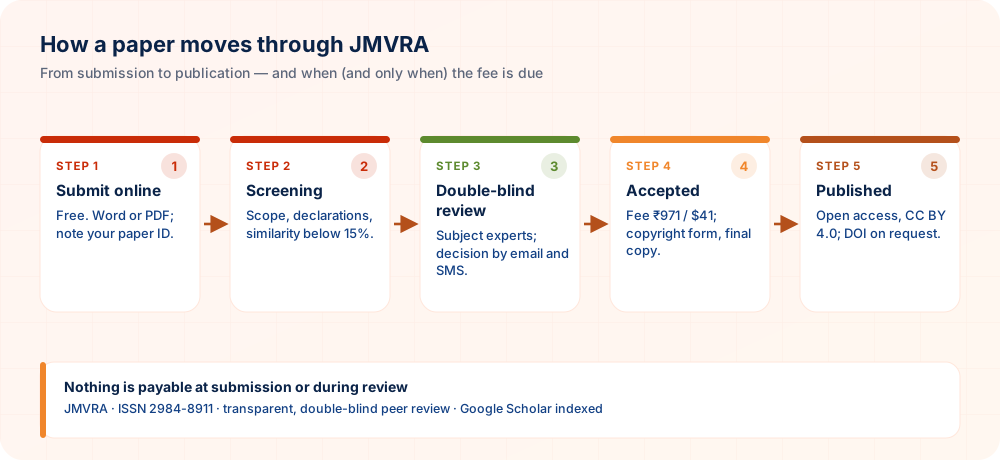
Prepare your manuscript according to the Publication Guidelines and submit it online (or send it by email to [email protected]); it then undergoes screening and double-blind peer review. You receive the decision by email and WhatsApp. Once accepted, you complete the copyright form, supply the camera-ready copy and pay the charge of ₹971 INR / $41 USD, after which the paper appears in the current monthly issue.
124How do I send my paper through the online system?
Go to the submission page, list every author just as they should appear in print, upload your Word or PDF file, and write down the paper ID given at submission. Include that ID in all your messages.
125Is it possible to email my paper to the editor?
Yes. Send the manuscript to [email protected] together with the title, authors, affiliations and subject area. The editorial office acknowledges receipt and confirms whether it fits. The online portal is faster, because it issues the paper ID at once.
126How can I follow the progress of my paper?
Open Track Your Paper and enter your paper ID, or email [email protected] with that ID. Do not submit again — doing so makes a duplicate record.
127How should I pay the publication fee?
Only once the paper is accepted. Pay online through the payment page or by the channels listed in your acceptance email, and include your paper ID. No payment is due at submission or during review.
128How can I obtain a Crossref DOI for my paper?
Request it on the DOI & Hard Copy page — it is optional and registered on request (on request). The DOI, under JMVRA’s Crossref prefix, appears on your article page once Crossref has registered it.
129How can I receive my publication certificate?
Certificates go to the authors named on the accepted manuscript after the paper is published. If you have not received yours, email [email protected] with your paper ID.
130How can I order a printed copy of the journal or certificate?
Use the DOI & Hard Copy page. A printed certificate is available on request, and the bundle of printed journal, certificate and DOI costs ₹1100 / $170. Both are optional and offered on request.
131How can I ask for the transparent peer review report?
Go to Request Review Report. The formal Transparent Peer Review Report can be obtained on request, and the review record is held on Scholar9 — read Open-Process Peer Review.
132How can I check for plagiarism before I submit?
Put your manuscript through a similarity check. The similarity allowed is below 15%; quote and cite any text you reuse, even from your own earlier work.
133How should I write a strong abstract?
Give the question, the method, the key finding and its importance — typically in 150–300 words, without citations. The guide Abstract Writing: What Every Sentence Must Do takes you through it sentence by sentence.
134How should I select keywords?
Choose four to eight terms that your target readers would really search for, and avoid repeating words from the title. Read Choosing Keywords That Get Your Paper Found.
135How should I format my research paper?
Follow the journal template, use a single citation style throughout, number figures and tables and give them captions, and use SI units. Details appear in the Formatting a Manuscript for Submission guide and the Publication Guidelines.
136How should I write a response letter to the reviewers?
Paste each reviewer comment into a numbered list or table, put your answer directly beneath it, and state precisely what you changed and where (section, page or line). If you disagree, explain courteously and give evidence. Upload the letter along with a revised manuscript that highlights the changes. Read Responding to Reviewers.
137How should an article from JMVRA be cited?
Include the authors, year, title, “Journal of Modern and Versatile Research Approach (JMVRA)”, volume and issue, page range, and a DOI link when one has been registered — for instance https://doi.org/10.5555/12345678. Keep to a single citation style.
138How can I locate my published paper on the JMVRA website?
Search using the title, author name, paper ID or issue — read How to Find Your Published Paper, or look through the current issue and past issues.
139How can I confirm JMVRA’s ISSN?
Go to the ISSN Portal record for 2984-8911 and check that the title and publisher agree with this site.
140How can I verify JMVRA’s impact factor?
The value is 11.25, a calculated metric based on citations from Google Scholar and Semantic Scholar, not an official Clarivate Journal Impact Factor (JCR). The method is on the Impact Factor page; citations, h-index and i10-index can be checked on the journal’s Google Scholar profile and are shown on JMVRA’s pages only once verified.
141How can I get my paper listed in Google Scholar?
Google Scholar picks up published JMVRA articles from their permanent article pages; correct author names and affiliations help them link to the right profile. Read Getting Indexed in Google Scholar.
142How can I get more citations for my paper?
Give it a title that is easy to find, put the finding in the first two sentences of the abstract, pick keywords people search for, use ORCID, and share the DOI link instead of a PDF so that citations are tied to the article record.
143How can I join JMVRA as a reviewer?
Apply via Join as Reviewer, stating your research area and publication record. In return reviewers get a Transparent Peer Review Certificate and a record on Scholar9 that others can verify.
144How can I publish my thesis or dissertation?
Turn one chapter into a self-contained article — see From PhD Thesis to Journal Article — or look at the choices in How to Publish a Thesis.
145How can I publish conference proceedings or a special issue?
Submit a proposal via Conference Proposal; the editorial office will respond with the scope, timeline and terms.
146How can I fix an author name or detail after publication?
By means of a formal correction notice. Email [email protected] giving the paper ID, the precise correction and the consent of all authors. The published record is annotated and never edited quietly.
147How should I write a cover letter for my submission?
Limit it to a single page addressed to the editor, covering the paper’s title and article type, two or three sentences on its findings and why JMVRA’s readers would value it, a statement that the work is original and not being considered elsewhere, and any declarations such as funding, conflicts of interest or a preprint. Sign as the corresponding author.
148How should I prepare figures and tables?
Number figures and tables in the sequence of their first mention, and refer to each in the text. Add a caption to every figure and a title to every table, label axes with units, choose a resolution that stays legible in print, and credit third-party material you have permission to reuse. Refer to the Publication Guidelines.
149How should I format my references?
Stay with one style from start to finish — the Publication Guidelines include a complete journal reference in APA style. Add DOIs where available, cite only works you have actually read, and verify that every in-text citation is in the reference list and every listed reference is cited.
150How should I disclose that I used AI tools in my paper?
Put a brief statement ahead of the reference list naming the tool and its role — for instance, improving grammar and readability — and confirm that the authors wrote, reviewed and verified all the content. AI tools cannot be authors, and they must not produce results, data or unchecked citations. Read the AI Content Policy.
151How should I declare a conflict of interest?
When you submit, describe any financial or personal tie that might reasonably be seen as influencing the work — employment, consultancy, funding, patents, shareholdings or a close relationship with people involved. If you have none, say so plainly, for instance “The authors declare no conflict of interest.”
152How should I write a Data Availability Statement?
Place it ahead of the reference list. Indicate where the data are held (a repository and identifier), that they can be had on request, or the reason they cannot be shared — for instance “No new data were created” or “Data cannot be shared for ethical reasons”. All papers must include one.
153How can I include my ORCID iD?
Sign up free at orcid.org, put your ORCID iD beside your name and affiliation in the author details of the manuscript, and link the published article to your ORCID record once it is online, so your work remains tied to you even when your name is written in different ways.
154How can I lower my paper's similarity score in an honest way?
Reword borrowed passages and cite their source, place exact wording in quotation marks with a citation, cite your own previous work, and sum up standard methods briefly with a reference. Do not use paraphrasing tools or hidden-character tricks to mask copying — that counts as misconduct. JMVRA requires similarity below 15%, checked before review.
155How can I post a preprint ahead of submitting to JMVRA?
Upload it to a recognised preprint server and declare it at submission. JMVRA does not regard a preprint as earlier publication; declaring it just prevents confusion if the similarity check finds your own preprint.
156How can I submit a paper in a language other than English?
JMVRA publishes in English as well as in Indian and foreign languages. Prior to submitting, ask the editorial office to confirm that a language editor and reviewers exist for your language, and email the font details (name, version, Unicode or legacy) and the font file (.ttf or .otf) to [email protected].
157How should I write a strong title for my research paper?
Be specific and easy to search for: name the topic, the setting or population and, if possible, the main finding or method, using roughly 10 to 15 words. Steer clear of unexplained abbreviations, puns and vague openers like “A study on”.
158How do I pick the correct article type?
Original research presents new findings; a review article brings together published work; a case study examines one particular case in depth; a short communication reports a brief yet important result. Pick the type that fits your contribution and name it in your cover letter.
159How can I keep my contact details current?
Stick to one email address and mobile number, because decisions and notices reach you by email and WhatsApp at the contact details provided when you submitted. Should either change, email [email protected] with your paper ID.
160How can I reach JMVRA on WhatsApp?
Message +91 91063 65667 on WhatsApp, or email [email protected]. Include your paper ID if you have one, which lets the editorial office locate your record fast.
Most Searched Keywords and Topics
The subjects researchers look up most often — each opens the answer or page that deals with it.
Do You Have Another Question?
When your question is not covered here, email [email protected] or send a message to +91 91063 65667. Include your paper ID if you have one — without it, tracing a message takes much longer.
Need more depth? Try Indexing Verification, Journal Transparency, Publication Charges, JMVRA Peer Review: Transparent & Double-Blind or Journal Information.
More on jmvra.org
Policies, records and author services on the main JMVRA site.
Journal & indexing
UGC & recognition
Peer review & ethics
For authors
Ready to publish?
Choose a Journal You Can Check for Yourself
Double-blind peer review, similarity screening, Crossref DOIs on request, open access with a CC BY 4.0 licence and alignment with UGC’s Suggested Parameters — the fee is ₹971 INR (Indian authors) or $41 USD (foreign authors) and is taken only after acceptance.