
Why Keywords Matter
Keywords serve two purposes, though authors tend to think of just one. They control how readers locate your article in databases, and they help the editor send your manuscript to suitable reviewers.
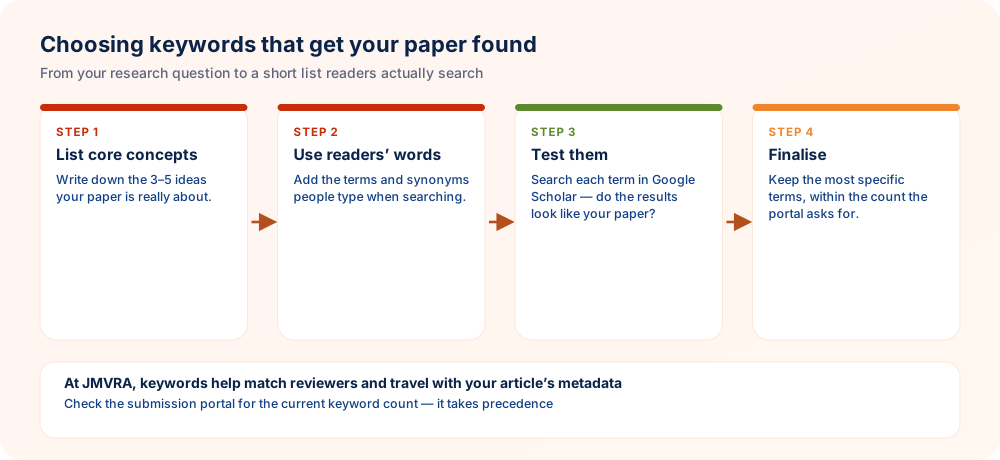
Poorly chosen keywords therefore carry a double cost: you reach fewer of the right readers, and you are more likely to be assessed by someone whose expertise lies a little away from your topic.
How to Choose Them
- Jot down the search-engine words you would use to track down your own paper if somebody else had authored it.
- Also list standard vocabulary covering your method, the population or dataset studied, and where the work took place.
- Look at which terms recent papers on the same topic use, and not the ones you would like to see become standard.
- Add one broader term so that readers browsing the general area come across your work.
- Add one specific term that sets your paper apart from neighbouring work.
Balance specificity on purpose: keywords that are all broad lose you among thousands of results, and keywords that are all narrow mean nobody beyond your immediate circle ever sees the paper.
How Many to Use
Four to eight is what most journals request. Look at the submission portal for the current requirement. Within that range, more does not help, since every extra keyword weakens the signal about what the paper is truly about.
Terms to Avoid
- Terms your title already uses — databases generally index the title anyway, so listing them again squanders slots
- Invented or in-house terms — if only your own research group uses the phrase, no one will search for it
- Very broad single words — "analysis", "system", "study" and "method" give no discriminating information
- Abbreviations without the expansion — give both forms when the abbreviation is really standard
- Aspirational terms — avoid tagging a paper with a fashionable technique that you did not actually use
The Parts of a Research Paper
Usual proportions for an empirical paper — guidance rather than a fixed rule.
- Background1–2 sentences describing the gap.
- ObjectiveState the question or hypothesis.
- MethodsStudy design, data and tools.
- ResultsThe main findings, supported by numbers.
- In SummaryWhat it means.
- Key Terms4–6 searchable terms.
A full abstract of about 150–250 words includes all five parts and is best written last. The complete rules are in JMVRA Publication Guidelines.
Testing Your Choices
Try each candidate keyword in the database your readers rely on. If the results resemble your paper, the term works. If they come from an unrelated field, the term is ambiguous and will steer your paper to the wrong audience.
Next, try the reverse: search for the problem your paper solves, in the words a newcomer would use, and check whether papers like yours turn up. If they do not, you have spotted a gap that your keywords ought to fill.
Working With Title and Abstract
Keywords form just one piece of a discovery set that also contains the title and abstract. Terminology should be consistent across all three, because a paper whose title says "machine learning", whose abstract says "statistical learning" and whose keywords say "AI" is harder to find than one that chooses a term and sticks to it.
To place this in context, consult Abstract Writing: What Every Sentence Must Do along with Writing a Research Paper Reviewers Can Assess. Precise keywords further enrich the metadata deposited alongside your CrossRef DOI.
Checklist
- Within the journal's stated number
- Mix of broader and specific terms
- Terms that current papers in the field actually use
- No repetition of title words
- No invented or in-house vocabulary
- Each term tested in a real database search
- Consistent with the terminology in the title and abstract
At-a-Glance Checklist
- Specific, not generic“Solar PV inverter efficiency” rather than “energy”
- Include synonymsAdd the term a reader in another field would use
- Spell out abbreviationsUnless the abbreviation is what people search
- Test in a search engineResults should resemble your paper
- Within the portal limitFollow the count the submission form asks for
Keyword Examples by Field
| Field | Weak | Better |
|---|---|---|
| Engineering | concrete | fly ash concrete; compressive strength |
| Commerce | banking | mobile banking adoption; rural India |
| Education | learning | flipped classroom; student engagement |
| Health | diabetes | type 2 diabetes; medication adherence |
Using Controlled Vocabularies
MeSH
Medical Subject Headings for health research.
ERIC thesaurus
Education terms.
ACM CCS
Computing classification.
JEL codes
Economics classification.
Testing and Refining Your Paper's Keywords Before Submission
Keywords work best when they reflect the language your readers actually use. A short testing routine turns a rough list into terms that help your paper reach the right audience.
- Ask colleagues how they would search. Describe your paper in a sentence to two or three peers and note the words they use to look for it. Their phrases are often better than yours.
- Read titles of similar papers. Scan recent articles in your field and note which terms recur. Adopting standard vocabulary helps your paper appear alongside related work.
- Prefer specific phrases over broad words. A narrow, descriptive phrase separates your paper from thousands of general ones. Keep broad words only where they genuinely describe the whole subject.
- Include variant spellings and synonyms. Where terms differ between regions or disciplines, consider including the alternative in your abstract so both groups of readers can find the paper.
- Repeat keywords naturally in the abstract. Use the chosen terms inside your title and abstract in ordinary sentences. Forced repetition reads badly and does not help real readers.
Choose keywords by testing them with real searchers and similar papers, then use them naturally in your title and abstract.
Questions Researchers Often Ask
How many keywords are expected?
Four to eight is typical for most journals. For JMVRA, the submission portal gives the current requirement, and that one prevails.
Is it fine to reuse words from my title as keywords?
A little overlap is acceptable, but the keyword field is best used for terms the title lacks, such as synonyms, methods or the setting of the study.
Are Google Scholar results affected by keywords?
Search engines index your title, abstract and full text, so use the same terms in those places. The keyword field chiefly assists databases, readers and the matching of reviewers.
Is it right for keywords to repeat the title?
Draw on some title terms, but add the synonyms and related terms that readers might search.
Do I have to use controlled vocabularies?
Only when the journal asks for them; in some fields they aid indexing.
More Researcher Resources
This guide belongs to the JMVRA Researcher Resources collection, offering practical advice that authors and researchers can verify, free of promotional claims.
Ready to Publish? Submit to JMVRA
JMVRA is aligned with UGC's Suggested Parameters for Choosing Peer-Reviewed Journals.
JMVRA is a Transparent, Peer-Reviewed, Open Access Journal (Refereed Journal). Following the discontinuation of the UGC and UGC-CARE journal listing, and in alignment with the latest UGC-CARE recommendations and guidelines, JMVRA is aligned with UGC’s Suggested Parameters for Choosing Peer-Reviewed Journals.
Related pages on jmvra.org
Key Terms
Subjects and search phrases this article addresses.
Related Reading
Further reading on the same theme from the JMVRA blog.
Publishing a Research Paper in a Journal (2026)
Read the guide RelatedGold, Green & Diamond Open Access Compared
Read the guide RelatedTypes of Research Papers and Which to Write
Read the guide RelatedJATS XML: Why Article Markup Matters
Read the guide RelatedSearching Research Papers on JMVRA
Read the guide RelatedDownload Your JMVRA Certificate and Paper
Read the guide From the blogGoogle Scholar for Researchers: Profiles & Visibility
Read the article From the blogGetting a Published Paper Into Google Scholar
Read the article From the blogChoosing a Journal: A 7-Step Scoring Framework
Read the articleKeep Reading on the JMVRA Blog
Published on the JMVRA journal blog, this guide gives practical direction on publishing, indexing, metrics and research integrity, with a focus on what can be verified instead of on promotion.