
After the research itself, picking the journal is the decision that matters most. A good match puts your paper in front of reviewers who grasp it and readers who need it, while a poor one costs you months. The seven steps below reduce a bewildering market to a brief, well-reasoned choice that you can justify to a supervisor or a promotion committee. Writing your reasoning down as you go makes that justification much easier.
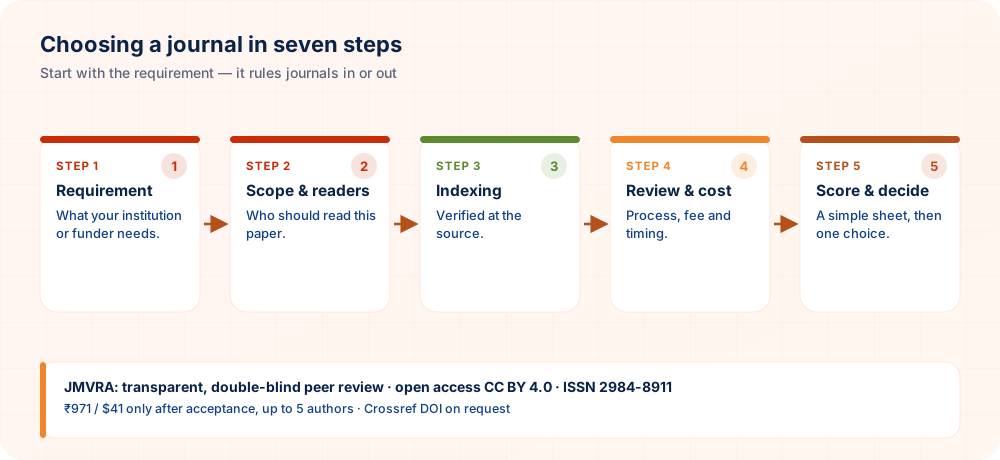
The 7-Step Framework
- Record what you need. What is the purpose of publishing — a PhD, promotion, grant, job or visibility? Note any indexing or recognition rule tied to it.
- Describe the paper. Its article type, subject area and length, and whether it sits within one discipline or across several.
- Gather candidates. See which journals published the works you cite, and run keyword searches in journal finders and databases.
- Test scope and fit. Go through the aims and scope plus two recent issues; your paper ought to sit comfortably among them.
- Confirm the claims. Check indexing, ISSN, DOI and the editorial board against independent sources.
- Weigh cost and timing. The fee, the moment it falls due and what it includes; also a realistic review duration.
- Choose one and submit. Take the journal with the top score and send the paper to that journal alone.
Tools That Find Candidate Journals
- Elsevier JournalFinder and Springer Nature’s journal search — recommend journals based on your title and abstract (limited to their own portfolios).
- JANE — recommends journals when you paste a biomedical abstract.
- SCImago — lets you browse journals by subject area and quartile.
- DOAJ — lets you look up open-access journals by subject.
A Simple Scoring Sheet
| Criterion | Weight | Score 1–5 |
|---|---|---|
| Meets my requirement | ×3 | |
| Scope and fit | ×3 | |
| Genuine peer review | ×3 | |
| Verified indexing / visibility | ×2 | |
| Fee transparency and affordability | ×2 | |
| Realistic timeline | ×1 | |
| Editorial board and ethics | ×1 |
Why the Requirement Comes First
An attractive journal that your university does not recognise is no use for a PhD submission, and a heavily indexed journal with a two-year backlog is no use for a promotion file due in three months. If you note the requirement first, you avoid chasing the wrong goal. It also gives you a clear yardstick for every later comparison.
Mistakes to Avoid
- Going for the highest impact factor with no thought for fit.
- Taking indexing badges on a journal’s own site at face value.
- Sending the same paper to multiple journals simultaneously.
- Overlooking article-type rules (for instance, submitting a review to a journal that does not accept reviews).
- Handing the choice and the submission to an agent.
A Worked Case: Choosing for a PhD Deadline
Situation: an environmental engineering PhD scholar must have one journal paper accepted within four months; the university takes peer-reviewed journals that meet its criteria.
- Requirement. A recognised, peer-reviewed journal; acceptance inside four months.
- Paper. Original research into groundwater quality, 6,500 words long.
- Candidates. Two specialist indexed journals (slower) and two multidisciplinary peer-reviewed journals (quicker).
- Verification. All four clear the basic checks; one multidisciplinary journal asks for payment before review, so it is removed.
- Decision. Send the paper first to the quicker specialist journal that fits well, holding the multidisciplinary journal in reserve in case the first outcome is a rejection.
The 10 Most-Searched Questions on This Topic
Here are the ten questions researchers search for most on this subject, each with a direct answer.
journal for publishing research paper
A journal whose scope, readership, review process and recognition suit both your paper and your requirement.
how to choose a journal to publish
Set out your requirement and paper, shortlist candidates, test the fit, confirm the claims, weigh cost and timing, and then submit to just one.
journal finder tool
Tools like Elsevier JournalFinder or Springer’s search propose journals based on your abstract.
aims and scope of journal
The journal’s own description of the subjects and article types it accepts.
where to publish my research paper
See where the works you cite were published, then verify and score each candidate.
journal selection criteria
Requirement, fit, peer review, indexing, fees, timeline, editorial board and ethics.
impact factor vs fit
Acceptance depends more on fit; metrics count only when your requirement refers to them.
journal shortlist
A sensible shortlist has three journals — one ambitious, one realistic and one backup.
publish research paper first time
Pick a genuine peer-reviewed journal that your supervisor approves of, observe its guidelines to the letter, and be ready for revisions.
journal recognition for PhD
Your university decides this; read its present rules before you choose.
How JMVRA Fits In
JMVRA is a Transparent, Peer-Reviewed, Open Access Journal (Refereed Journal). Following the discontinuation of the UGC and UGC-CARE journal listing, and in alignment with the latest UGC-CARE recommendations and guidelines, JMVRA is aligned with UGC’s Suggested Parameters for Choosing Peer-Reviewed Journals. UGC public notice (PDF)
Apply the same framework to JMVRA: a monthly, open-access, multidisciplinary journal with double-blind peer review, openly published fees (₹971 INR / $41 USD, payable after acceptance) and identifiers that anyone can verify.
- ISSN
- 2984-8911 (online) · publishing since June 2023
- Issues
- Monthly issues across many disciplines
- Review
- Two-way anonymous review by specialists
- Access
- CC BY 4.0, open to all readers
- Fee
- ₹971 INR for Indian and $41 USD for foreign authors, due only after acceptance
- DOI
- Crossref — available as an optional extra
- Indexing
- Covered by Google Scholar; not covered by Scopus, Web of Science or DOAJ
- Impact factor
- 11.25, derived from Google Scholar data
Screening begins the moment a paper arrives and each decision is sent as soon as it is reached, yet JMVRA never promises a set number of days: actual review time depends on the reviewers and on how much revision the paper needs.
At-a-Glance Checklist
- Requirement notedPrior to searching
- Scope confirmedLatest articles
- Indexing checkedUsing the ISSN
- Fees clearPayable after acceptance
- Decision loggedReasons included
Thinking About Your Readers
| Readers | Suitable venue |
|---|---|
| Specialists in your subfield | Specialised journal |
| Researchers across disciplines | Multidisciplinary journal |
| Practitioners | Applied or professional journal |
| Local communities | Journal publishing in regional languages |
A Cover Letter That Supports Your Choice
- State the article and its type — research article, review, case study
- Show why it fits — what this journal’s readers will gain from it
- Confirm originality — not previously published or under review elsewhere
- Include declarations — ethics, conflicts of interest and funding
Making a Scoring Sheet Work for Your Deadline
A scoring sheet is only as good as the discipline behind it. These tips help you apply a structured comparison honestly, particularly when a thesis or funding deadline adds pressure.
- Decide your weights beforehand. Choose which factors matter most before you look at any journal. Setting priorities first stops an attractive website from quietly shifting your scores.
- Rate each journal from evidence. Base every score on something you have read, such as aims, guidelines or recent articles. Gut feeling should not replace a note explaining your rating.
- Keep a realistic backup option. Pick a second suitable journal in case the first declines your paper. Planning a fallback protects your timetable without lowering your standards.
- Align your cover letter with the choice. Explain briefly why your findings suit this journal's readers. A focused letter signals that you chose deliberately and read the scope carefully.
Fix your priorities first, score from evidence and keep a backup journal ready so deadlines never force a poor choice.
Questions Researchers Often Ask
Your Paper's Journey at JMVRA, From Submission to Publication
- SubmissionPaper ID is issued
- ScreenScope & similarity
- ReviewDouble-blind
- DecideEmail & SMS
- ReworkEach point answered
- AcceptCopyright & fee
- ProduceYou can request a DOI
- PublishMonthly issue
How long review takes depends on the reviewers and on any revision required, so no set turnaround is promised; you are told of acceptance or rejection by email and WhatsApp.
Ready to Publish? Submit to JMVRA
JMVRA is aligned with UGC's Suggested Parameters for Choosing Peer-Reviewed Journals.
JMVRA is a Transparent, Peer-Reviewed, Open Access Journal (Refereed Journal). Following the discontinuation of the UGC and UGC-CARE journal listing, and in alignment with the latest UGC-CARE recommendations and guidelines, JMVRA is aligned with UGC’s Suggested Parameters for Choosing Peer-Reviewed Journals.
Where to go next on jmvra.org
Key Terms
Subjects and search phrases this article addresses.
Related Reading
Further reading on the same theme from the JMVRA blog.
Build Your Own Reliable Journal Shortlist
Read the guide RelatedHow to Judge a Journal's Real Review Speed
Read the guide RelatedBudget & Timeline Planner for Publishing
Read the guide RelatedJournal Finder — A Quick Path to a Low-Cost, UGC CARE-Aligned Quality Journal
Read the guide RelatedVerifying UGC-CARE, Scopus & Web of Science Claims
Read the guide RelatedRecognising a Predatory Journal
Read the guideKeep Reading on the JMVRA Blog
Find this guide on the JMVRA journal blog, a collection of practical guidance on publishing, indexing, metrics and research integrity that favours verifiable content over promotion.