
Authors ask about review speed early on, and it is among the simplest claims for a journal to inflate. A few journals really are efficient, while others are quick only because nobody reads the submission. Here we explain what determines review time, how to discover a journal’s actual turnaround, and the signals that tell efficient review apart from no review whatsoever. Treat any promise of speed as a prompt to look for evidence.
What Determines Review Time
Reviewer availability
Securing two or three reviewers who agree to help is frequently the slowest stage.
Paper readiness
Papers that are unclear or incomplete require extra rounds.
Journal workflow
Waiting time falls when screening is automated and the reviewer pool is large.
Author response
The time you take to revise adds to the total, and that part is up to you.
Discovering a Journal’s Actual Turnaround
- Study published articles. Numerous journals show “received”, “revised” and “accepted” dates on every article, so compare several.
- See the journal’s own figures. A few report the median time to a first decision.
- Contact the editorial office. Enquire about the usual time to a first decision in recent months.
- Talk to colleagues. Authors who published lately offer the best evidence.
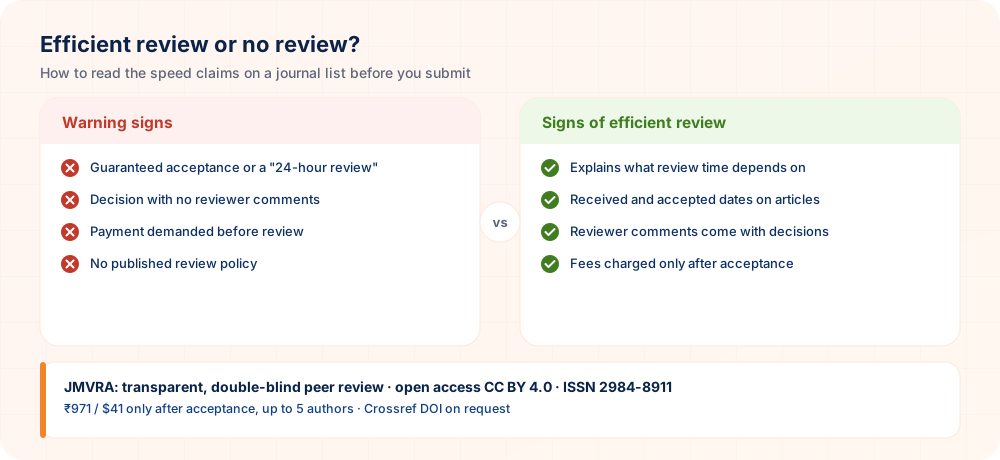
Efficient Review Compared with No Review at All
| Efficient review | No real review |
|---|---|
| Time frames expressed as ranges | Set promises (“decision in 24 hours”) |
| Specific reviewer comments | Vague comments or none |
| Revisions sometimes requested | All papers accepted exactly as sent |
| Fee after acceptance | Payment requested prior to or alongside submission |
Review Speed Varies Between Fields
In fast-moving applied fields, review may take just weeks, whereas careful review in mathematics or the humanities can stretch to months. Measure a journal’s speed against other journals in its own field instead of against a blanket promise in an advertisement. Remember that depth of review, not only speed, shapes the quality of your final paper.
Speeding Up Your Part of the Process
- Send in a finished paper that is properly formatted.
- Propose appropriate independent reviewers where the journal permits.
- Answer revision requests within a few days.
- Sign off on proofs on the day you get them.
A Courteous Email Asking a Journal About Review Time
Dear Editorial Office,
I am writing a research article on [topic], around [length] words long, and I am thinking of submitting to [Journal]. Could you let me know how long it typically takes from submission to first decision in recent months, and from acceptance to online publication?
With thanks,
[Name, affiliation]
A quick, precise answer that gives ranges instead of guarantees is itself a positive indication of how the journal is managed.
The 10 Most-Searched Questions on This Topic
Here are the ten questions researchers search for most on this subject, each with a direct answer.
journal with fast review process
A journal that screens efficiently and has a big reviewer pool; confirm its true turnaround from received/accepted dates.
paper publication journal list fast review
Judge each candidate’s actual review time by article dates or replies from editors, not by advertisements.
how long does peer review take
From a few weeks to several months, depending on the field, the journal and any revisions.
time to first decision meaning
How long it takes from submitting a paper to the editor’s first verdict: accept, revise or reject.
received revised accepted dates
Dates shown on articles that reveal the real duration of review and revision.
24 hour acceptance journal
This is a red flag, since genuine peer review cannot be promised within hours.
journal review time by field
Applied sciences tend to be quicker, while mathematics and the humanities tend to be slower.
how to speed up peer review
Send a finished paper, recommend fitting reviewers, and reply promptly to revision requests.
fast review journal India
A number of Indian journals work efficiently; confirm how they review and request up-to-date timelines.
email editor about review status
Courteously, with your paper ID quoted, once the journal’s usual review period is over.
How JMVRA Fits In
JMVRA is a Transparent, Peer-Reviewed, Open Access Journal (Refereed Journal). Following the discontinuation of the UGC and UGC-CARE journal listing, and in alignment with the latest UGC-CARE recommendations and guidelines, JMVRA is aligned with UGC’s Suggested Parameters for Choosing Peer-Reviewed Journals. UGC public notice (PDF)
JMVRA starts screening right away and tells authors as soon as a decision has been reached. It offers no guarantee of a fixed number of days, as each paper’s timeline rests on its reviewers and revisions.
- ISSN
- 2984-8911 (online) · publishing since June 2023
- Issues
- Monthly issues across many disciplines
- Review
- Two-way anonymous review by specialists
- Access
- Free to read, CC BY 4.0 licence
- Fee
- ₹971 INR for Indian and $41 USD for foreign authors, due only after acceptance
- DOI
- Crossref — available as an optional extra
- Indexing
- Within Google Scholar, yes; within Scopus, Web of Science or DOAJ, not so
- Impact factor
- 11.25, derived from Google Scholar data
Screening begins the moment a paper arrives and each decision is sent as soon as it is reached, yet JMVRA never promises a set number of days: actual review time depends on the reviewers and on how much revision the paper needs.
At-a-Glance Checklist
- Article dates reviewedDates of receipt, revision and acceptance
- Policy locatedA stated review model and procedure
- Editor contactedA courteous email on present timelines
- Field taken into accountCertain subjects just need more time
- Your part preparedFull files and fast revisions
Making Your Revision Round Faster
- Go through every comment, then pause for a day — prior to replying
- Build a response table — the comment, the change made, and where
- Start with the major changes — fresh analysis or new text
- Mark the changes within the manuscript — letting reviewers verify them fast
- Provide a full response — partial answers prompt more rounds
Read more on responding to reviewer comments.
If Review Drags On Beyond Expectation
Managing Your Waiting Period During Journal Review
Once a paper is submitted, much of the process is outside your control. How you use the waiting period, and how you respond to news, still shapes the final result.
- Note the stated review process. Before submitting, read how the journal describes its checking stages and keep that description. It gives you a fair benchmark when deciding whether a follow-up message is reasonable.
- Use the time for next steps. While waiting, prepare supplementary files, tidy your data and start outlining a follow-up study. You will then handle revision requests calmly instead of scrambling.
- Follow up politely and once. If the expected period has clearly passed, send a short courteous message with your manuscript number. Repeated daily emails rarely help and may harm the relationship.
- Read reviews without reacting. Put critical comments aside for a day before replying. A calmer second reading often shows that a harsh-sounding remark contains a useful suggestion.
- Avoid parallel submissions. Do not send the same manuscript to another journal while one is considering it. Withdraw formally first if you truly need to move, and keep the confirmation.
Be patient, prepared and courteous during review, and never let impatience push you into duplicate submissions.
Questions Researchers Often Ask
Your Paper's Journey at JMVRA, From Submission to Publication
- SubmitPaper ID given
- ScreenScope & similarity
- ReviewDouble-blind
- DecideEmail & SMS
- UpdateOne point at a time
- AcceptCopyright & fee
- ProduceRequest a DOI
- PublishMonthly issue
No fixed turnaround is promised, because review time varies with the reviewers and with any revision that may be needed. Acceptance or rejection is communicated by email and WhatsApp, and your paper ID lets you follow progress whenever you wish.
Ready to Publish? Submit to JMVRA
JMVRA is aligned with UGC's Suggested Parameters for Choosing Peer-Reviewed Journals.
JMVRA is a Transparent, Peer-Reviewed, Open Access Journal (Refereed Journal). Following the discontinuation of the UGC and UGC-CARE journal listing, and in alignment with the latest UGC-CARE recommendations and guidelines, JMVRA is aligned with UGC’s Suggested Parameters for Choosing Peer-Reviewed Journals.
Pages worth visiting on jmvra.org
Key Terms
Subjects and search phrases this article addresses.
Related Reading
Further reading on the same theme from the JMVRA blog.
Budget & Timeline Planner for Publishing
Read the guide RelatedWhat Makes a Journal Truly International?
Read the guide RelatedWhat an Affordable Publication Fee Buys in India
Read the guide RelatedKeeping Publication Moving Without Rushing Review
Read the guide RelatedOpen Access, Peer Review, Impact Factor & UGC Parameters Norms — A Complete Guide
Read the guide RelatedRecognising a Predatory Journal
Read the guideKeep Reading on the JMVRA Blog
As part of the JMVRA journal blog, this guide shares practical help on publishing, indexing, metrics and research integrity, and is written to be verifiable rather than promotional.