"Transparent peer review" gets used as a single label, but it actually describes a spectrum of different practices — some journals share reviewer comments with authors, others publish reviewer identities, and a few open the entire discussion to public view after publication. Knowing which model a journal actually uses, rather than just seeing the word "transparent" on a badge, is what matters when deciding where to submit. This article walks through that spectrum, where JMVRA sits on it, and how that connects to UGC CARE and the other indexing standards JMVRA aligns with.
Already know how JMVRA reviews papers and just want to submit? Go straight ahead.
₹971 INR Indian authors · $41 USD internationalKey takeaways
- “Transparent” peer review is a spectrum: open reports, open identities, open participation and post-publication review are separate choices, not one package.
- Full openness is not automatically better; double-blind review protects early-career authors and reviewers, and can still be fully documented.
- JMVRA runs documented double-blind review: stages are stated, authors are told where the paper stands, and reviewers receive a transparent peer review certificate.
- Judge any journal’s claim by what it publishes about the process, not by the adjective; the fee at JMVRA is ₹971 INR for Indian authors and $41 USD for international authors, due only after acceptance.
Why peer review transparency is a growing expectation
UGC officially discontinued the static UGC-CARE Journal List via a public notice issued on 3rd October 2024 (584th UGC meeting). In its place, UGC introduced a 2025 Peer-Reviewed Journal Policy that provides suggestive parameters for identifying credible journals — with a specific emphasis on transparency, research integrity, and genuine, documented peer review, rather than a fixed list authors had to check a journal against.
That shift moved the practical question authors need to ask from "is this journal on the list?" to "can this journal actually show me how its review process works?" — which is exactly what a transparency model answers. Full text of the notice: UGC Public Notice, 3 October 2024.
UGC CARE: what changed, and what a journal must show now
Before October 2024, "UGC CARE approved" meant a journal's name appeared on a fixed, periodically-updated list. That list is gone. What replaced it is a set of parameters — covering editorial process, peer review documentation, ethics policy and publishing standards — that a journal is expected to demonstrate directly rather than simply point at a listing.
Documented Peer Review
A journal has to show HOW review works, not just claim it happens — which is the whole reason a transparency model is now the relevant question.
Research Integrity Policy
Plagiarism checking, authorship criteria and ethical handling of submissions, stated in writing rather than assumed.
Real Editorial Board
Named, verifiable editorial and reviewer expertise behind the journal, not an anonymous or decorative board.
Publishing Standards
Consistent metadata, a real ISSN, and complete records for every published paper.
JMVRA (ISSN 2984-8911) follows Scopus Journal Indexing Standard practices in its peer review process, editorial board composition and CrossRef metadata submission — the same evidence-based approach the 2025 policy asks for. The full standard-by-standard breakdown is on the approval & indexing standards page.
Verified against the 2025 UGC framework, not just a badge — submit to JMVRA with that in writing.
₹971 INR Indian authors · $41 USD internationalBeyond UGC CARE: the other indexing standards that matter
UGC CARE is not the only reference point authors check. Google Scholar, Semantic Scholar, ROAD and an ISSN record each verify a different, narrower fact about a journal, and it is worth knowing what each one actually confirms.
| Standard / Database | What it actually confirms |
|---|---|
| UGC 2025 Policy | The journal meets the suggestive parameters for a credible, peer-reviewed journal — documented review, ethics and editorial process, in place of the old fixed list. |
| Scopus Standard | Editorial board composition, review rigor and metadata practices modelled on Scopus's own indexing requirements — a standard JMVRA follows without claiming Scopus indexing itself. |
| Google Scholar | Automatic crawling based on structured metadata — title, authors, abstract, full text and citation graph — with no formal application process. |
| Semantic Scholar | AI-indexed citation data, used as one of the two real inputs behind JMVRA's own impact factor. |
| ISSN / ROAD | A journal-level record confirming the ISSN is real and registered, plus the journal's open access status. |
Know exactly which standards JMVRA aligns with before you submit — nothing overstated.
₹971 INR Indian authors · $41 USD internationalThe transparency spectrum: beyond just blind vs. open
Most authors are familiar with single-blind and double-blind review. Transparency adds a separate set of layers on top of that baseline, and a journal can adopt some layers without adopting all of them:
Open Reports
Reviewer comments and the editorial decision rationale are shared alongside the manuscript, rather than a bare accept/reject verdict.
Open Identities
Reviewers may choose to reveal their identity to the author, promoting accountability — usually opt-in rather than a requirement.
Open Participation
Authors, reviewers and editors can engage in direct discussion to improve the manuscript before a final decision.
Post-Publication Review
The published work remains open for further scholarly comment and discussion after it goes live.
A journal can genuinely be "transparent" by adopting just the first layer — sharing reviewer comments and reasoning with the author — without necessarily going all the way to public reviewer identities or open post-publication commentary.
Comparing the models
| Model | What's disclosed | Disclosed to |
|---|---|---|
| Traditional double-blind | Final decision only | Author (no reviewer comments shared in detail) |
| Open Reports | Reviewer comments + decision rationale | Corresponding author |
| Open Identities | Reviewer name (optional) | Author, sometimes publicly |
| Open Participation | Full discussion thread | Author, reviewer and editor jointly |
| Post-Publication Review | Ongoing public commentary | All readers, after publication |
Ready to see how your own paper fares under this process?
₹971 INR Indian authors · $41 USD internationalWhy full openness isn't automatically better
This is why many credible journals — including JMVRA — deliberately choose a middle point on the spectrum: enough transparency that authors see exactly why a decision was made, without the trade-offs that come with full public openness.
Where JMVRA fits on the spectrum
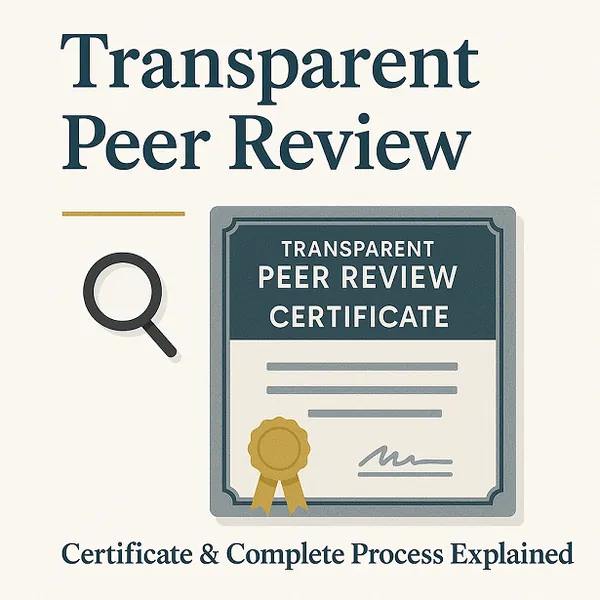
JMVRA runs double-blind peer review with author-facing transparency — the "Open Reports" layer as its baseline, documented with a Transparent Peer Review Certificate. Concretely, that means:
- The corresponding author receives the reviewer's comments alongside the editorial decision, at every stage — not just a bare accept/reject.
- Reviewer and author identities stay hidden from each other throughout review (double-blind) by default.
- Reviewer identity disclosure is optional and reviewer-consented, not published to every reader as a default policy.
- There is no separate fee for receiving reviewer comments or the decision rationale — it is part of the standard publication process for every author.
For the complete stage-by-stage breakdown of how this actually runs, from submission to published certificate, see JMVRA's Transparent Peer Review — the complete guide and the policy and certificate page.
See JMVRA's full transparent peer review policy, then submit knowing exactly what to expect.
₹971 INR Indian authors · $41 USD internationalWhat this means for reviewers
Transparency benefits reviewers too, not just authors. JMVRA's 3,000+ reviewer panel receives real, disclosed recognition for their work:
Transparent Peer Review Certificate
Official recognition issued to reviewers and editorial board members who contribute to the review process.
Appreciation Letter
A formal letter acknowledging the reviewer's contribution, issued alongside the certificate.
Referral Reward Points
Through the Reviewer & Referral Management System (RMS), earn 300 points (1 point = ₹1) for every referred paper that goes on to publish — redeemable once your balance reaches ₹971 INR.
No Cost to Join
Joining the reviewer/referral panel is free, with no obligation to review a fixed number of papers.
Interested in reviewing for JMVRA? See Reviewer & Referral Advantages for the full picture, or go straight to Join as Reviewer to apply.
Prefer to review rather than submit right now? Join the panel instead — it's free.
₹971 INR Indian authors · $41 USD internationalHow to evaluate any journal's transparency claims
- Ask whether reviewer comments are shared with you as standard practice, not on request or for an extra fee.
- Check whether editorial decisions come with documented reasoning, not just "accepted" or "rejected."
- Verify the journal's UGC CARE / peer-review compliance claims directly, rather than trusting a badge alone.
- Confirm reviewer recognition (certificates, acknowledgement) is disclosed as policy, not an ad-hoc favour.
JMVRA states its review model in writing, not just on a badge — see for yourself.
₹971 INR Indian authors · $41 USD internationalFrequently asked questions
Still deciding? JMVRA typically completes review within 1–3 working days.
₹971 INR Indian authors · $41 USD internationalRelated reading
The transparency spectrum
Each step up reveals more about who reviewed and what they said. Higher is more open, not automatically more rigorous.
Who sees what, model by model
The three questions that define any review model. Ask a journal all three before you accept its label.
| Model | Reviewer knows author | Author knows reviewer | Reports published |
|---|---|---|---|
| Double-blind | ✕ No | ✕ No | ✕ No |
| Single-blind | ✓ Yes | ✕ No | ✕ No |
| Open identities | ✓ Yes | ✓ Yes | ✕ No |
| Open reports | Varies | Varies | ✓ Yes |
| Post-publication | ✓ Yes | Usually | ✓ Yes |
Related articles and guides
Publish with JMVRA
Peer-reviewed, open access, ISSN 2984-8911. The publication charge is ₹971 INR for Indian authors and $41 USD for international authors, due only after acceptance. A Crossref DOI is an optional add-on priced on the DOI page.