

JMVRA Indexing & Discovery: Every Listing, Linked to Its Source
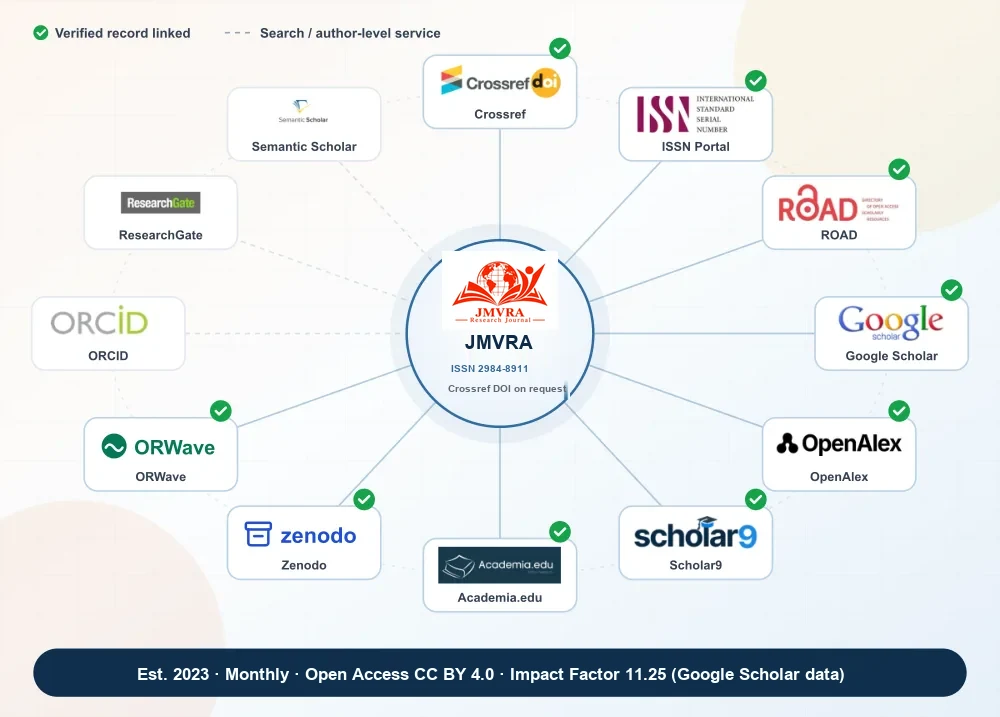
Where Journal of Modern and Versatile Research Approach (ISSN 2984-8911) is registered, indexed and discoverable — with a direct link to each record, so you never have to trust a logo. Crossref DOIs are registered on request.
- Open Access
- Monthly
- Peer Reviewed
- DOI via Crossref
- CC BY 4.0
- 6 verified records
Verify JMVRA Yourself
Verified links open the journal’s own record or a search result for it at the service. Search links open a general search on a sharing platform.

Google Scholar Verified
The journal’s Google Scholar profile; citation figures are shown on JMVRA pages once verified.



OpenAlex Search
Open catalogue of scholarly works — a discovery search for JMVRA (search results).
Google Search Search
Search results for the journal’s full name (a discovery link, not proof of indexing).
ROAD / ISSN Verified
The ISSN record for 2984-8911 in the ISSN International Centre’s directory.

ResearchGate Search
Research network where authors share JMVRA papers — search it for the journal name.
Indexing
Where the journal or its articles are formally listed or registered.
Crossref Verified
DOI registration agency — metadata for every DOI-registered paper is deposited here.
DOI prefix 10.56975 Verified
A permanent Digital Object Identifier on request, so a paper stays citable.
ISSN Portal Verified
The journal’s serial registration — ISSN 2984-8911, held with the ISSN International Centre.

ORCID Registry
Author identifier registry — links each author’s record to their published work.

Publons / ResearcherID Registry
Reviewer and researcher registry (now Web of Science reviewer recognition), used for peer-review activity.
Zenodo Verified
Open repository at CERN — a deposit target for archived research outputs.
Scholar9 Verified
Transparent peer-review registry — where the journal’s review certificate is recorded.
Discovery
Where researchers can discover, search, read, save or share published articles.
Google Scholar Verified
Search and citation tracking — one of the citation sources (with Semantic Scholar) behind the calculated 11.25 impact factor.
OpenAlex Verified
Open index of works, authors and citations — the successor to Microsoft Academic’s data.
ORWave Verified
Open Research Wave — open-access journal and research discovery platform.
Google Search Verified
General web search for the journal’s full name (a discovery link).
Academia.edu Verified
Academic sharing platform with reader analytics for each uploaded paper.

Semantic Scholar Search
AI-powered search that surfaces papers by meaning, citation and influence.
ResearchGate Search
Research network where authors share papers and readers follow their work.


SSRN Search
Elsevier’s preprint and working-paper network (a repository, not a journal index).
Microsoft Academic, listed on older pages, was retired by Microsoft at the end of 2021; its data lives on in OpenAlex, shown above.
What Each Tag Does and Does Not Prove
The tag on each card is a claim about the link, not about the journal's standing. This is the exact scope of each one.
| Tag on a card | What it means | What it proves | What it does not prove |
|---|---|---|---|
| Verified | The link opens the journal's own record on that service | The journal is registered or listed there | A quality ranking, or coverage in Scopus, Web of Science or DOAJ |
| Search | The link opens search results for the journal name | What that service finds today | That the journal is indexed there, or holds a DOI prefix |
| Registered | An identifier record (ISSN, DOI) exists for the journal or its articles | Identity and permanence of the record | Peer-review quality; predatory journals register identifiers too |
| Document | The link opens a certificate, regulation or notice as a file | The document says what the page quotes | That the issuer vouches for the journal today |
Plagiarism Detection: Turnitin & iThenticate
Every submission is screened for similarity before peer review, and the similarity report is available to the author on request. The accepted similarity threshold is below 15%.
Turnitin
Similarity check against published literature, web content and submitted work.

iThenticate
Turnitin’s service for publishers and researchers, with AI-writing detection available.
Licences, Access and Recognition


ISSN Registered • Open Access • Transparent Peer Review • Creative Commons CC BY 4.0 • Ethics policies follow COPE guidance
JMVRA is a Transparent, Peer-Reviewed, Open Access Journal (Refereed Journal). Following the discontinuation of UGC and UGC-CARE journal listing, JMVRA is aligned with UGC's Suggested Parameters for Choosing Peer-Reviewed Journals. UGC public notice (PDF)
Impact Factor and Citation Metrics
Where JMVRA stands on impact and citations: the calculated Impact Factor, plus Google Scholar citation counts that are added here only after they are checked against the journal’s own profile.
Source: JMVRA Google Scholar profile
Until then, you can check JMVRA’s citations yourself on Google Scholar, OpenAlex (search results) or Crossref Search.
Important note: The Impact Factor (11.25) is a calculated metric based on citations from Google Scholar and Semantic Scholar. It is not an official Clarivate Journal Impact Factor (JCR). All other statistics are taken from their respective platforms and may vary over time; please verify each metric at the original source using the links above.
JMVRA at a Glance
Journal statistics and publication information
How JMVRA Preserves Every Published Paper
JMVRA currently preserves its archive through its own preservation network. It has now started the process of applying to join a LOCKSS-based preservation network, so copies will also be held independently by libraries.
- Now
Own preservation network
- Every article at a permanent URL that is never restructured or reused
- Crossref DOIs (registered on request) that resolve independently of the website
- Archived copies in Zenodo (CERN) and records in OpenAlex and Google Scholar
- Withdrawn and retracted papers kept online and marked, never deleted
- A written succession plan if the journal ever stops publishing
- In progress
Applying to join LOCKSS
JMVRA has started the process of applying to join a LOCKSS-based network, in which participating libraries each keep a copy and check it against the others. The application is under way; this page will be updated when participation is confirmed.
About LOCKSS ↗ - Options
Further services
CLOCKSS, Portico and the PKP Preservation Network are also assessed below, with what each requires.
Compare the services ↓
CLOCKSS vs Portico vs LOCKSS vs PKP PN
These are different approaches to preserving digital scholarly content.
| Feature | CLOCKSS | Portico | LOCKSS | PKP PN |
|---|---|---|---|---|
| Primary purpose | Long-term preservation | Long-term preservation | Distributed preservation | Preservation of journals published on OJS |
| Technology | LOCKSS-based | Independent preservation infrastructure | Open-source LOCKSS software | LOCKSS-based network run by PKP |
| Dark archive | Yes | Yes, for its preservation service | Depends on network configuration | Yes |
| Public access after trigger | Yes, under its policies | Yes, under defined conditions | Access depends on network and preservation arrangements | Yes, if the journal stops publishing or content is no longer available |
| Publisher participation | Paid service | Paid service | Some participation options are free | Free for eligible journals |
| Community model | Publishers and libraries | Preservation service supported by libraries and publishers | Library-centered preservation networks | PKP with participating libraries |
| Main requirement | Participation agreement and fee | Participation agreement and fee | Joining or forming a network | The journal must run on Open Journal Systems (OJS) and enable the PN plugin |
| Fit for JMVRA | Possible later (paid) | Possible later (paid) | Application process started | Only if the journal moves to OJS — JMVRA runs its own platform |
Journal of Modern and Versatile Research Approach (JMVRA) at a Glance
- Journal
- Journal of Modern and Versatile Research Approach About
- ISSN (online)
- 2984-8911 Verify
- Established
- 2023
- Frequency
- Monthly Current issue
- Publisher
- JMVRA Publication
- Impact Factor
- 11.25 (calculated metric, not a Clarivate JIF) Details
- DOI
- Crossref, on request DOI
- Review
- Double-blind, transparent records Policy
- Access & licence
- Open access, CC BY 4.0 Policy
- Subjects
- Multidisciplinary Research areas
- Editorial board
- Named editors View board
- Reviewers
- 3,000+ Reviewer list Join
- [email protected] Contact
- Phone / WhatsApp
- +919106365667 Support
| Charge | Indian authors | Foreign authors |
|---|---|---|
| Publication fee (after acceptance) Details | ₹971 INR | $41 USD |
| Crossref DOI (optional) Add | ₹300 | $20 |
| Hard copy of certificate (optional) | ₹500 | $100 |
| Bundle: journal hard copy + certificate + DOI | ₹1100 | $170 |
| Transparent peer-review report (optional) | ₹700 | $20 |
Pay online: publication charges · pay fees online · payment options · payment terms
How JMVRA Meets Today’s Peer-Review Standards
Peer review is judged on process and evidence. These are the practices institutions and indexing services look for, each with its policy page.
Double-blind review Verified
Subject experts evaluate each paper without seeing author identities.
Transparent review records Verified
Reviewer reports and certificates recorded on Scholar9.
Similarity screening Verified
Every submission checked with Turnitin / iThenticate before review; report available to the author on request.
AI-use disclosure Verified
Authors must disclose AI tools; AI-writing detection is available.
Ethics following COPE guidance Verified
Authorship, misconduct, corrections and retractions policies.
UGC’s New Recommendations: Where JMVRA Stands
JMVRA is a Transparent, Peer-Reviewed, Open Access Journal (Refereed Journal). Following the discontinuation of UGC and UGC-CARE journal listing, JMVRA is aligned with UGC's Suggested Parameters for Choosing Peer-Reviewed Journals.
35 suggestive parameters in 8 groups
Annexure-I of UGC’s notice. JMVRA reports 28 met, 2 partly met, 3 not published and 2 not applicable — with the reason for each.
UGC circulars and notices
- Public Notice — CARE Journals (discontinuation) (PDF) ↗
- Final list of UGC-CARE journals (1,474, archived) (PDF) ↗
- Public Notice — CARE (PDF) ↗
- Public Notice — CARE, 14 January 2019 (PDF) ↗
Parameter-by-parameter evidence
From the Numbered UGC List to the Suggested Parameters
The sequence behind the position stated above: numbered list, CARE list, discontinuation, suggested parameters.
- UGC-Approved List of JournalsUGC publishes a numbered list; each journal on it carries a UGC journal number.
- Re-evaluation of the listUGC reviews the list and removes titles that scored low. Numbers from that list belong only to those journals.
- UGC-CARE List replaces itThe CARE reference list supersedes the earlier approved list; no new UGC journal numbers are issued.
- JMVRA is foundedEstablished after the numbered list had closed, so the journal has no UGC journal number to quote.
- CARE List discontinuedUGC's 584th meeting withdraws the CARE list. No replacement list is created.
- Suggested Parameters approvedEight categories of suggestive parameters (public notice 16 July 2025). JMVRA is aligned with UGC's Suggested Parameters for Choosing Peer-Reviewed Journals.
How to Verify Any Journal in Six Steps
- Check the ISSN on the ISSN Portal and confirm the title matches exactly.
- Resolve a DOI at doi.org — it should open the article on the journal’s own site.
- Search Crossref for the journal name to see its registered articles.
- Open the Google Scholar and OpenAlex records to see real citation data.
- Read the review and ethics policies and look for transparent review records.
- Confirm the fee is published up front and charged only after acceptance.
Quick Links
Publish With a Journal You Can Verify
Double-blind peer review, similarity screening, Crossref DOIs on request, open access under CC BY 4.0 and alignment with UGC’s Suggested Parameters — with a fee of ₹971 INR (Indian authors) or $41 USD (foreign authors), charged only after acceptance.
A Record You Cannot Find?
Ask the editorial office for the link to any listing on this page; the contact details come from the journal's database record.



















