WhatsApp

Page reviewed 17 Oct 2026 · facts read from the journal record

Transparent Peer Review at JMVRA

Reviewer reports published alongside the article, optional identity disclosure, a public review history and a verifiable certificate — the practices the UGC 2025 Peer-Reviewed Journal Policy asks a credible journal to demonstrate.

1–2Days to Review
3Open Review Models
₹700Report (Indian)
$20Report (Intl.)

The Three Open Review Models

Open Reports

The reviewer’s written comments and the editorial decision are published beside the article, so a reader can see how a conclusion was tested rather than taking “peer reviewed” on trust.

Open Identities

Reviewers may choose to be named. It stays optional on purpose — a junior reviewer assessing a senior author’s work must be able to be candid without attribution.

Open Participation

Authors, reviewers and editors discuss revisions in the open, turning review from a verdict handed down into a conversation that improves the paper.

The Process at a Glance

Submission of Research Paper

The author submits through the online system. The manuscript is checked for plagiarism, formatting and scope before it goes any further.

Peer Review Assignment

The editorial team assigns the paper to expert reviewers through the Scholar9 portal, selected on expertise, review history and availability.

Open and Transparent Review

Reviewers assess originality, methodology, significance and clarity under one of three open models — open reports, open identities or open participation.

Editorial Decision and Revisions

Accept, accept with minor or major revisions, or reject. Authors revise against the written feedback and resubmit.

Post-Publication Transparency

Selected review reports, reviewer identities where consented, and editorial decisions are made public, and the Transparent Peer Review Certificate is issued.

Transparent vs. Traditional Peer Review

 Traditional (Closed)Transparent
Reviewer reportSeen only by the authorPublished with the article
Reviewer identityAlways anonymousDisclosed if the reviewer consents
Editorial decisionUnexplained to readersDocumented and visible
Reviewer creditInvisible workCertificate and appreciation letter
Accountability for biasHard to detectOpen to scrutiny
Reader can verify rigourMust take it on trustCan read the review itself

Transparent Peer Review — the complete guide

A dedicated page covering the certificate, the UGC 2025 policy position, pricing, benefits for authors, reviewers and editors, and the full FAQ.

Read the Full Guide

A Transparent Peer Review Process ensures openness in scholarly publishing by making the peer review process accessible to authors, reviewers, and readers. This approach enhances trust, credibility, and accountability in journal publications.

JMVRA Transparent Peer Review Certificate (PDF)

UGC has officially discontinued the UGC CARE Journal List as per the Public Notice issued on 3rd October 2024 (584th UGC Meeting). Under the new system, the UGC has introduced the 2025 Peer-Reviewed Journal Policy, which provides suggestive parameters for selecting credible journals-focusing on transparency, research integrity, and authentic Transparent Peer Review Journal Publication.

Recently, the UGC discontinued the UGC-CARE Journal List and introduced new parameters that allow publication in Transparent Peer-Reviewed (Refereed) Journals. JMVRA is Transparent Peer Review Journal Valid As per New UGC Notification.


You can now publish your research paper in JMVRA.ORG. JMVRA is a Transparent Peer-Reviewed Open Access (Refereed Journal), UGC and UGC CARE Approved, Crossref DOI, Multidisciplinary, Impact Factor calculate by Google Scholar. As an International, open-access, and online journal, Publishing with us ensures wider reach, academic credibility, and enhanced recognition for your work.


For more details, refer to the official notice: UGC Public Notice


⭐ Low Cost ₹971 INR | 📚 UGC CARE Approved | 🔍 Peer-Reviewed | 🌐 Open Access | 🔗 Crossref DOI & Global Indexing | 📊 Google Scholar Impact Factor | 🧪 Multidisciplinary


Submit Paper Online  Call for Paper  About JMVRA UGC CARE Approval

About UGC CARE Peer Review Journal Policy

Key Aspects of a Transparent Peer Review Process:

Open Reviewer Reports – Review comments and editorial decisions are published alongside the article.
Click Here For Sample Report

For Indian Authors : We offer a transparent peer review report via Scholar9.com for just ₹700. View Sample Report

For Foreign Authors : A detailed peer review report is available through Scholar9.com for $20 USD. View Sample Report

Reviewer Identity Disclosure (Optional) – Reviewers may choose to reveal their identities to promote accountability.

Public Peer Review History – Submission history, review reports, author responses, and editorial decisions may be made available.

Collaborative Reviews – Authors, reviewers, and editors can engage in discussions to improve research quality.

Post-Publication Comments – The research remains open for further scholarly discussion after publication.

Benefits of Transparent Peer Review:

For Authors: Greater trust, constructive feedback, and recognition of review efforts.

For Reviewers: Acknowledgment for their work and a chance to contribute openly.

For Journals: Increased credibility, reduced bias, and enhanced research integrity.

Your Research, Our Platform: Submit Your Article- Click Here to Submit Paper Online


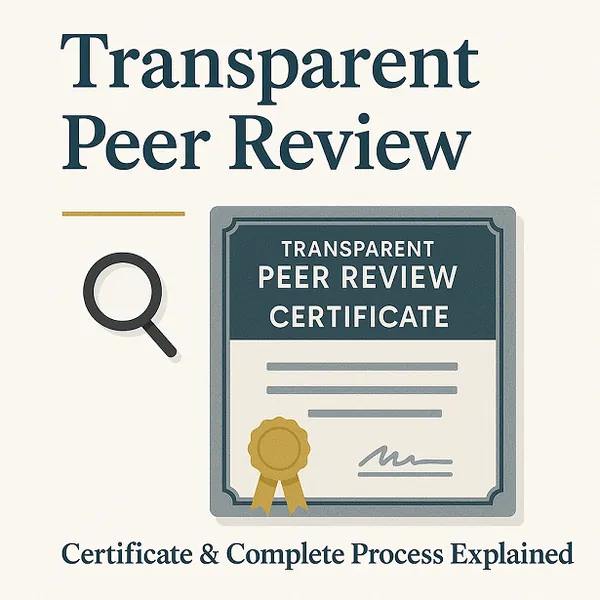
Transparent Peer Review Certificate for Reviewers & Editorial Board Members

The Transparent Peer Review Certificate is an official recognition issued exclusively to reviewers and editorial board members who contribute to our transparent, ethical, and accountable peer-review system. This certificate confirms that your evaluation work upholds the highest standards of research integrity, transparency, and scholarly professionalism.

As a Reviewer or Editorial Board Member, your contributions are formally acknowledged through:

  • Official Transparent Peer Review Certificate
  • Reviewer / Editor Appreciation Letter
  • Verified proof of review activity for academic promotions, institutional records, portfolios, and research credentials
  • Recognition for ethical, unbiased, and high-quality evaluation within the academic community

Your role is essential in maintaining transparency, improving manuscript quality, reducing biases, and strengthening the credibility of every Peer Review Journal Publication processed by the journal.

📄 Sample Certificate
📄 Sample Appreciation Letter

Transparent Peer Review Certificate for Reviewers & Editorial Board Members
Click Here to Join as Reviewer

Benefits of a Transparent Peer Review Certificate for the Journal

Enhanced Credibility-A Transparent Peer Review Certificate strengthens the journal’s reputation for ethical, accountable, and high-quality Peer Review Journal Publication, positioning JMVRA as a trusted scholarly platform.

Higher Author Trust-Researchers and academicians are more confident submitting their work to journals with a clear, transparent, and fair review process-resulting in better-quality submissions.

Stronger Indexing Opportunities-Transparent peer review practices significantly improve the journal’s chances of being indexed in reputed international databases such as Scopus, Web of Science, and other global directories.

Greater Academic Impact-Journals that adopt transparent review systems experience higher citation rates, improved visibility, and stronger research influence across global academic communities.

Get Your Transparent Peer Review Certificate for Your Journal
Create a Publisher Account on Scholar9.com

Why is Transparent Peer Review Important for Reviewers & Editorial Team?

Transparent peer review benefits not only the journal but also authors, reviewers, and the editorial team by ensuring accountability, increasing trust, and promoting ethical publishing. It helps in minimizing biases and conflicts of interest while improving the overall quality of published research papers.

Key Benefits for Reviewers & Editorial Team

Benefits for Reviewers:

Recognition & Career Growth

  • Reviewers' contributions are formally acknowledged, enhancing their academic profile.
  • Certified journals may publicly recognize reviewers' efforts, improving their professional reputation.

Encourages Fair & Unbiased Evaluations

  • Transparency minimizes bias and ensures a fair and ethical assessment of research papers.
  • Reviewers are motivated to provide high-quality, well-structured feedback.

Builds Credibility in the Research Community

  • Transparent review systems promote trust in the reviewer’s expertise and decision-making.
  • Reviewers gain visibility, increasing opportunities for collaborations and future invitations.

Access to Better Manuscripts

  • Transparent peer-reviewed journals attract high-quality submissions, ensuring that reviewers work on significant and impactful research

Reduces Reviewer Workload

  • A structured, transparent review process ensures that reviews are efficient, reducing unnecessary revisions and re-evaluations.

Your Research, Our Platform: Submit Your Article.
Click Here to Submit Paper Online

Benefits for Editorial Team:

Enhances Journal Reputation & Credibility

  • A Transparent Peer Review Certificate strengthens a journal’s standing in the academic and research community.
  • Journals with certified transparent reviews attract high-impact submissions and ethical researchers.

Improves Editorial Decision-Making

  • Transparent peer review ensures that editorial decisions are well-documented, reducing bias and disputes.
  • Editors can justify decisions based on publicly available review reports.

Increases Indexing & Recognition

  • Many indexing bodies (Scopus, Web of Science, etc.) prefer journals with transparent review systems, increasing indexing chances.
  • Open and ethical peer review practices enhance impact factor and research citations.

Minimizes Author Complaints & Disputes

  • Authors receive clear, well-documented reviewer feedback, reducing conflicts over rejections and revisions.
  • Editorial teams can provide transparent explanations for decisions, improving author satisfaction.

Attracts High-Quality Reviewers & Editors

  • Ethical and open review systems encourage experienced reviewers and editors to participate.
  • Transparent review processes prevent unethical practices, strengthening the editorial board.

Improves Long-Term Journal Sustainability

  • Certified journals gain recognition for trustworthy peer-review practices, ensuring long-term success.
  • Journals with transparent peer review maintain strong relationships with universities, funding agencies, and research institutions.

By implementing Transparent Peer Review, reviewers and editorial teams contribute to ethical research evaluation, higher academic trust, and a better publishing experience for all stakeholders.

Interested in implementing Transparent Peer Review? Contact us at [email protected]

Benefits of a Transparent Peer Review Certificate

For the Journal (JMVRA Transparent Peer Review Certificate)

Enhanced Credibility - The journal gains a stronger reputation for ethical publishing.

Higher Author Trust - Researchers prefer submitting their work to journals with a clear and fair review process.

Increased Indexing Chances - Transparent peer review increases the likelihood of journal indexing in reputed databases (Scopus, Web of Science, etc.).

Greater Academic Impact - Research papers from transparently reviewed journals receive higher citations and visibility.

For Reviewers

Recognition of Efforts - Transparent peer review acknowledges the reviewer’s contributions, helping them build their academic portfolio.

Encourages Fair Reviews - Since the process is open, reviewers are motivated to provide thorough and unbiased evaluations.

Builds Professional Credibility - Publicly visible, well-structured reviews strengthen the reviewer’s academic reputation.

For the Editorial Team

Efficient Decision-Making - Transparent peer review ensures clear documentation of the editorial decision-making process.

Improved Journal Management - A structured and open review system reduces disputes and enhances workflow efficiency.

Attracts Quality Submissions - Authors prefer journals that follow ethical and transparent review processes.

Your Research, Our Platform: Submit Your Article.
Click Here to Submit Paper Online

Transparent Peer Review Process

Step 1: Submission of Research Paper

  • The author submits a manuscript to the journal through the online submission system.
  • The manuscript undergoes an initial check for plagiarism, formatting, and scope.

Step 2: Peer Review Assignment through Scholar9 Portal

  • The editorial team assigns the paper to expert reviewers in the relevant field.
  • Reviewers are selected based on their expertise, past reviews, and availability.

Step 3: Open & Transparent Review Process

The review process follows one of the three transparent peer-review models:

  • Open Reports: Reviewer comments are published alongside the paper. Click Here For Sample Report
  • Open Identities: Reviewers’ names are disclosed (with consent).
  • Open Participation: Authors, reviewers, and editors discuss revisions openly.

Reviewers evaluate the paper based on originality, methodology, significance, and clarity.

Step 4: Editorial Decision & Author Revisions

Based on the reviews, the editorial team makes a decision:

  • Accept without revisions
  • Accept with minor/major revisions
  • Reject - Authors revise the manuscript according to feedback and resubmit.

Step 5: Post-Publication Transparency

  • Upon publication, selected review reports, reviewer identities (if applicable), and editorial decisions are made publicly available.
  • The journal issues a Transparent Peer Review Certificate confirming its adherence to ethical and open peer-review practices.

Your Research, Our Platform: Submit Your Article

Conclusion: Why Transparent Peer Review Matters for Modern Research

Transparent Peer Review is no longer optional-it is the foundation of ethical, credible, and high-impact Journal Publication. With open reviewer reports, clear decision histories, Crossref-verified documentation, and structured double-blind evaluation, this system ensures fairness, trust, and academic excellence.

JMVRA’s transparent review framework not only strengthens the quality of published research but also supports:

  • ✔ Ethical Peer Review Journal Publication
  • ✔ Scopus Journal indexing standard practices
  • ✔ UGC CARE Approved Journal Publication
  • ✔ Low Cost Journal Publication ₹971 INR accessibility
  • ✔ Strong credibility for authors, reviewers, and editors

By adopting transparent peer review, researchers gain confidence, reviewers earn recognition, and journals achieve higher visibility, citations, and indexing opportunities.

Contact us at [email protected] to apply for a Transparent Peer Review Certificate for your journal!

Get Your Transparent Peer Review Certificate Today!

A Transparent Peer Review Certificate is essential for ensuring credibility, trust, and ethical publishing in research journals. By adopting a transparent review process, your journal can attract top-quality research papers, gain international recognition, and improve its indexing opportunities.

Contact us at [email protected] to apply for a Transparent Peer Review Certificate for your journal!

Checklist

Reviewer checklist before you consent to disclosure

What an open report asks of a reviewer, from the duties on this page.

  • You have no competing, collaborative or financial link with the authors or their institution
  • The manuscript has stayed confidential — not shared, not uploaded to a public AI tool
  • Your report gives reasons a reader can follow, not just a verdict
  • Personal criticism is left out; the comments are about the work
  • You are comfortable with the report being published beside the article
  • Identity disclosure is your free choice — it is optional and can be declined
Quick answers

Transparent peer review: quick answers

Four questions authors and reviewers ask first.

What is published under transparent peer review?
The reviewer report and the editorial decision can be published alongside the article; reviewer names appear only where the reviewer consents. The journal also records the submission history and author responses.
Does transparent review change the double-blind process?
No. Review is still double-blind while it runs; transparency changes what is published about the review after the decision, not how the decision is made.
What does the transparent peer review report cost?
The report is an optional service issued through Scholar9.com: ₹700 for Indian authors and $20 USD for international authors, separate from the publication charge.
Who issues the Transparent Peer Review Certificate?
The journal issues it to reviewers and editorial board members for completed reviews; a journal-level certificate is obtained through a publisher account on Scholar9.com.
Related policies

Related pages

Quick contact

Questions about the review or the certificate?

The editorial office answers authors, reviewers and journals applying for a certificate.

Peer-Reviewed Journal Certificate
Now accepting papers Volume 4 · Issue 10 (October 2026) Submit Paper Call for Paper Current Issue
Journal facts ISSN 2984-8911 ESTD 2023 MonthlyOpen Access Impact Factor 11.25 ₹971 INR Indian author $41 USD international
Editorial office [email protected] WhatsApp +919106365667 Contact form Track Paper India · online journal
Research & Publication Timeline
Indexed, Abstracted & Author Benefits
Just ₹971 INR
Publish in a UGC CARE Approved Parameters Aligned Journal | Low Cost ₹971 INR Indian Author | 🌐 $41 USD International
CrossRef DOI Google Scholar Transparent Review ISSN Registered 1–2 Days UGC CARE
Submit Paper →