
Nearly every journal labels itself “international”, a word found in thousands of titles, including many whose authors come from one city. What counts for your CV and your readers is whether the journal works internationally: who edits it, who reviews for it, who publishes in it and who reads it. Below is how to judge that, and what speed to expect.
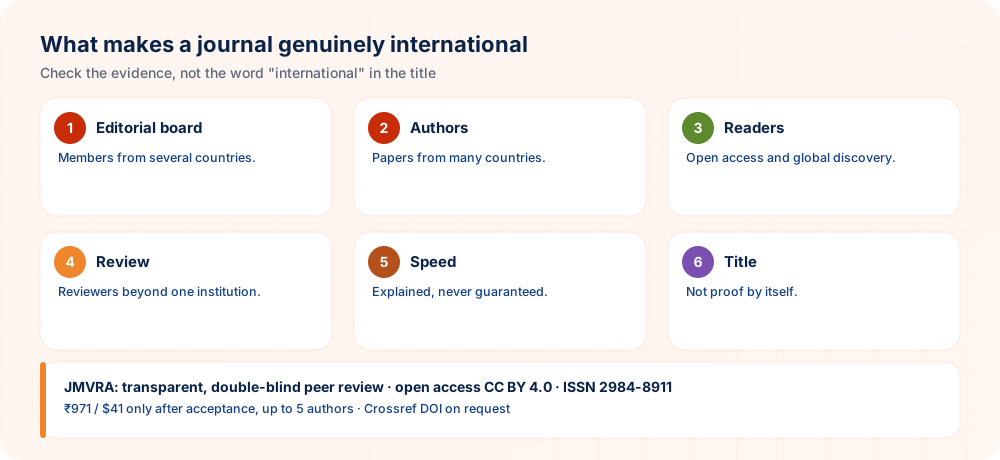
Signs of a Truly International Journal
Editorial board
Board members from multiple countries, with affiliations that can be verified.
Authors
Authors in recent issues come from various countries and institutions.
Review
Reviewers recruited from beyond the publisher’s own city or institution.
Readership and visibility
Indexing and visibility that reach a worldwide readership.
A Journal’s Name Proves Nothing
Starting a title with “International Journal of…” is a naming habit, not a certificate. Assess the journal by what it does: a board you can verify, a varied author base, and visibility via services used by researchers around the world.
A 15-Minute Check
- Visit the editorial board page. Look up three members and their institutions on your own.
- Skim two recent issues. Record the authors’ countries and affiliations.
- Look the journal up in Google Scholar. Check whether its articles show up and receive citations.
- Verify the ISSN. On the ISSN Portal you can see the registered title and the country of publication.
Realistic Expectations on Speed
A well-run international journal may take just weeks from submission to decision, depending on how available the reviewers are and how many revisions are needed. Publication then follows the journal's issue schedule. Be wary of promises tied to a fixed number of days, as our guide to publishing faster without skipping review explains.
Tips for Indian Authors Publishing Internationally
- Address a worldwide audience by explaining local terms, units and institutions.
- Apply an international referencing style throughout.
- Find out if your institution treats national and international journals differently.
- Store the acceptance letter and the published PDF safely for your records.
How to Check an Editorial Board
- Choose three names randomly. Do not stop at the editor-in-chief.
- Look up every name together with the institution listed. Try to find a staff page or an ORCID profile.
- Compare their specialism. Does their published work fit the journal’s subjects?
- See whether they confirm the role. Plenty of editors mention it on their own profiles.
The 10 Most-Searched Questions on This Topic
Here are the ten questions researchers search for most on this subject, each with a direct answer.
international journal for research paper publication
A journal whose board, authors and readers are international — judge its practices instead of its title.
what is an international journal
A journal that operates internationally in its editing, reviewing, authors and visibility.
international vs national journal
National journals serve the authors and readers of a single country, while international ones attract people from many.
editorial board international
Editorial members from various countries whose affiliations are verifiable.
fast international journal publication
Streamlined review plus rolling submission can speed up publication, but be careful with guarantees.
ISSN country of publication
Where a journal is registered appears in its ISSN Portal record.
international journal India
A journal published in India may still be international when its board, authors and readers are.
journal impact international
Being visible in Google Scholar and major databases helps a journal reach readers abroad.
international publication for API
Certain institutions treat international and national journals differently, so read your own rules.
how to publish in international journal
Select a suitable journal, comply with its guidelines, write with a global audience in mind and answer reviewers with care.
How JMVRA Fits In
JMVRA is a Transparent, Peer-Reviewed, Open Access Journal (Refereed Journal). Following the discontinuation of the UGC and UGC-CARE journal listing, and in alignment with the latest UGC-CARE recommendations and guidelines, JMVRA is aligned with UGC’s Suggested Parameters for Choosing Peer-Reviewed Journals. UGC public notice (PDF)
JMVRA accepts authors from India and overseas, offering double-blind review by subject experts, worldwide open access and indexing in Google Scholar. Foreign authors pay $41 USD, and only once the paper is accepted.
- ISSN
- 2984-8911 (online) · publishing since June 2023
- Issues
- Monthly issues across many disciplines
- Review
- Two-way anonymous review by specialists
- Access
- Open access, licensed CC BY 4.0
- Fee
- ₹971 INR for Indian and $41 USD for foreign authors, due only after acceptance
- DOI
- Crossref — available as an optional extra
- Indexing
- You will see it in Google Scholar, but not in Scopus, Web of Science or DOAJ
- Impact factor
- 11.25, derived from Google Scholar data
Screening begins the moment a paper arrives and each decision is sent as soon as it is reached, yet JMVRA never promises a set number of days: actual review time depends on the reviewers and on how much revision the paper needs.
At-a-Glance Checklist
- Board countries reviewedGenuine affiliations
- Recent authors reviewedWhich countries appear
- Access reviewedOpen and easy to find
- Speed claims assessedReasons rather than pledges
- Title set asideNot treated as proof
What Gives an Author List International Character
A journal is international because of its authors, reviewers and readers, not its name. Examine its latest issues:
Contributors from multiple countries
Not limited to the journal’s own country.
Reviewers from diverse institutions
Where details of the review are made public.
An editorial board spread across institutions
Actual individuals whom you can check.
Readership and citations
Articles that researchers elsewhere cite.
Getting Ready for International Reviewers
- Clarify the local background — policies, institutions or data sources that readers abroad may not know
- Draw on international literature — beyond national studies alone
- Follow international standards — for units, reporting guidelines and citation style
- Explain the broader relevance — what readers in other places can take away
Realistic Expectations About Speed When Publishing Internationally
Fast publication is attractive, but speed that comes from skipped checks is a warning, not a benefit. Use these ideas to judge turnaround sensibly and to speed up the parts you control.
- Remember what you control. Authors influence speed through manuscript quality, complete files and prompt replies. A clean submission avoids administrative back-and-forth that quietly adds delay.
- Be wary of fixed-time promises. Genuine review depends on reviewer availability and the paper itself. A firm promise of outcome or timing before anyone has read your work deserves close questioning.
- Read the stated process. Look for a described sequence of editorial check, review and decision. Journals that explain their stages openly are easier to hold to their own standards.
- Prepare before you submit. Have co-author approvals, declarations, figures and permissions ready in advance. Missing documents are one of the most avoidable causes of slow progress.
- Use waiting time productively. While the paper is under review, begin the next draft or tidy your datasets. Patience is easier when other useful work continues.
Control your own preparation and replies, and treat any promise of unusual speed with scepticism until the process is clearly explained.
Questions Researchers Often Ask
Your Paper's Journey at JMVRA, From Submission to Publication
- SubmitA paper ID is issued
- ScreenScope & similarity
- ReviewDouble-blind
- DecideEmail & SMS
- ReviseAnswer every point
- AcceptCopyright & fee
- ProduceDOI available on request
- PublishMonthly issue
Review time varies with the reviewers and with any revision needed, so no fixed turnaround is promised; acceptance or rejection is communicated to you by email and WhatsApp. You can follow progress at any time using your paper ID.
Ready to Publish? Submit to JMVRA
JMVRA is aligned with UGC's Suggested Parameters for Choosing Peer-Reviewed Journals.
JMVRA is a Transparent, Peer-Reviewed, Open Access Journal (Refereed Journal). Following the discontinuation of the UGC and UGC-CARE journal listing, and in alignment with the latest UGC-CARE recommendations and guidelines, JMVRA is aligned with UGC’s Suggested Parameters for Choosing Peer-Reviewed Journals.
Helpful pages on jmvra.org
Key Terms
Subjects and search phrases this article addresses.
Related Reading
Further reading on the same theme from the JMVRA blog.
What an Affordable Publication Fee Buys in India
Read the guide RelatedPublishing Quickly in India Without Taking Risks
Read the guide RelatedOpen Access Models & Multidisciplinary Journals Explained
Read the guide RelatedInternational Authors at JMVRA: What to Expect
Read the guide RelatedA Stepwise Route to Having Your Research Paper in the Google Scholar Index
Read the guide RelatedJournal Finder — A Fast Way to Choose a Good Low-Cost Journal Aligned with UGC CARE
Read the guideKeep Reading on the JMVRA Blog
This guide belongs to the JMVRA journal blog, which offers practical advice on publishing, indexing, metrics and research integrity, written to be checkable instead of promotional.