
Journal Scope
JMVRA covers many disciplines. Original research, review articles, short communications and case studies are welcome from any field named on this page, as well as from areas lying between fields.
Treat the list that follows as a guide, not a complete catalogue. What counts in the assessment of a manuscript is the strength of its question, method and evidence, not whether its precise topic is a bullet point here. Work on a subject that is not named is still in scope if it is scholarly, backed by evidence and of interest outside your own institution.
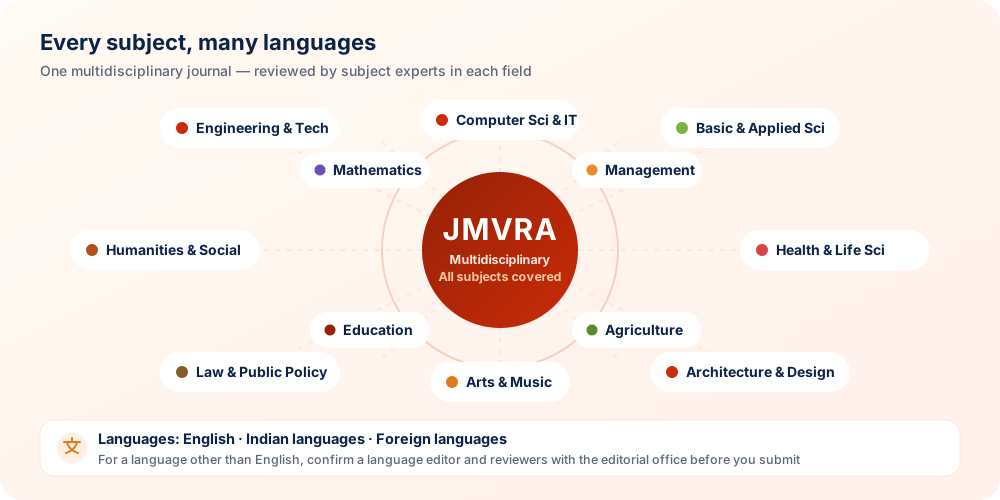
| Coverage | Multidisciplinary — all subjects covered, spanning each major academic and professional discipline |
|---|---|
| Accepted work | Accepted types: original research alongside reviews, short communications, case studies and technical notes |
| Review model | Subject experts conduct transparent, double-blind peer review — read how every paper is reviewed |
| Language | Multilingual — English plus all Indian (local) languages and foreign languages. If you write in another language, ask the editorial office before submitting to confirm that a language editor and reviewers are available, and send the font details and font file; Publishing in Your Language has more. |
| Frequency | Published monthly, with submissions open on a rolling basis |
Engineering and Technology
Structural, geotechnical and civil engineering; thermal, production and mechanical engineering; electronics and electrical engineering; renewable energy and power systems; communication and electronics; control and instrumentation; aerospace and automobile engineering; petrochemical and chemical engineering; materials science; industrial engineering; automation, robotics and mechatronics; quality engineering and manufacturing processes.
An engineering paper ought to set out the design problem, its constraints, the way analysis or testing was done, and the means by which results were checked. Where simulation is used, give the software and its version, list the assumptions and boundary conditions, and justify why the model is sound enough for the conclusion drawn. Readers can only trust a simulated result if they can retrace the setup behind it.
Information Technology and Computer Science
Data structures and algorithms; software architecture and engineering; machine learning and artificial intelligence; analytics and data science; distributed systems and computer networks; edge and cloud computing; cryptography and cybersecurity; information retrieval and databases; image processing and computer vision; natural language processing; human–computer interaction; embedded systems and Internet of Things; distributed ledgers and blockchain.
A computing paper should say which dataset or benchmark was used, which baselines it was measured against, which evaluation metrics were applied and what hardware or environment ran the experiments. Any claimed improvement needs results that a different researcher could reproduce by following the description provided.
Applied and Basic Sciences
Physics, covering condensed matter, optics, nuclear and applied physics; chemistry in its organic, inorganic, physical, analytical and green forms; biochemistry, biotechnology, microbiology, zoology, botany and biology; geology, geophysics and earth sciences; nanotechnology and nanoscience; space science and astronomy.
An experimental paper should describe the materials, instruments, procedures and controls, and how uncertainty was handled, with enough precision that someone else can run the experiment again.
Mathematics and Statistics
Applied and pure mathematics; algebra, topology, analysis and geometry; numerical methods and differential equations; optimisation and operations research; combinatorics and graph theory; stochastic processes, probability and statistical inference; biostatistics and applied statistics; mathematical models of economic, biological and physical systems.
Papers with a theoretical contribution need to list their assumptions and present full proofs. Applied statistical studies should identify the population, how the sample was drawn, its size and the tests used, and should keep statistical significance separate from practical importance. A reader should never have to guess which test produced a reported p-value.
Management and Commerce
Strategic and general management; banking, insurance and finance; auditing and accounting; consumer behaviour and marketing; organisational behaviour and human resource management; supply chain and operations management; small business and entrepreneurship; trade and international business; hospitality and tourism management; business analytics; sustainability reporting and corporate governance.
Empirical research in management needs to explain the sampling frame and instrument, report response rates, and show how reliability and validity were evaluated. A case study should make clear why the case teaches something useful to readers in other settings.
Education
Development and design of curricula; instructional methods and pedagogy; e-learning and educational technology; evaluation and assessment; professional development and teacher education; administration and policy in higher education; special and inclusive education; education in early childhood; technical and vocational education; psychology of education; open and distance learning.
A report on a classroom intervention should give details of the participants, how long it ran, the comparison condition if there was one, and the measures employed, so readers can decide if the result would carry over to their own situation.
Life Sciences and Health
Epidemiology and public health; allied health and nursing; pharmaceutical sciences and pharmacy; rehabilitation and physiotherapy; dietetics and nutrition; management, policy and health systems; education in medicine; informatics in health; complementary and traditional medicine.
Agriculture and Environment
Crop science, horticulture and agronomy; plant nutrition and soil science; entomology and plant pathology; dairy science, veterinary science and animal husbandry; post-harvest technology and food science; precision farming and agricultural engineering; extension and agricultural economics; forestry; pollution control and environmental science; water resources; renewable energy, sustainability and climate change; disaster management.
A field trial report should include the location, the season, the design, the replication and the statistical analysis, because agronomic outcomes depend strongly on the conditions in which they were recorded.
Public Policy and Law
Administrative and constitutional law; criminology and criminal law; commercial and corporate law; intellectual property; human rights law and international law; environmental law; labour law; data protection and cyber law; governance, public administration and policy analysis.
A doctrinal paper should cite primary sources exactly, name the jurisdiction, and state the date up to which the analysis is current, because statutes and case law keep changing. Precise dating spares later readers from relying on a position that has since been overtaken.
Design, Planning and Architecture
Urban design and architecture; regional and town planning; landscape architecture; interior design; industrial and product design; management of construction; green and sustainable building; conservation and restoration of heritage.
A design paper should state the brief, the context of the site or the user, the design method, and how the result was assessed — whether by post-occupancy study, simulation, user testing or expert review.
Music, Arts and Performing Arts
Visual and fine arts; musicology and music; film, theatre and dance studies; criticism and art history; digital media arts, animation and photography; craft and folk traditions.
Practice-based research should say what question the work explores, how it was made or performed, and in what way its result adds knowledge that goes beyond the work itself.
Yoga, Sports and Physical Education
Pedagogy and physical education; coaching and sports science; biomechanics and exercise physiology; sports management and sports psychology; wellness, yoga and health promotion.
An intervention study should report who took part, the training protocols, how long they lasted, the measurement instruments and any ethics approval, so that findings can be set against those from other settings.
Textiles, Fashion and Home Science
Family resource management and home science; nutrition and food science; family studies and human development; technology and design of fashion; apparel, merchandising and textile science.
Applied studies need to describe the samples, materials and test standards exactly, and explain how the findings apply in households, industry or policy.
Interdisciplinary Work
Research spanning the boundaries above is warmly welcomed, for instance bioinformatics, digital humanities, health economics, environmental policy, engineering education and computational social science, along with comparable combinations.
Manuscripts that cut across fields carry an additional responsibility: reviewers from every contributing discipline must be able to follow them. Frame the research question in language that each audience recognises, explain specialist terms when they first appear, and spell out the contribution to each field instead of presuming that readers share your perspective.
More Subjects Covered
JMVRA is multidisciplinary — all subjects are covered. Apart from the areas above, manuscripts in the following fields are just as welcome:
- Pharmacy and pharmaceutical technology
- Dentistry and oral health
- Ayurveda, Homeopathy, Unani and Siddha
- Paramedical and medical laboratory technology
- Forensic science
- Biomedical engineering
- Textile engineering
- Mining and metallurgy
- Marine and ocean engineering
- Petroleum and energy engineering
- Environmental engineering
- Geoinformatics, remote sensing and GIS
- Quantum computing
- Generative AI and large language models
- AR, VR and immersive media
- Fintech and digital banking
- Digital marketing and e-commerce
- Logistics and aviation management
- Hotel, hospitality and event management
- Journalism and mass communication
- Library and information science
- Defence and strategic studies
- Social work and community development
- Rural development and cooperatives
- Women’s and gender studies
- Tribal and indigenous studies
- Religious and philosophical studies
- Sanskrit, Hindi and regional languages
- Indian knowledge systems
- Food and dairy technology
- Fisheries and aquaculture
- Sericulture and apiculture
- Veterinary and animal sciences
- Disaster and risk management
- Public administration and e-governance
- Psychology and counselling
- Commerce and taxation
- Insurance and actuarial studies
- Data journalism and digital humanities
- Sustainability and ESG reporting
This list expands as authors send in new work. What counts is how good the question, method and evidence are, and not whether your exact topic is named above.
Publish in Your Own Language
JMVRA is multilingual. Besides English, it takes papers written in all Indian (local) languages and in foreign languages, letting research appear in the language it was carried out in and in which its readers work.
When a paper is not in English, the journal needs an editor who handles that language and reviewers able to judge it. For this reason one brief step takes place before you submit: check with the editorial office that a language editor and reviewers exist for your language, and supply the font you used so the paper can be typeset and shown correctly.
Examples of Indian languages
- Hindi
- Gujarati
- Marathi
- Bengali
- Tamil
- Telugu
- Kannada
- Malayalam
- Punjabi
- Odia
- Urdu
- Assamese
- Sanskrit
- Konkani
- Maithili
- Nepali
- Sindhi
- Kashmiri
- Dogri
- Manipuri
- Bodo
- Santali
- and other local languages
Examples of foreign languages
- French
- Spanish
- German
- Arabic
- Portuguese
- Russian
- Chinese
- Japanese
- and others
Prior to submitting in a language other than English
- Contact the editorial officeSend an email to [email protected] or a WhatsApp message stating your title, subject and language
- Wait for confirmationThe office tells you whether a language editor and reviewers can be arranged for your language
- Send font details & fileThe name and version of the font, whether it is Unicode, plus the font file itself (.ttf or .otf)
- Submit your paperMention the confirmation at submission so the paper reaches the correct editor
Get your language confirmed first
Let the editorial office know your paper's language, subject and title. Attach the font file together with its details (font name, version, and whether the encoding is Unicode or legacy). Submit only after the office has confirmed that a language editor and reviewers can be found.
The Review Route for Every Paper
Regardless of subject or language, each research paper undergoes transparent, double-blind peer review carried out by experts in the relevant field.
Double-blind
Authors cannot see who their reviewers are, and reviewers cannot see who the authors are.
- First screened for similarity (under 15%)
- Evaluated by subject-matter experts
- Decision sent by email & WhatsApp
Transparent
With the review documented, there is proof for anyone that it took place.
- The review entry on Scholar9
- Public reviewer list
- Report in formal form upon request
Reviewers are picked for the method a paper applies as well as for its subject, so selecting the right subject area (below) is important. You can read the complete workflow on the JMVRA Peer Review: Transparent & Double-Blind page.
Article Types
Every subject accepts five types of paper. Each card describes what the paper reports and, beneath it, what reviewers look for.
Out of Scope
Submissions of the following kinds are rejected at editorial screening, ahead of peer review:
How to Choose Your Subject Area
- Match the methodSelect the area whose reviewers are best qualified to judge your method, and not only your topic
- Name primary & secondaryFor interdisciplinary work, state the main area and note the second one in your covering letter
- Choose real keywordsUse terms that readers in that area truly search for — they influence both reviewer selection and discoverability
- Unsure? Ask firstBefore submitting, email your title and abstract to [email protected]
Can't Find Your Subject? Get in Touch with the Editor
Write to the editor directly with your paper
A subject that is not named on this page is still quite likely to be within scope. Send the manuscript, or only its title and abstract, to [email protected] and the editorial office will confirm whether it fits and which reviewers suit it. WhatsApp messages and the usual online submission are also options. Giving a short note on your methodology helps the office judge the match faster.
- Put the title, abstract, keywords and subject area in the body of the email
- To have it considered right away, attach the manuscript as a Word or PDF file
- State any interdisciplinary aspect so suitable reviewers can be located
Positioning Interdisciplinary Work Within a Broad Subject List
A wide range of subjects helps authors whose work crosses boundaries, yet it also means you must frame your contribution clearly. These ideas help you present your study to the right readers.
- Name your primary field plainly. Even when methods come from several areas, state which discipline your main question belongs to. This helps editors choose reviewers who can judge the central argument.
- Explain specialist terms for outsiders. Reviewers may know the topic but not your technical vocabulary. Define key terms briefly at first use so that readers from neighbouring subjects follow your reasoning.
- Show why the combination matters. Make clear what is gained by joining approaches, such as a new insight or a practical application. Do not leave readers to guess why the mix was needed.
- Cite across the relevant literatures. Include references from each field you draw on. Balanced citation signals that you understand the debates in all the areas your paper touches.
- Choose keywords from each side. Select terms used by each contributing community so that readers in different subjects can find your paper. Varied vocabulary widens your potential audience.
In a broad journal, state your primary field, explain unfamiliar terms and show clearly why combining approaches adds value.
Questions Researchers Often Ask
Which subjects are published in JMVRA?
All of them. As a multidisciplinary journal, JMVRA takes in computing and engineering, the sciences and mathematics, management, social sciences and humanities, education, health, agriculture, law, architecture, arts, sports, home science, interdisciplinary studies, and the extra fields named further down this page.
Is it possible to submit in Hindi, Gujarati or another Indian language?
Yes. Papers in every Indian (local) language are accepted by JMVRA. Ahead of submission, check with the editorial office that a language editor and reviewers can be assigned for your language, and send along the font details and the font file.
Is a foreign language other than English acceptable?
Yes. Papers in foreign languages are handled in the same way: first confirm with the editorial office that a language editor and reviewers are available, and then submit.
Which font details do I need to send with a non-English paper?
Send the font's name and version, say whether it is a Unicode font or a legacy (non-Unicode) font, and attach the font file itself (.ttf or .otf). Email everything to [email protected], quoting your paper title.
What is the review method for papers?
Papers go through transparent, double-blind peer review: neither side sees the other's identity while subject experts evaluate the paper, and once published the review is recorded on Scholar9, with a formal Transparent Peer Review Report supplied if requested.
Can I still submit if my subject is missing from the list?
Probably so. Mail the title and abstract to [email protected]; the editorial office replies on whether the paper suits the journal and who should review it.
Ready to publish?
A Journal You Can Verify for Your Publication
Authors are charged ₹971 INR (Indian) or $41 USD (foreign) only after acceptance, never before. The journal offers transparent, double-blind peer review, similarity screening, Crossref DOIs on request, CC BY 4.0 open access and alignment with UGC’s Suggested Parameters.
Social Sciences and Humanities
Development studies and economics; anthropology and sociology; international relations and political science; behavioural science and psychology; archaeology and history; ethics and philosophy; linguistics, languages and literature; cultural studies, media and communication; urban studies and geography; information science and library science; gender studies; social work.
A qualitative study should explain how participants or texts were chosen, how data were gathered and analysed, and in what ways the researcher's own standpoint could have influenced the interpretation. Where human participants were involved, consent and any ethical clearance received must be recorded.