
Call for Papers
Journal of Modern and Versatile Research Approach (JMVRA)
Original research, reviews, short communications and case studies from all fields — a multidisciplinary journal covering every subject. Submissions are open on a rolling basis, so any day of the month works. Having the manuscript ready in the journal template beforehand saves time.
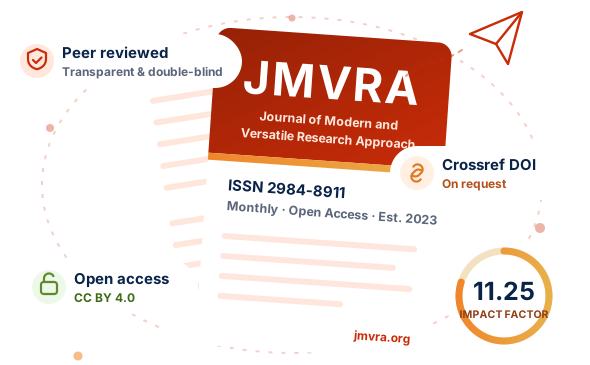
- ISSN 2984-8911
- Since 2023
- Transparent & double-blind review
- Crossref DOI on request
- Open access · CC BY 4.0
- Impact factor 11.25
₹971 INR / $41 USD for each accepted article, covering up to 5 authors — payable only once the paper is accepted.
Journal Information
The checkable facts about this journal, set out plainly. Each claim below can be tested against the linked page or an outside source, so none of it relies on trusting the journal's word.
| Journal | Journal of Modern and Versatile Research Approach |
|---|---|
| Abbreviation | JMVRA |
| ISSN | 2984-8911 (online) — ISSN Portal record |
| Publisher | JMVRA Publication (JMVRA Publication), India |
| Established | 2023 |
| Frequency | Monthly — you can submit on any day |
| Language | English |
| Access | Open Access — free of paywall and embargo |
| Review | Subject-expert reviewers, 3,000+ in number, carry out transparent double-blind peer review — learn how your paper is reviewed and consult the JMVRA Peer Review: Transparent & Double-Blind |
| Similarity check | Each manuscript is screened before review; similarity has to be below 15% — see the Plagiarism Policy |
| Licence | CC BY 4.0 — copyright stays with the authors |
| Crossref DOI | on request, DOIs registered; available on request — see Crossref DOI |
| Impact factor | 11.25, a calculated metric based on citations from Google Scholar and Semantic Scholar; it is not an official Clarivate Journal Impact Factor (JCR) — the method is explained on Impact Factor Details |
| Indexing & discovery | ISSN Portal / ROAD, Scholar9, Crossref, Zenodo, OpenAlex and Google Scholar listings can each be confirmed via Indexing Verification |
| UGC | . JMVRA is aligned with UGC’s Suggested Parameters for Choosing Peer-Reviewed Journals — see UGC Status & Parameters |
| Subject | Multidisciplinary — every subject covered; read Research Area |
| Publication fee | ₹971 INR (Indian authors) / $41 USD (foreign authors) for each accepted article, with up to 5 authors included; due only after acceptance — read Publication Charges |
| Website | jmvra.org |
| Editorial contact | [email protected] • +91 91063 65667 |
The Journal Information page and the Journal Policies give a full account of every area. These include the editorial board, aims and scope, publication ethics, peer review, open access, copyright, plagiarism, archiving, complaints, corrections and retractions, the AI policy and conflict of interest. To see what is indexed and how to check it, visit the Indexing Verification page.
The Invitation
Researchers, academicians, research scholars and practitioners from any discipline are invited by JMVRA to send original research papers, review articles, short communications and case studies for its coming monthly issues.
Postgraduate students, doctoral researchers, faculty and practitioners are all welcome to submit. Each piece of work is assessed on its merits, and the authors' seniority, institution and country have no role in the editorial decision. A clear statement of your contribution makes that assessment easier.
| Journal | Journal of Modern and Versatile Research Approach (JMVRA) |
|---|---|
| ISSN | 2984-8911 |
| Frequency | Monthly — submissions are taken all year |
| Scope | Multidisciplinary — read Research Area |
| Review | Open-process, two-way anonymous peer review |
| Access | Open access; permanent CrossRef DOI on request |
| Submission status | Open |
Important Dates
Publication is monthly and submissions are taken on a rolling basis, so no single yearly deadline exists. The same cycle applies to every issue:
- Submission opensContinuously — submit on any day
- Last date for the issueShown on the submission page for the current issue
- Editorial screeningStarts when the paper arrives, ahead of peer review
- Review & decisionFollows screening; sent by email and WhatsApp
- Camera-ready & paymentOnly after acceptance
- Issue publishedEvery month
Accepted Article Types
Original research
Fresh empirical, experimental, analytical or design work
Review articles
A critical synthesis of the existing literature on a subject
Short communications
Brief reports of important early results
Case studies
In-depth analysis of one case that offers transferable lessons
Technical & methodological notes
Tools, datasets, instruments or procedures that other researchers can use
Topics Invited
This multidisciplinary journal welcomes submissions from healthcare and allied areas, agriculture, law, education, humanities and social sciences, mathematics and statistics, basic and applied sciences, management and commerce, computer science and information technology, and engineering and technology, and from interdisciplinary studies that link them. Find every subject listed on the Research Area page.
- Multidisciplinary — Every Subject Covered
- Engineering & Technology
- Computer Science & IT
- Management & Commerce
- Basic & Applied Sciences
- Mathematics & Statistics
- Humanities & Social Sciences
- Education
- Law
- Agriculture
- Healthcare & Allied Areas
- Interdisciplinary Research
Submission Requirements
Go through these eight points prior to submitting — they decide whether a paper moves directly to review or is sent back for correction.
The Publication Guidelines page gives complete formatting instructions. Any submission that falls short of these requirements is sent back for correction ahead of review.
How to Submit
- PrepareDraft the manuscript using the journal template.
- SubmitUpload it through the online submission page.
- Note your paper IDGiven at submission — include it in all correspondence.
- Answer the reviewersReply to their comments within the period stated in the decision email.
- PublishWhen accepted, you sign the undertaking online, send in the camera-ready copy and pay.
The Way Your Paper Is Reviewed
JMVRA follows transparent, double-blind peer review: while your paper is under review, identities remain concealed, and the review is documented so that it can be verified after the paper is published.
Double-blind
Reviewers cannot see the author's identity, and authors cannot see who reviewed their paper.
- Similarity screening comes first (below 15%)
- Peer-reviewed by subject specialists
- Decision sent by email & WhatsApp
Transparent
Because the review is logged, anyone is able to confirm it actually happened.
- Scholar9 record of the review
- Public reviewer list
- Official report available on request
You can find the complete workflow on the JMVRA Peer Review: Transparent & Double-Blind page and within the Peer Review Policy.
Acceptance and Time to Publication
Authors with no news whose paper ID is several weeks old should email the editorial office quoting the ID, and should not resubmit the paper, since that produces a duplicate record.
After Publication
Once a paper is published, its author list can be changed only by a formal correction notice, so go over the names with care before the camera-ready stage.
Charges
JMVRA is open access and levies a single article processing fee after acceptance. No payment is due at submission, and payment has no influence on the editorial decision. The charge is ₹971 INR (Indian authors) or $41 USD (foreign authors) — read Publication Charges.
- No payment due at submission or during review
- Billed only after an acceptance decision
- Includes up to 5 authors — ₹500 for every author beyond the 5th
- No refund once accepted and paid; an overpayment is returned — read the Refund Policy
Optional services, all offered on request once the paper is accepted:
- Crossref DOI on request
- Review report shared with the author ₹700 / $20
- Hard copy of certificate on request
- Journal hard copy + certificate + DOI ₹1100 / $170
Contact the Editorial Office
The editorial office is run by the publisher, JMVRA Publication (JMVRA Publication), India.
Confirmed straight from the source
Real-Time Figures Open to Verification
Each value points to its publishing service. Numbers shown were taken on 30 Sep 2026; expect changes as the services update.
Impact Factor and Citation Metrics
Before you submit, see what JMVRA’s citation figures are and how each one can be checked.
Source: JMVRA Google Scholar profile
Until then, you can check JMVRA’s citations yourself on Google Scholar, OpenAlex (search results) or Crossref Search.
Important note: The Impact Factor (11.25) is a calculated metric based on citations from Google Scholar and Semantic Scholar. It is not an official Clarivate Journal Impact Factor (JCR). All other statistics are taken from their respective platforms and may vary over time; please verify each metric at the original source using the links above.
JMVRA at a Glance
Journal statistics and publication information
Indexing & discovery
Indexing
Official listings and registrations covering the journal or its articles.

Crossref Verified
Agency for DOI registration, where each registered paper’s metadata is deposited.
Crossref DOI on request Verified
A Digital Object Identifier that does not change can be assigned when requested, so the paper remains citable.

ISSN Portal Verified
ISSN 2984-8911 is the journal’s serial registration, kept at the ISSN International Centre.

ROAD Verified
The open access scholarly resources directory maintained by the ISSN Centre.

ORCID Registry
Author ID registry connecting each author’s record with their publications.

Publons / ResearcherID Registry
Registry of reviewers and researchers (today Web of Science reviewer recognition) that records peer-review work.
Zenodo Verified
An open repository hosted at CERN where archived research outputs can be deposited.

Scholar9 Verified
Registry of transparent peer review that holds the record of the journal’s review certificate.
Discovery
Researchers use it to discover, browse, read, store or pass on published articles.

Google Scholar Verified
A tool for search and citation tracking; the journal’s Impact Factor draws its citation data from it.

OpenAlex Verified
Open catalogue of works, authors and citations that took over from Microsoft Academic’s data.
ORWave Verified
A platform, Open Research Wave, where open-access journals and research can be discovered.
Google Search Verified
Web-wide search, covering pages from jmvra.org that it has indexed.

Academia.edu Verified
Scholarly sharing site providing reader statistics per uploaded paper.


ResearchGate Search
Authors upload papers to this research network, and readers can follow what they publish.

Mendeley Search
Readers keep papers in this reference manager and cite them from the stored metadata.


SSRN Search
A preprint and working-paper network from Elsevier — a repository rather than a journal index.
Microsoft retired Microsoft Academic, still named on older pages, at the end of 2021, and OpenAlex above continues to hold its data.
Originality
Detecting Plagiarism With Turnitin & iThenticate
Before peer review starts, each submission is checked for similarity; the author may request the resulting report. A similarity level below 15% is the accepted threshold.
Turnitin
Text is screened for similarity against the literature, the web and submitted manuscripts.

iThenticate
A Turnitin service aimed at publishers and researchers; AI-writing detection can be added.
Licences & standards
Licences, Access and Recognition



ISSN Registered • Open Access • Transparent Peer Review • Creative Commons CC BY 4.0 • Ethics policies follow COPE guidance
JMVRA is a Transparent, Peer-Reviewed, Open Access Journal (Refereed Journal). Following the discontinuation of the UGC and UGC-CARE journal listing, and in alignment with the latest UGC-CARE recommendations and guidelines, JMVRA is aligned with UGC’s Suggested Parameters for Choosing Peer-Reviewed Journals. UGC public notice (PDF)
UGC & UGC-CARE
UGC’s New Recommendations: Where JMVRA Stands
JMVRA is a Transparent, Peer-Reviewed, Open Access Journal (Refereed Journal). Following the discontinuation of the UGC and UGC-CARE journal listing, and in alignment with the latest UGC-CARE recommendations and guidelines, JMVRA is aligned with UGC’s Suggested Parameters for Choosing Peer-Reviewed Journals.
8 groups containing 35 suggestive parameters
JMVRA’s self-report follows Annexure-I of UGC’s notice. Results: 2 are partly met and 3 not published, 2 are not applicable, and 28 are met; each is backed by a reason.
Notices and circulars issued by UGC
- Public Notice — CARE Journals (discontinuation) (PDF) ↗
- Final list of UGC-CARE journals (1,474, archived) (PDF) ↗
- Public Notice — CARE (PDF) ↗
- Public Notice — CARE, 14 January 2019 (PDF) ↗
Proof, parameter by parameter
About the journal
Journal of Modern and Versatile Research Approach (JMVRA) at a Glance
- Journal
- Journal of Modern and Versatile Research Approach About
- ISSN (online)
- 2984-8911 Verify
- Established
- 2023
- Frequency
- Monthly Current issue
- Publisher
- JMVRA Publication
- Impact Factor
- 11.25 (Google Scholar data) Details
- DOI
- Crossref DOI
- Review
- Double-blind, transparent records Policy
- Access & licence
- Open access, CC BY 4.0 Policy
- Subjects
- Multidisciplinary Research areas
- Editorial board
- Named editors View board
- Reviewers
- 3,000+ Reviewer list Join
- [email protected] Contact
- Phone / WhatsApp
- +91 91063 65667 Support
| Charge | Indian authors | Foreign authors |
|---|---|---|
| Publication fee (after acceptance) Details | ₹971 INR | $41 USD |
| Crossref DOI (optional, on request) Add | Optional | $20 |
| Hard copy of certificate (optional) | ₹500 | $100 |
| Bundle: journal hard copy + certificate + DOI | ₹1100 | $170 |
| Transparent peer-review report (on request) | ₹700 | $20 |
Pay online: publication charges · pay fees online · payment options · payment terms
Related Pages
More on jmvra.org
Policies, records and author services on the main JMVRA site.
Journal & indexing
UGC & recognition
Peer review & ethics
For authors
Ready to publish?
Publishing in a Journal That Can Be Verified
JMVRA pairs alignment with UGC’s Suggested Parameters with open access under CC BY 4.0, similarity screening, transparent double-blind peer review and Crossref DOIs on request; authors pay ₹971 INR (Indian) or $41 USD (foreign), but only following acceptance.
Getting a Paper Ready to Answer a Call
A call for papers invites many kinds of work, but editors still expect submissions that fit and arrive complete. Use these steps to turn a draft into a convincing response.
- Choose the right article type. Decide honestly whether your work is original research, a review, a short communication or a case study. The structure and expected depth differ, and a mismatch weakens the submission.
- Tie your topic to the invitation. State in your cover letter how the paper relates to the themes invited. A brief, specific explanation helps editors see relevance without hunting for it.
- Write a self-contained abstract. Summarise the problem, method, main result and implication in plain language. Many readers and editors decide from the abstract alone whether to continue.
- Check every requirement before sending. Compare your file with the stated length, formatting, declaration and reference rules. Missing items are a common reason for returned papers and wasted weeks.
- Allow time for a final read. Leave your draft aside for a short while, then proofread for clarity, consistency of terms and figure labels. Fresh eyes catch errors that reviewers would otherwise notice.
Respond to a call with a paper that fits the invitation, follows the rules and has been read once more.