
Before You Submit
Any manuscript sent to JMVRA has to be original, unpublished and not being considered by another journal. Offering identical work to two journals at once wastes reviewers' time and counts as a breach of publication ethics. Choose one journal at a time and wait for its decision.
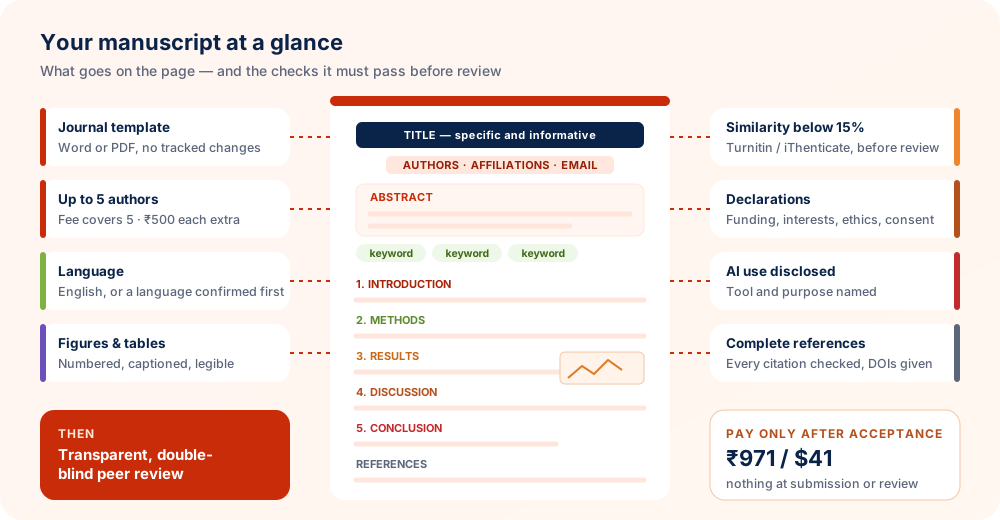
Sort out these six matters before opening the submission page:
Key points at a glance
Manuscript Structure
- Title & abstract · ~6%
The paper in brief - Introduction · ~10%
The problem, the gap and the aim - Literature · ~14%
Existing knowledge, fairly presented - Methods · ~20%
Detail sufficient for replication - Results · ~22%
Findings stated a single time - Discussion · ~18%
Significance and limitations - In Summary · ~5%
What was established - References · ~5%
Full and verified
Usual proportions for an empirical paper — guidance rather than a fixed rule. Review articles and case studies are organised differently.
| Section | What belongs in it |
|---|---|
| Title | Precise and informative, naming the subject and, if possible, the result. Do not use abbreviations without explaining them. |
| Authors and affiliations | Complete names, institutions, and the email of the corresponding author. |
| Abstract | A stand-alone summary covering the question, approach, main findings and implications, without citations or undefined abbreviations. |
| Key Terms | Words a reader would look up; they guide the choice of reviewers and help people find the paper afterwards. |
| Introduction | The problem and its importance, current knowledge, and the gap this study fills. |
| Literature review | Discussion of earlier work, among it studies that contradict your position. |
| Methodology | Sufficient detail that another researcher could replicate the work: design, materials, participants or data, procedure and analysis. |
| Results | The findings alone, shown a single time in text, a table or a figure rather than all three. |
| Discussion | The meaning of the results, their link to earlier work, and the factors that restrict interpretation. |
| In Summary | What has been shown and what follows from that; new results do not belong here. |
| References | Full and consistent, with each in-text citation listed here and each entry cited in the text. |
Where their material demands it, review articles and case studies can deviate from this structure, yet they still have to state clearly how sources were selected and analysed.
Formatting Requirements
Figures and Tables
Do
- Number figures and tables by order of first mention and point to each one in the text
- Compose captions that can be understood without the nearby text
- Give axes labels with quantities and units that stay legible at the published size
- Acknowledge where reproduced material came from and make sure permission is in place
Avoid
- Images of low resolution; chart screenshots copied from slides seldom remain readable
- Presenting identical data in a table and also in a figure
- Captions that merely restate the figure title
- Undisclosed alteration of what an image displays
References and Citations
Compare every citation with the source it refers to. Errors spread through a body of literature when a paper is cited from another paper's reference list without being read. Reading the original takes little time and prevents embarrassing mistakes.
- Each citation in the text needs an entry in the reference list, and each listed reference needs a citation in the text.
- List every detail: who wrote it, the year, the title, the journal or publisher, volume, issue, page range and, where available, the DOI.
- Where both exist, choose the published version of a work instead of the preprint.
- Credit the source of each idea, figure, dataset and quotation that you did not produce yourself.
- Avoid filling the reference list with works you never used, and avoid adding citations just to raise somebody's count.
Author, A. A., & Author, B. B. (Year). Title of the article. Journal Name, Volume(Issue), pages. https://doi.org/10.xxxxx/xxxxx
Authorship
Those who contributed substantially, whether to conception or design, to gathering or analysing data, or to drafting and revising the manuscript, qualify as authors, provided they approve the submitted version and accept responsibility for it.
Anyone who helped without reaching that standard, for example by funding a project, supplying materials, offering general supervision or proofreading, belongs in the acknowledgements and not on the author list. Both adding a non-contributor (gift authorship) and leaving out a real contributor (ghost authorship) amount to misconduct.
A paper's publication fee includes up to 5 authors. ₹500 is charged for every author beyond the 5th; see Publication Charges.
Declarations
Where relevant, the manuscript has to state:
Use of AI Tools
State whether generative AI tools helped prepare the manuscript, naming the tool and its purpose, such as language editing, code generation, literature searching or something else.
An AI tool cannot be named as an author, since it can neither accept responsibility for the work nor approve its submission. Authors stay fully accountable for all content in the manuscript, including the accuracy of any text, citation or analysis created with such help. If a tool invents references and nobody checks them, the author bears the responsibility, not the tool.
Similarity and Originality
Similarity screening applies to every manuscript before review. Text recycled from your own earlier publications is included as well, because self-plagiarism still duplicates the published record.
When another author's exact words are needed, quote them directly and cite the source. Otherwise paraphrase properly; swapping a few words while keeping the sentence structure does not count as paraphrasing. The Plagiarism Policy sets out the acceptable similarity threshold and the action taken if it is exceeded.
Originality
Detecting Plagiarism With Turnitin & iThenticate
A similarity check comes first, ahead of peer review, and the author may request the report. Anything below 15% similarity is within the accepted threshold.
Turnitin
The text is checked for overlap with published literature, web pages and other submitted manuscripts.

iThenticate
Aimed at publishers and researchers, this Turnitin service offers optional AI-writing detection.
How to Submit
- PrepareWork from the journal template and fill in every declaration
- Check the fileThe file opens properly and contains no tracked changes
- UploadVia the submission portal at jmvra.org
- Enter authors exactlyExactly as they are to be printed on publication, since this feeds the DOI metadata
- Keep the paper IDInclude it in all later messages
Two Ways to Submit
Submit through the portal or by email, as you prefer
The online submission portal gives you a paper ID at once when you upload; otherwise, email the manuscript to [email protected] together with the title, authors, affiliations and subject area. If the template and forms are new to you, download them beforehand.
Frequent Reasons for a Paper's Return Before Review
Editorial screening is where most returns occur, and they can be avoided. Go through these six points prior to uploading:
Out of scope
The topic is beyond the journal’s subject coverage, or there is no suitable reviewer. Ask the editor beforehand if you are uncertain.
Similarity above 15%
Recycled text, your own previous work included, that is neither quoted nor cited. Do a similarity check prior to submission.
Missing declarations
Missing statements on funding, competing interests, ethics approval, consent or data availability.
Incomplete manuscript
An absent abstract or keywords, lacking references, illegible figures, or a file that fails to open.
Previously published or being reviewed elsewhere
Work submitted to several journals at once, or already published, is declined immediately.
No ethical approval
Studies involving human participants, patient data or animals that lack committee and consent statements.
What Happens Next
- SubmitYou receive a paper ID
- ScreenScope & similarity
- ReviewDouble-blind
- DecideEmail & SMS
- RevisionReply to each point
- AcceptCopyright & fee
- ProduceProofs, plus a DOI on request
- PublishCurrent issue
| Stage | What happens |
|---|---|
| 1. Submission | Paper ID issued once the manuscript arrives |
| 2. Screening | Checks of scope, completeness, declarations and similarity |
| 3. Peer review | Subject experts carry out transparent, double-blind review |
| 4. Decision | Decision to accept, revise or reject, sent by email and WhatsApp |
| 5. Revision | Authors answer each point and resubmit |
| 6. Acceptance | Online signed undertaking, copyright form, camera-ready copy and payment |
| 7. Production | Copy editing, proofreading and DOI registration (on request) |
| 8. Publication | The article is placed in the current issue |
The way the review works
Double-blind
Neither side knows the other: reviewers are unaware of the author, and authors are unaware of the reviewer.
- Similarity screening comes first (below 15%)
- Assessed by experts in the field
- Decision sent by email & WhatsApp
Transparent
Anyone can check that the review was truly carried out, because a public record of it exists.
- Review listing at Scholar9
- Public reviewer list
- A formal report, if you ask for it
The JMVRA Peer Review: Transparent & Double-Blind page lays out the full process stage by stage.
Responding to Reviewers
- Answer each commentOne by one, in a separate letter, following the reviewer’s order
- Say what & whereThe changes you made, with section and page numbers
- Disagree with evidenceDisagreement with reasons is acceptable, but disregarding a comment is not
- Highlight changesSo the revision lets readers find them fast
- Return on timeOtherwise request an extension ahead of the deadline
Reviewers donate their time. A response letter that is polite and substantive speeds a manuscript through a second round much more than a defensive one.
Camera-Ready File and Proof Checking
Once accepted, a paper needs three things from you: payment of the publication charge, the signed copyright form and a camera-ready file. Then go through the proof carefully, paying attention to:
- Author names, order & affiliations
- Title & abstract
- Equations, symbols & special characters
- Figure & table numbers and captions
- Reference list
The permanent DOI metadata takes in author names and affiliations, and file conversion most often damages equations and special characters, so inspect those first.
Use proof corrections to fix errors and not to rewrite. Significant content changes at this point may send the manuscript back to review.
After Publication
Mistakes found after publication are dealt with by a correction, an expression of concern or a retraction, whichever fits. The original record gets an annotation instead of being deleted, which keeps the scholarly record whole.
Final Checklist
- Original work, unpublished and not being reviewed elsewhere
- Formatted in the journal template and including abstract and keywords
- All contributors have agreed the author list, order and affiliations
- Each citation verified against its source, and the reference list is complete
- Figures and tables carry numbers and captions and are readable
- Declarations made on funding, competing interests, ethical approval, consent and data availability
- Use of any AI tools disclosed
- Similarity kept within the limit in the policy
- Tracked changes deleted, and the final file confirmed to open properly
- The submitted version has the approval of all authors
- At most 5 authors, or the charge for extra authors understood
- English, or a different language already agreed with the editorial office
Polishing Your Manuscript Before You Follow the Author Guidelines
Guidelines tell you what a journal expects, but good writing habits decide how your paper is received. These steps improve a draft before formal checks begin.
- Write the abstract last. Once results and conclusions are settled, summarise them accurately. An abstract written at the end mirrors the paper, whereas an early one often drifts from what you actually found.
- Make figures stand alone. Give each figure and table a clear caption, labelled axes and units, so a reader understands it without hunting through the text. Readers often scan visuals first.
- Use one reference style consistently. Let a reference manager format citations and check every entry against its source. Cross-check that each in-text citation appears in the list, and the reverse.
- Edit for plain, precise language. Prefer short sentences, define terms at first use and avoid unexplained abbreviations. Ask a colleague outside your subfield to read a page and tell you where they stumble.
- Prepare declarations before uploading. Draft statements on funding, conflicts, ethics approval and data availability while writing. Having them ready makes the submission step quick and keeps the information accurate.
Strong structure, clear figures, consistent references and prepared declarations make any manuscript easier to review.
Author Questions
What file format should be submitted?
Submit Word or PDF, formatted in the journal template, according to the submission portal. Delete tracked changes and comments prior to uploading.
What abstract length and number of keywords are expected?
Typically journals request 150–300 words and four to eight keywords. The current requirement appears on the submission portal and overrides this.
What citation style do I follow?
Any established style works, provided it is used consistently from first citation to last reference. A mixture of styles is among the most frequent causes of return before review.
Must anything be paid when submitting?
No. The ₹971 INR charge for Indian authors, or $41 USD for foreign authors, falls due solely after acceptance. Nothing needs paying at submission or while review is ongoing.
What level of similarity is permitted?
It must be below 15%. Turnitin / iThenticate screens every manuscript before review, and the author may request the similarity report.
May I email my paper to the editor?
Yes. Send the manuscript to [email protected] with its title, authors, affiliations and subject area. The online portal is faster, as the paper ID comes immediately.
Is it permitted to use AI tools when preparing my manuscript?
Only when disclosed, with the tool and its purpose named. An AI tool cannot be an author, and you stay responsible for each sentence and citation.
How long until I hear back after submitting?
Specialist reviewers assess your paper, and you receive the acceptance or rejection decision by email and WhatsApp. No fixed turnaround is promised, because review time depends on the reviewers and the revision needed.
How will my paper be reviewed?
Through transparent, double-blind peer review. Subject experts review the paper with identities hidden on both sides, and once it is published the review is placed on record at Scholar9; a formal Transparent Peer Review Report can be requested.
Is it possible to write my paper in a language besides English?
Yes, JMVRA takes papers written in any Indian (local) language or foreign language. Beforehand, ask the editorial office whether a language editor and reviewers can be arranged, then forward the font details and font file.
How many authors may be listed on a paper?
Up to 5 authors are covered by the publication fee. For every author beyond the 5th, ₹500 is charged.
Before you upload
Format rules at a glance
Quick contact
A formatting question?
Attach the file and say which rule you are unsure about.
Ready to publish?
Publishing in a Journal That Can Be Verified
Authors get open access under CC BY 4.0, similarity screening, transparent double-blind peer review and, if requested, a Crossref DOI, all at a journal aligned with UGC’s Suggested Parameters — JMVRA. The fee, ₹971 INR (Indian) or $41 USD (foreign), is due only after acceptance.