
What Does a Journal Finder Mean?
Students, scholars and faculty members looking for a reputable home for their research often ask something like "Which good, low-cost journal is UGC CARE-aligned and offers transparent peer review?" A journal finder is just a systematic approach — in effect a checklist — for pairing your manuscript with a suitable and trustworthy journal on the basis of subject scope, indexing status, review speed, cost and UGC CARE compliance, rather than sending it to the first journal you happen to find. Writing down your priorities first makes the comparison faster and less biased.
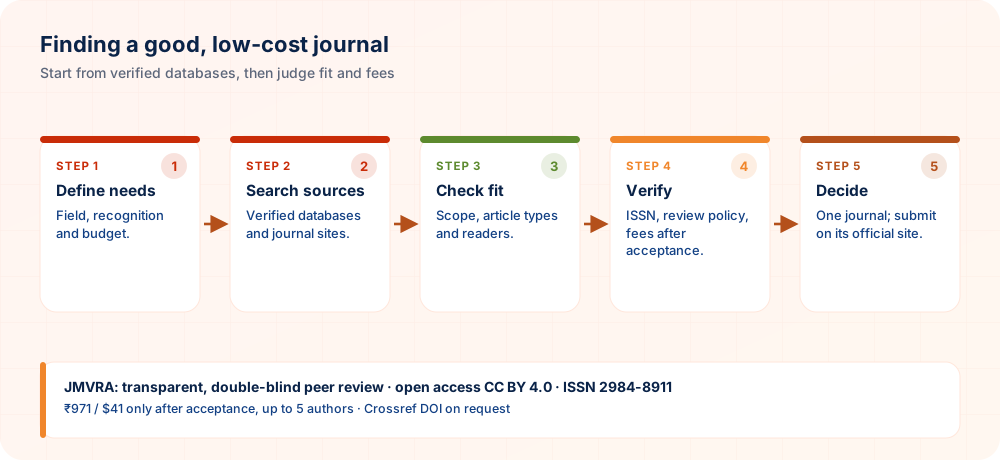
How a Journal Finder Strategy Helps
- Pair your research topic with a journal whose subject truly fits
- Check UGC CARE, Scopus or Web of Science indexing claims on your own
- Screen journals by realistic publication timelines and clear, affordable fees
- Check that CrossRef DOI, certificates and hard copy options are available
- Make sure the journal fits the newest UGC CARE Peer-Reviewed Journal Policy
UGC CARE Rules All Researchers Should Know
When papers are put forward for a Ph.D. thesis, a faculty promotion or a grant application, UGC wants them to come from genuinely peer-reviewed (refereed) journals that follow the UGC CARE framework. Keep these points in mind:
- A journal needs a documented and transparent peer review process.
- If your requirement is that exact compliance, the journal ought to appear, in a way you can verify, under UGC CARE Group I or Group II.
- Any claim of Scopus or Web of Science indexing has to be independently verifiable — never accept it at face value.
- Stay away from journals that levy hidden fees after acceptance or claim indexing they do not really hold.
Each of these criteria is explained fully in the article UGC CARE Journal Guidelines, a walkthrough on how to publish.
Start with Verified Journal Databases
Whichever journal you consider — JMVRA or another — check indexing and listing status directly with the official resources instead of relying on what the journal says about itself:
- UGC recognition: the UGC-CARE list has been discontinued (UGC public notice), so compare the journal with UGC's Suggested Parameters and your institution's rules
- ISSN Portal: portal.issn.org
- Scopus Sources: scopus.com/sources
- Web of Science (Clarivate) Master Journal List: mjl.clarivate.com
Searching each of these databases is explained in the guide on how to find and verify UGC-CARE, Scopus and Web of Science indexed journals.
JMVRA's Network: Genuinely Low-Cost, UGC CARE-Aligned Choices
Instead of steering you to unrelated third-party journals, here is a frank overview of the three journals in JMVRA's own publishing network. All three are multidisciplinary, open access, peer-reviewed and published monthly, and each one states its fee openly before you submit:
| Journal | Scope | Fee (India / International) | ISSN · ESTD |
|---|---|---|---|
| JMVRA — Journal of Modern and Versatile Research Approach (jmvra.org) | Multidisciplinary, all subjects; Impact Factor 11.25 (calculated by Google Scholar) | ₹971 INR / $41 USD | 2984-8911 · June 2023 |
| TIJER — International Research Journal (tijer.org) | Multidisciplinary, all subjects; High Impact Factor | ₹970 / $50 (low cost) | 2349-9249 · 2014 |
| JNRID — Journal of Novel Research and Innovative Development (jnrid.org) | Multidisciplinary, all subjects; High Impact Factor | ₹970 / $50 (low cost) | 2984-8687 · 2023 |
Read the fee column carefully, because the cheapest option depends on where you live. For an Indian author the three fees sit within one rupee of each other — ₹970 at TIJER and JNRID, ₹971 INR at JMVRA — so price should not decide the choice at all. For an international author the gap is real: JMVRA's $41 USD is nine dollars lower than the $50 charged by TIJER and JNRID. Submissions to TIJER and JNRID go through the Research Wave page at researchwave.org/researchwave_jmvra.html, while JMVRA papers are sent through its own submission form.
Before you send a paper to any of the three, type its ISSN into portal.issn.org and confirm that the title, ISSN and website on the record match what you see on the journal's own site. This two-minute step protects you from cloned websites that copy a real journal's name and ISSN to collect fees.
The same core standards apply across the whole network: transparent double-blind peer review, a registered ISSN, Crossref DOI when requested, and a fee that is stated openly in advance without hidden charges. The full Our Journals page shows logos, subjects covered and direct links for submitting. Comparing these shared standards against your own priorities helps you pick the best home for a paper.
Journal Finder Checklist
- Clearly documented peer-reviewed or refereed status
- UGC CARE alignment (or Group I/II listing if specifically needed)
- Independent verification of any Scopus/Web of Science claim
- Crossref DOI offered, at least when requested
- A disclosed, affordable fee with no hidden charges once accepted
- A hard copy of the journal or certificate on offer, should you want one
How to Choose the Journal That Suits Your Paper
Inside JMVRA's own network, the choice depends mainly on subject fit instead of any difference in quality, because every journal applies the same editorial standards. All three — JMVRA (₹971 INR / $41 USD), TIJER (₹970 / $50) and JNRID (₹970 / $50) — accept work from every subject, so a paper that is truly multidisciplinary or sits outside a specialty niche fits any of them. The useful differences lie elsewhere:
- Student or first-time author: start with the journal whose recent issues carry papers most like yours in length and method. Browse JMVRA's current issue and past issues, and use the Research Wave page for TIJER and JNRID, before deciding.
- PhD scholar or faculty member: check what your university or selection committee expects. JMVRA is aligned with UGC's Suggested Parameters for Choosing Peer-Reviewed Journals; TIJER and JNRID describe themselves as "UGC CARE Approved, Transparent Peer-Reviewed (Refereed) Journal as per new UGC Notification". Ask your institution which basis it accepts.
- International author: JMVRA's $41 USD is the lowest foreign-author fee in the network, nine dollars below TIJER and JNRID.
- Need a longer publishing history: TIJER was established in 2014, while JMVRA (June 2023) and JNRID (2023) are newer titles.
Whichever you pick, send the paper to one journal at a time and wait for its decision before trying another.
Red Flags to Avoid
No matter which journal you are assessing — within JMVRA's network or outside it — look out for the same red flags: promised acceptance without genuine review, indexing claims that fail on the official database, hidden editorial boards, and fee structures that disclose additional costs only once your paper is accepted. A detailed explanation of these red flags is in Cloned & Fake Journal Alert: Protect Your Paper.
At-a-Glance Checklist
- Requirements notedPrior to searching
- Sources confirmedUse databases, not ads
- Suitability testedLook at recent articles
- Fees comparedTotals
- Warning signs avoidedGuarantees, advance payment
Selecting Keywords for a Journal Search
- Begin with terms from your title and abstract — the precise technical vocabulary
- Include synonyms — words other disciplines use for the same concept
- Include the method — such as survey, simulation or meta-analysis
- Look through recent articles — to learn which journals carry comparable work
Weighing Two Candidate Journals Against Each Other
| Question | Journal A | Journal B |
|---|---|---|
| Recent papers on similar topics? | ||
| Is a peer review policy published? | ||
| Total fee and timing of payment | ||
| Indexing verified | ||
| Meets institutional criteria |
Getting More From a Journal Finder Search
A finder tool gives you candidates, but the final choice depends on your paper. These practical steps help you move from a long list of results to a confident, defensible shortlist.
- Search with your abstract. Paste a clean summary of your paper into the tool instead of one broad subject word. Specific wording returns journals whose readers actually work on your question.
- Study recent issues yourself. Browse the latest contents pages and note article length, methods and tone. If your manuscript would look out of place beside them, move on to another candidate.
- Rank by fit, not by speed. Order your shortlist by scope match and review quality first, and turnaround last. A rejected fast submission usually costs more time than a careful first choice.
- Read the author guidelines early. Check word limits, formatting rules and data policies before you commit. Discovering a mismatch late forces avoidable rewriting and delays your submission.
- Prepare a backup journal. Decide on a second choice in advance and keep your manuscript flexible enough to adapt. Having a plan removes pressure and prevents hasty decisions after a rejection.
Let the tool propose journals, but make the decision yourself after reading real articles and the guidelines of each candidate.
Questions Researchers Often Ask
How JMVRA Measures Up to UGC’s 35 Suggested Parameters
The final Annexure-I attached to UGC’s 16 July 2025 notice lists 35 parameters under 8 categories; the February 2025 draft had 36. When JMVRA assessed itself, 28 came out as met, 2 as partly met, 3 as not published and 2 as not applicable, each with an explanation.
Source: UGC public notice on CARE journals (PDF) · see JMVRA & UGC parameters for every detail.
Ready to Publish? Submit to JMVRA
JMVRA is aligned with UGC's Suggested Parameters for Choosing Peer-Reviewed Journals.
JMVRA is a Transparent, Peer-Reviewed, Open Access Journal (Refereed Journal). Following the discontinuation of the UGC and UGC-CARE journal listing, and in alignment with the latest UGC-CARE recommendations and guidelines, JMVRA is aligned with UGC’s Suggested Parameters for Choosing Peer-Reviewed Journals.
Helpful pages on jmvra.org
Key Terms
Subjects and search phrases this article addresses.
Related Reading
Further reading on the same theme from the JMVRA blog.
UGC-CARE Criteria and How JMVRA Addresses Them
Read the guide RelatedUGC Status & Parameters Journal Publication — Complete Guide to Affordable publication charges Peer Review Publication
Read the guide RelatedUGC Status & Parameters Journal Standards
Read the guide RelatedUGC Parameters, Scopus, Web of Science and DOAJ Compared: The Difference
Read the guide RelatedUGC CARE Journal Guidelines — How to Publish, Step by Step
Read the guide RelatedUGC Parameters New Policy for Peer-Reviewed Journals: Parameters Explained
Read the guideKeep Reading on the JMVRA Blog
This guide belongs to the JMVRA journal blog, which offers practical advice on publishing, indexing, metrics and research integrity, written to be checkable instead of promotional.