
Why Checking a Journal Counts for More Than Ever
Placing your work in the right academic journal is no longer merely an achievement — it is a requirement. Academic evaluations, Ph.D. submissions, faculty promotions and research grant approvals increasingly depend on whether a journal can be independently confirmed in a recognised database. Every scholar needs to know precisely how to find and verify UGC-CARE, Scopus and Web of Science (WoS) listed journals before investing time, a manuscript or a fee in any of them.
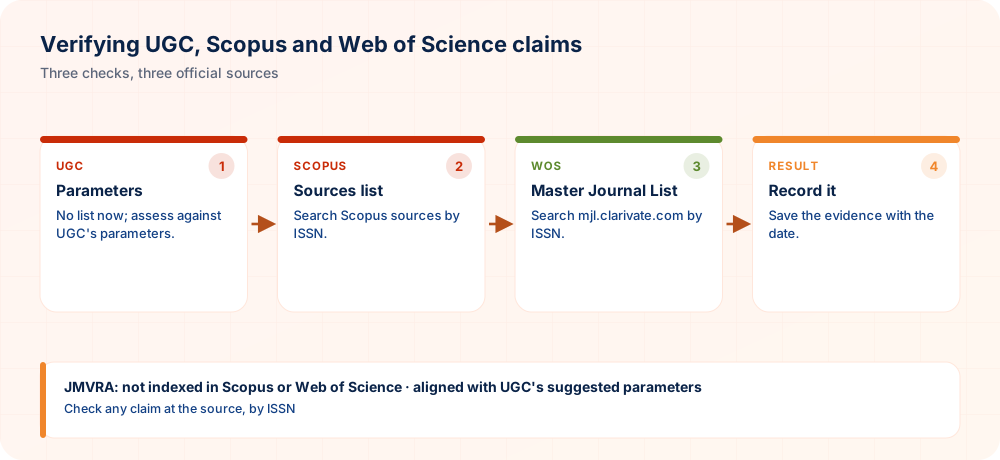
This guide takes you through the exact search steps for each of the three databases, gives a quick-reference comparison, shows how to recognise cloned or discontinued journals, and states honestly where JMVRA itself stands in all three.
The Three Databases You Really Should Check
| Database | Run By | Relevant For |
|---|---|---|
| UGC-CARE List | UGC / Savitribai Phule Pune University (SPPU) | PhD submissions, API scoring, Indian institutional compliance |
| Scopus | Elsevier | International citation tracking, CiteScore, some institutional/grant requirements |
| Web of Science | Clarivate | Journal Impact Factor (JCR), SCIE/SSCI/AHCI/ESCI categories |
Finding UGC-CARE Listed Journals, Step by Step
- Go to ugccare.unipune.ac.in.
- Sign up and log in using your name and email.
- Narrow your search with these filters: Journal Name, ISSN, Subject, Publisher, Language, plus Group I / II.
- Make sure the journal is in the current list, not an archived or replaced version.
Finding Scopus Indexed Journals, Step by Step
- Go to scopus.com/sources (Elsevier's official Scopus Source List).
- Narrow the results by Title, ISSN, Subject Area, or Publisher.
- Make sure the journal is listed as currently, actively indexed, since Scopus from time to time drops titles that stop meeting its standards.
Finding Web of Science Indexed Journals, Step by Step
- Go to mjl.clarivate.com (the Clarivate Master Journal List).
- Search using the journal's exact title or its ISSN.
- Each category carries a different status, so work out which one applies: ESCI (Emerging Sources Citation Index), AHCI (Arts & Humanities Citation Index), SSCI (Social Science Citation Index) or SCIE (Science Citation Index Expanded).
The categories cannot be swapped for one another: in Clarivate's system SCIE/SSCI/AHCI journals have a Journal Impact Factor (JCR), whereas ESCI-listed journals do not at present. If you specifically need a "JCR Impact Factor", make sure the journal is in SCIE, SSCI or AHCI, and not merely somewhere on the Master Journal List.
Quick-Reference Verification Table
| What You Want to Confirm | Where to Check | What to Look For |
|---|---|---|
| UGC-CARE listing (Group I/II) | ugccare.unipune.ac.in | Journal appears in current list, correct ISSN |
| Scopus indexing | scopus.com/sources | "Active" status, matching ISSN and title |
| Web of Science indexing | mjl.clarivate.com | Listed with a specific index category (SCIE/SSCI/AHCI/ESCI) |
| DOAJ (Open Access) listing | doaj.org | Journal appears with matching ISSN |
| Cloned/fraudulent journal warning | UGC-CARE cloned journals lists (Group I & II) | Journal name should not appear here |
Does Scopus/WoS Indexing Count for More Than UGC CARE Listing?
People ask this often and with good reason, and the honest reply is: it rests wholly on the evaluation framework of your own institution, and not on some universal ranking of the databases. Certain institutional API frameworks give extra weight to Scopus or Web of Science indexed publications over basic UGC CARE listing, while others treat UGC CARE Group I and Group II listings alike for compliance, whatever the separate Scopus/WoS status.
Warning Signs: Recognising Cloned or Discontinued Journals
Journals can be dropped from UGC-CARE, Scopus or Web of Science because of weak content, failure to publish on time, or not meeting continuing standards. Apart from that, cloned journals pose as real, listed titles by using the same name, ISSN or logo to mislead authors. Be alert to:
- A journal site whose domain differs from the one on the official database entry.
- Indexing badges or logos shown without a working link that lets you verify them.
- "Scopus indexed" or "peer-reviewed" claims that you cannot confirm yourself on the official portals.
- Promised acceptance, an unusually quick turnaround with no real review, or aggressive demands for fees before any review takes place.
A Practical Checklist Before You Submit
- Searched the exact journal title and ISSN on ugccare.unipune.ac.in
- Searched scopus.com/sources if Scopus indexing is a specific requirement
- Searched mjl.clarivate.com if Web of Science indexing is a specific requirement
- Verified that the domain of the journal's own website agrees with the official database listing
- Made certain the journal is absent from every UGC-CARE cloned-journal list
- Found the editorial board and the peer review process publicly disclosed and open to checking
- Verified that fees are transparent and no extra charges appear after acceptance
JMVRA's Position in All Three Databases
| Database | JMVRA's Status |
|---|---|
| UGC-CARE | Works as a Transparent Peer-Reviewed Refereed Journal inside the UGC-CARE framework |
| Google Scholar | Indexed — basis for the disclosed 11.25 Impact Factor |
| CrossRef | Registered — DOI issued on request |
| Scopus | Not currently indexed |
| Web of Science | Not currently indexed |
| DOAJ | Not currently listed |
This is stated plainly and openly so that you can check it yourself by following the same steps described above, then judge whether JMVRA suits your own submission requirement. To see why JMVRA follows Scopus/WoS-style editorial rigor without being indexed in either, read Does JMVRA Follow Scopus & Web of Science Standards?
At-a-Glance Checklist
- ISSN usedFor every search
- Official sourcesNot journal homepages
- Cloned titles checkedExact match
- Evidence savedWith date
- Institution ruleConfirmed
What to Check Now That the CARE List Has Ended
- Check your institution’s current rules — they set the criteria
- Apply UGC’s suggested parameters — to the journal
- Verify database indexing — Scopus or WoS where required
- Keep evidence — with dates
A Record Sheet for Verification
| Item | Entry |
|---|---|
| Journal title and ISSN | |
| Database checked and date | |
| Result (link or screenshot) | |
| Institution rule applied |
Practical Habits for Verifying Database Claims Independently
Journals sometimes advertise databases they are not part of, or coverage that has ended. Verification is straightforward if you rely on the database itself instead of the journal's own description.
- Search from the database side. Start on the database's official search page and look up the journal there. Arriving through a link supplied by the journal can lead you to a copied page.
- Compare titles and identifiers carefully. Match the exact title, publisher and serial number against the entry you find. A similar name with a different identifier is a common sign of imitation.
- Look for current coverage. Check whether the entry is active and whether recent issues appear. Coverage that stopped in the past should not be advertised as ongoing.
- Keep a verification record. Write down what you searched, what you found and when. If a dispute arises after publication, your dated notes show you acted with care.
Verify through the database itself, match identifiers exactly and keep dated notes of every check you perform.
Questions Researchers Often Ask
How JMVRA Measures Up to UGC’s 35 Suggested Parameters
The 35 parameters in the final Annexure-I of UGC’s 16 July 2025 notice, sorted into 8 categories, take the place of the 36 in the February 2025 draft. Counted by JMVRA, 28 are met, 2 partly met, 3 not published and 2 not applicable, each carrying a reason.
Reference: UGC public notice on CARE journals (PDF) · the complete explanation is in JMVRA & UGC parameters.
Ready to Publish? Submit to JMVRA
JMVRA is aligned with UGC's Suggested Parameters for Choosing Peer-Reviewed Journals.
JMVRA is a Transparent, Peer-Reviewed, Open Access Journal (Refereed Journal). Following the discontinuation of the UGC and UGC-CARE journal listing, and in alignment with the latest UGC-CARE recommendations and guidelines, JMVRA is aligned with UGC’s Suggested Parameters for Choosing Peer-Reviewed Journals.
Where to go next on jmvra.org
Key Terms
Subjects and search phrases this article addresses.
Related Reading
Further reading on the same theme from the JMVRA blog.
UGC Parameters and the API Score: How Research Papers Contribute to Faculty Promotion
Read the guide RelatedComparing UGC Parameters with Scopus, Web of Science and DOAJ: What Sets Them Apart?
Read the guide RelatedOpen Access, Peer Review, Impact Factor & UGC Parameters Norms — A Complete Guide
Read the guide RelatedUGC-CARE Criteria and How JMVRA Addresses Them
Read the guide RelatedParameters Explained: UGC Parameters in the New Policy for Peer-Reviewed Journals
Read the guide RelatedUGC Status & Parameters Journal Publication — Your Guide to Affordable publication charges and Peer Review Publication
Read the guideKeep Reading on the JMVRA Blog
Find this guide on the JMVRA journal blog, a collection of practical guidance on publishing, indexing, metrics and research integrity that favours verifiable content over promotion.