
A Question to Ask Before You Submit
"Does this journal meet the standards of Scopus and Web of Science?" and "Is this journal listed in Scopus and Web of Science?" can seem like one and the same question, yet they differ, and mixing them up ranks among the commonest and costliest errors authors make when picking a venue. This article keeps the two apart, taking JMVRA as a concrete example that is disclosed honestly.
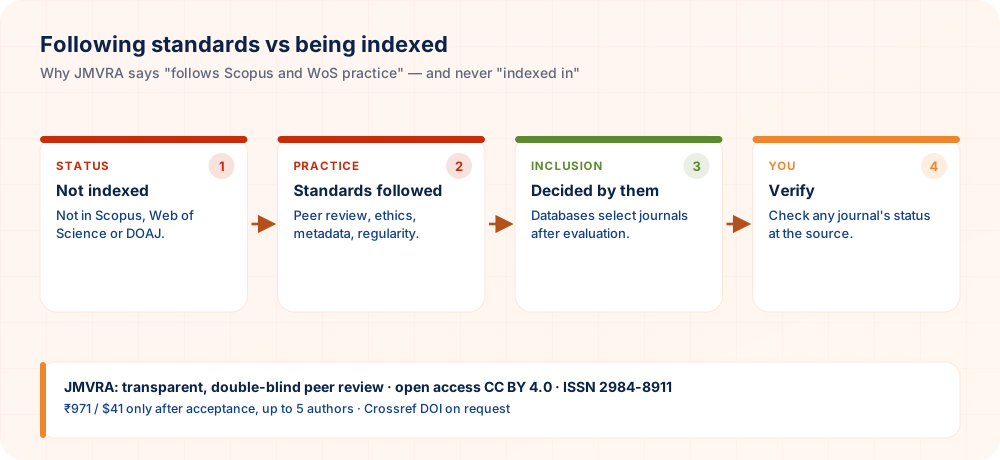
Upfront Disclosure: The Present Indexing Status of JMVRA
Google Scholar indexes JMVRA, which is also registered with CrossRef for DOI issuance and is aligned with the UGC CARE framework as a Transparent Peer-Reviewed Refereed Journal. Each of these is real, verifiable, and separate from Scopus/Web of Science indexing.
The Real Meaning of "Following Scopus/WoS Standards"
Neither Scopus nor Web of Science indexes every journal that applies; they expect accepted journals to show a baseline of editorial rigor already. That baseline consists mostly of practices that any well-run journal can and should follow, whether or not it is indexed. Authors can use the same list as a quick screening tool when comparing journals:
- A real double-blind peer review process that is documented
- A publicly named editorial board that can be verified, with genuine institutional affiliations
- A steady record of publishing on schedule
- A defined policy and threshold for plagiarism and similarity screening
- Ethical practice in line with COPE guidelines
- An ISSN that is valid and active
JMVRA puts each of these practices into effect through its internal editorial policy, and that is what "following Scopus/Web of Science-style standards" amounts to in practice. The phrase describes how rigorous the process is, not a claim that either database formally includes the journal.
Standards Checklist Compared with JMVRA's Practice
| Editorial Rigor Standard | JMVRA's Practice |
|---|---|
| Double-blind peer review | Yes — at least 2 independent reviewers for each manuscript |
| Disclosed editorial board | Yes — shown together with institutional affiliations |
| Regular publication schedule | Yes — monthly, without gap, since June 2023 |
| Plagiarism screening & threshold | Yes — Turnitin/iThenticate with a 15% threshold |
| Ethics policies guided by COPE | Yes — policies on authorship, conflict of interest and misconduct |
| Valid ISSN | Yes — 2984-8911 |
| Formal inclusion in the Scopus/WoS index | No — not indexed at present |
Why Following Standards ≠ Indexing
A journal may satisfy every editorial benchmark listed above and yet remain outside Scopus and Web of Science, since reaching a quality bar does not automatically bring indexing; that is a distinct, formal selection process run solely by two commercial organisations: Elsevier (Scopus) and Clarivate (Web of Science).
What Truly Decides Scopus/WoS Inclusion
Besides editorial rigor, Scopus and Web of Science weigh several elements that a single journal can hardly influence in the near term:
| Additional Factor | Its Relevance to Indexing |
|---|---|
| Citation record over several years | Each index wants evidence of citations accumulating across multiple years, and editorial quality alone is not enough |
| Geographic diversity of the editorial board | A defined composition requirement that goes further than merely naming a board publicly |
| Formal application and evaluation round | Calls for applying to the indexing body directly, which runs on its own schedule and has its own acceptance rate |
| Ongoing compliance monitoring | Journals already indexed get re-assessed from time to time and may be dropped (delisted) if their quality slips |
How This Difference Affects Your Career Choices
Should your institution's promotion rules, PhD regulations or grant terms explicitly require Scopus or Web of Science indexing, wording about following standards cannot stand in for that formal requirement. That is exactly why JMVRA states its indexing status plainly instead of relying on vague marketing phrases such as “international publishing practice” without explaining what they do and do not imply. Always get the requirement from your institution in writing before choosing where to publish.
- Need UGC CARE compliance in particular? JMVRA's alignment with UGC's Suggested Parameters for Choosing Peer-Reviewed Journals can be verified.
- Looking for Google Scholar discoverability? JMVRA is indexed there and its articles can be cited.
- If formal Scopus or Web of Science indexing is a must for you, JMVRA does not currently satisfy it, so you should pick a journal that does.
JMVRA's Position, Stated Plainly
JMVRA adopts editorial rigor in the style of Scopus and Web of Science as its own working standard, since it yields stronger research and more trustworthy peer review whatever the indexing result, and not to hint at an indexing status it lacks. The purpose of this page is to keep that difference unambiguous. Treat any journal's description of its own standards as a starting point for your own checking.
How to Check Any Journal's Indexing Status Yourself
- Look the journal up in the official Scopus Source List from Elsevier to confirm it is in Scopus.
- Use the Clarivate Master Journal List to check whether a journal is in Web of Science.
- Go straight to DOAJ.org and search there to confirm a listing in the Directory of Open Access Journals.
- Do not trust a journal's own statements by themselves. Compare each claim with the public database kept by the indexing body, whether the journal is JMVRA or any other. A dated note of what you found makes a handy record.
At-a-Glance Checklist
- Status statedHonestly
- Practice verifiedIn policy pages
- Database consultedUsing the ISSN
- Career rules understoodYour institution's needs
- Date notedCoverage can change
Benefits Authors Get From These Standards
Useful feedback
Reviewer feedback that strengthens the manuscript.
Clear policies
Ethics rules, charges and licence set out in advance.
Reliable metadata
Crossref DOIs available when requested.
Honest disclosure
A plain statement of indexing status.
When Scopus or WoS Indexing Is Required
- Confirm the rule — must this paper be indexed?
- Rely on official lists — the Scopus Sources list and the Master Journal List
- Plan extra time — journals with strict selection tend to be slower
- Choose JMVRA when its indexing suffices — indexed in Google Scholar, with Crossref DOIs
Practical Tips for Reading Indexing Claims Critically
Phrases about following international standards are not the same as being listed in a database. These habits help you read such statements carefully and decide what they mean for your career.
- Separate benchmark from membership. When a journal says it follows certain standards, ask whether that describes its own conduct or a formal inclusion. Only the database owner can confirm the second.
- Search the databases directly. Use each database's official source list or search tool to look up the journal title and its identifier. Do this yourself instead of trusting an email or a banner.
- Know your promotion rules. Read your university's current policy on what publications count for appointments or degrees. Requirements differ between institutions, and assumptions made from hearsay often turn out wrong.
- Watch for changing status. Lists are reviewed over time, so a journal's position may shift. Recheck before you submit and again before you cite the publication in an application.
- Ask the journal plainly. Write to the editorial office with a direct question about indexing and keep the reply. An honest, specific answer is a good sign; evasive wording is a warning.
Treat standards language as a description of practice, verify any listing at its source, and match your choice to your own requirements.
Questions Researchers Often Ask
Where JMVRA Appears — With Current Figures
Confirm Google Scholar coverage within one minute
- Look up the titleGoogle Scholar accepts the exact article title as a search.
- Use the source: operatorWith
source:"Journal Name"typed in, the papers a journal has published are displayed. - View the profileRead the journal's citation profile if one can be found.
Links for all the records above are gathered on the Indexing & Discovery page (figures as of 30 Sep 2026).
Ready to Publish? Submit to JMVRA
JMVRA is aligned with UGC's Suggested Parameters for Choosing Peer-Reviewed Journals.
JMVRA is a Transparent, Peer-Reviewed, Open Access Journal (Refereed Journal). Following the discontinuation of the UGC and UGC-CARE journal listing, and in alignment with the latest UGC-CARE recommendations and guidelines, JMVRA is aligned with UGC’s Suggested Parameters for Choosing Peer-Reviewed Journals.
More useful pages at jmvra.org
Key Terms
Subjects and search phrases this article addresses.
Related Reading
Further reading on the same theme from the JMVRA blog.
JMVRA Recognition, Associations & Indexing
Read the guide RelatedWhat Scopus Looks For Before Indexing a Journal
Read the guide RelatedChecking a Journal's Indexing Claims One by One
Read the guide RelatedJMVRA's Transparency Statement in Practice
Read the guide RelatedWhat Is a Scopus Journal? A Complete Guide for Researchers and Academics
Read the guide RelatedHow Papers Get Into Google Scholar (and Why Some Don't)
Read the guideKeep Reading on the JMVRA Blog
You are reading part of the JMVRA journal blog, a source of hands-on guidance about publishing, indexing, metrics and research integrity that aims to be verifiable, not promotional.