
UGC CARE Approval
The University Grants Commission (UGC) created the CARE (Consortium for Academic and Research Ethics) framework as a group of parameters used to assess peer-reviewed journals. JMVRA's present position appears on the UGC Status & Parameters page, and you should confirm it with the official UGC source before depending on it. Whether a publication earns credit towards a faculty promotion, a PhD submission or an academic appraisal is decided by your own institution, not by the journal. Ask your research office early which evidence it expects, so you can gather it before you submit.
ISSN
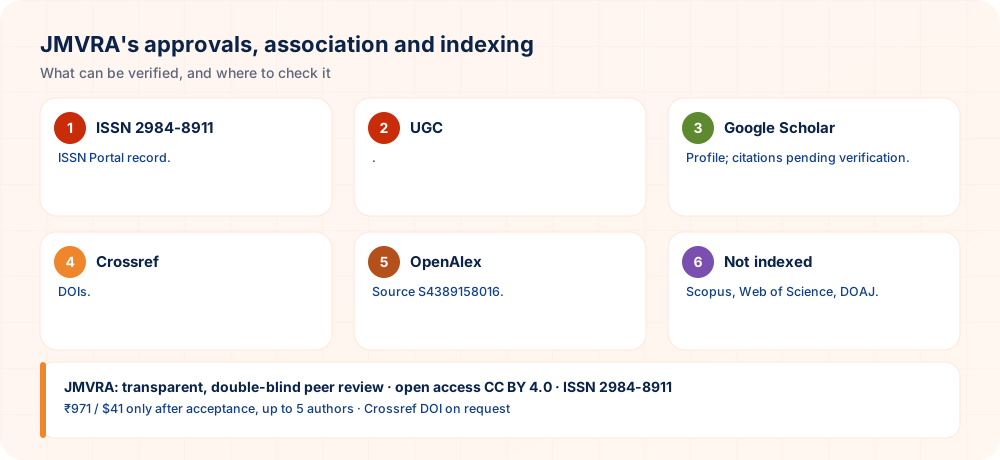
The ISSN 2984-8911 (Online) belongs to JMVRA and was assigned by the ISSN International Centre, Paris. It identifies JMVRA uniquely as an academic journal published in serial form. Quoting the ISSN correctly in citations helps readers and databases match your article to the right journal.
Indexing & Databases
The academic databases and repositories listed below index JMVRA:
Associations
- Company registration under the Indian Government
- ISSN allotted by the ISSN International Centre (Paris)
- A Crossref member, able to register a DOI for each paper
- Adheres to the guidelines of COPE (Committee on Publication Ethics)
- Follows UGC Parameters New Notification for Transparent Peer Review
Checking These Details on Your Own
- ISSN — look up 2984-8911 on the ISSN Portal
- Google Scholar — look for JMVRA articles using their titles
- Crossref DOIs — search the Crossref DOI on request in Crossref
- Institutional acceptance — ask your own research office to confirm
Current links are on the indexing verification page.
Where UGC Stands Today
Rather than one list, institutions today assess journals against parameters of this kind. Refer to UGC’s suggested parameters.
Practical Tips for Verifying Journal Recognition and Indexing Claims
Any journal can make claims about recognition, so independent checking is a healthy habit for authors. These steps help you confirm statements yourself before relying on them in applications.
- Go to the original source. Search for the journal directly inside the database or registry it mentions, rather than trusting a logo or badge on a website. Official listings are the authority.
- Match the identifier exactly. Compare the serial number and title carefully, because similar names and cloned sites exist. A small difference in spelling may point to an entirely different publication.
- Distinguish discovery from indexing. Appearing in a search engine or aggregator is not the same as being selected for a curated database. Describe your journal's visibility using the correct term.
- Know your institution's requirements. Promotion and degree rules differ, so confirm with your department which listings they accept before choosing where to publish.
- Record when you checked. Note the date and the address you consulted, since listings change over time and your evidence should reflect what was true when you looked.
Verify every claim in the official source yourself, describe visibility accurately, and match the journal to your institution's actual requirements.
Questions Researchers Often Ask
At-a-Glance Checklist
- ISSN verifiedOn the ISSN Portal
- UGC stance reviewedIts suggested parameters
- Records viewedOne by one
- Truthful claimsWhat is indexed and what is not
- Verified firstCitation figures shown only once verified
Where JMVRA Appears — With Current Figures
Look up Google Scholar coverage in a single minute
- Find by titlePaste the title, exactly as published, into the Google Scholar search field.
- Source filter:Entering
source:"Journal Name"brings up the papers carried by a journal. - Read the profileIf the journal has a citation profile, go through it.
Follow the Indexing & Discovery page to reach each of the records listed here; Crossref Search and OpenAlex open search results (discovery links), and citation figures are shown only once verified.
Ready to Publish? Submit to JMVRA
JMVRA is aligned with UGC's Suggested Parameters for Choosing Peer-Reviewed Journals.
JMVRA is a Transparent, Peer-Reviewed, Open Access Journal (Refereed Journal). Following the discontinuation of the UGC and UGC-CARE journal listing, and in alignment with the latest UGC-CARE recommendations and guidelines, JMVRA is aligned with UGC’s Suggested Parameters for Choosing Peer-Reviewed Journals.
Quick links across jmvra.org
Key Terms
Subjects and search phrases this article addresses.
Related Reading
Further reading on the same theme from the JMVRA blog.
Web of Science Quartiles Q1 to Q4 Explained
Read the guide RelatedIndexing & Abstracting
Read the guide RelatedWhy Is JMVRA's Impact Factor 11.25? Google Scholar H-Index Explained
Read the guide RelatedWhy JMVRA Follows Scopus Journal Indexing Standard — Quality Without Compromise at ₹971 INR
Read the guide RelatedIs JMVRA in Line with Scopus & Web of Science Standards? The Honest Answer
Read the guide RelatedWhat Does h-index Mean? An Easy Guide (With Examples)
Read the guideKeep Reading on the JMVRA Blog
Our JMVRA journal blog carries this guide along with other practical advice on publishing, indexing, metrics and research integrity, all written so that claims can be verified and nothing is promotional.