
For researchers and academics, appearing in a high-quality journal is more than a milestone; it confirms the effort and the contribution made to a field. Among the best-known journal indexing services is Web of Science (WoS). Newcomers to research publishing have probably heard of Q1, Q2, Q3 and Q4 journals, but what do these quartile rankings really mean, and how do they affect a research career? This guide explains WoS quartiles, how they are set, and why they matter.
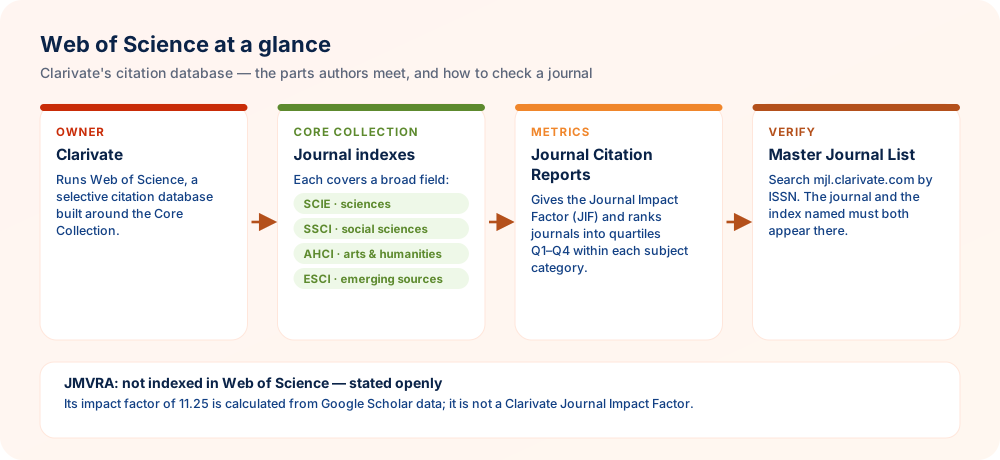
About Web of Science (WoS)
Web of Science is a respected citation database run by Clarivate Analytics, which indexes high-impact scientific and scholarly journals in many disciplines. It contains citation indexes and offers tools to follow citation data, Journal Impact Factor and research influence.
Understanding Quartiles (Q1–Q4) in WoS
WoS-indexed journals are placed in four quartiles according to their Impact Factor (IF) within a particular subject category, and not against every journal that exists.
| Quartile | Position Range within Category | Description |
|---|---|---|
| Q1 | Top 25% | The top-ranked, most-cited journals in the category |
| Q2 | 25%–50% | Strong, reliable journals |
| Q3 | 50%–75% | Moderate impact journals |
| Q4 | Bottom 25% | Lower-ranked journals in the category that are still indexed |
The Value of Quartile Rankings
- Academic recognition — Q1/Q2 publications raise your standing with peers and evaluators
- Career progress — frequently cited for promotions, PhD requirements and research grants
- Institutional ranking — lifts institutions in global university rankings
- Research impact — Q1 journals tend to reach more readers and earn more citations
How Quartile Rankings Are Assigned
Each year Clarivate ranks journals in the Journal Citation Reports (JCR) using measures such as:
- Journal Impact Factor (IF)
- 5-Year Impact Factor
- Citation counts
- Category-level metrics, as one journal can rank differently in each of the several categories it may belong to
How Q1, Q2, Q3 and Q4 Journals Differ
| Feature | Q1 | Q2 | Q3 | Q4 |
|---|---|---|---|---|
| Prestige | Very High | High | Moderate | Low |
| Typical Acceptance Rate | Very Low (5–20%) | Low (10–25%) | Medium (20–35%) | Higher (>30%) |
| Review Process | Strict, multi-round | Thorough | Average | Sometimes basic |
| Visibility | Global | Wide | Medium | Limited |
| Citation Rate | High | Moderate–High | Moderate | Low |
These figures show general tendencies, not fixed rules: acceptance rates and rigor differ noticeably even inside one quartile across subject categories.
Checking a Journal’s Quartile
- Open Clarivate’s own Master Journal List, found at mjl.clarivate.com
- Look the journal up by name or ISSN
- Identify the JCR subject category it is assigned to
- Then see how the Journal Citation Reports (JCR) split that category into quartiles
A badge or claim on a journal’s own website does not prove quartile status; always confirm it against Clarivate’s public tool.
Frequent Myths About Quartiles
Truth: It means the journal ranks in the top 25% of its own specific category, so a Q1 journal in a small, niche category can have a lower absolute Impact Factor than a Q2 journal in a far larger, more competitive one.
Truth: Q4 journals remain indexed in Web of Science and satisfy its baseline quality standards; the quartile only shows relative citation position within the category, not legitimacy.
Advice for Getting into Q1/Q2 Journals
- Choose a specific niche that closely matches your research instead of the widest possible category
- Browse the journal’s past issues to learn its true scope and typical paper style
- Write clearly and originally; reviewers at higher quartiles look hard for a real contribution
- Make sure the methodology is strong and well justified and the citations thorough and relevant
- Expect several rounds of revision before acceptance
Does JMVRA Hold a WoS Quartile?
To answer directly: no. Web of Science does not currently index JMVRA, which is why it carries no Q1–Q4 ranking, and this site never uses quartile terms to describe it. JMVRA is UGC Status & Parameters and indexed in Google Scholar; it also upholds the editorial standards Web of Science looks for in the journals it covers: transparent double-blind peer review, a named editorial board, plagiarism checks and ethics policies guided by COPE.
Should a Web of Science quartile be your specific requirement, confirm the genuine status of any journal, JMVRA among them, on the Clarivate Master Journal List prior to submitting. Should you instead need UGC CARE compliance, transparent peer review and real, checkable indexing at a modest published price, JMVRA was designed for precisely that.
In Summary
Picking the right journal matters as much as doing quality research. Knowing WoS quartiles — Q1, Q2, Q3 and Q4 — gives you a clear framework for judging where a paper might fit. Q1 and Q2 journals bring prestige and reach, while Q3 and Q4 can still be legitimate, useful venues for building an academic portfolio. Whatever quartile or indexing status you are weighing, confirm it on the source database instead of a journal’s own claim, and put quality, relevance and ethical publication ahead of the label alone.
At-a-Glance Checklist
- Name the categoryA quartile applies to one subject category
- Name the yearQuartiles shift between JCR releases
- Verify on the MJLThen in Journal Citation Reports
- Q does not grade your paperIt ranks the journal, not your article
Journals Listed in Several Categories
| Category | Quartile |
|---|---|
| Category A | Q1 |
| Category B | Q2 |
The same journal may land in different quartiles depending on category, so quote the one your institution works with.
Using Quartiles Sensibly
Within field
Compare journals within one category.
Current year
Quartiles are revised every year.
With other evidence
Fit and review quality count.
Source named
JCR and SJR quartiles are not the same.
Using Journal Quartile Rankings Sensibly in Career Decisions
Quartile labels can influence hiring, funding and promotion, which makes them easy to overvalue. A balanced view helps you use them as a guide without letting them dictate every decision.
- Remember rankings are relative. A quartile places a journal among others in a category, not on an absolute scale. Consider how crowded or narrow that category is before reading too much into it.
- Check the year of the ranking. Rankings are revised regularly, so a journal's position can move. Always confirm the current listing instead of repeating a label from an older document.
- Do not equate rank with fit. A highly ranked journal that rarely publishes your topic is a poor target. Choose the venue whose readers will genuinely use your findings.
- Report quartiles precisely. When stating a quartile in an application, mention the category and source. Vague or unsupported labels invite questions from evaluators.
Use quartiles as one relative indicator, verify them against the current source and always weigh topic fit as well.
Questions Researchers Often Ask
Snapshot of JMVRA Citation Metrics
Impact factor applies at the journal level; an h-index, by contrast, may describe either a journal or an author. The numbers were read on 30 Sep 2026 from the journal’s Google Scholar profile, which you can open to confirm them.
Ready to Publish? Submit to JMVRA
JMVRA is aligned with UGC's Suggested Parameters for Choosing Peer-Reviewed Journals.
JMVRA is a Transparent, Peer-Reviewed, Open Access Journal (Refereed Journal). Following the discontinuation of the UGC and UGC-CARE journal listing, and in alignment with the latest UGC-CARE recommendations and guidelines, JMVRA is aligned with UGC’s Suggested Parameters for Choosing Peer-Reviewed Journals.
More useful pages at jmvra.org
Key Terms
Subjects and search phrases this article addresses.
Related Reading
Further reading on the same theme from the JMVRA blog.
Abstract Writing: What Every Sentence Must Do
Read the guide RelatedHow Papers Get Into Google Scholar (and Why Some Don't)
Read the guide RelatedPreparing a Journal for DOAJ: Readiness Checklist
Read the guide RelatedUnderstanding the h-index: A Plain Explanation With Examples
Read the guide RelatedIndexing & Abstracting
Read the guide RelatedScopus, Web of Science, DOAJ & Google Scholar Compared
Read the guide From the blogWeb of Science Q1, Q2, Q3 & Q4 Journals, Explained
Read the article From the blogSCIE, SSCI, AHCI & ESCI Explained: The Web of Science Journal List
Read the article From the blogWeb of Science Journals: By Index and Subject
Read the articleKeep Reading on the JMVRA Blog
You are reading part of the JMVRA journal blog, a source of hands-on guidance about publishing, indexing, metrics and research integrity that aims to be verifiable, not promotional.