
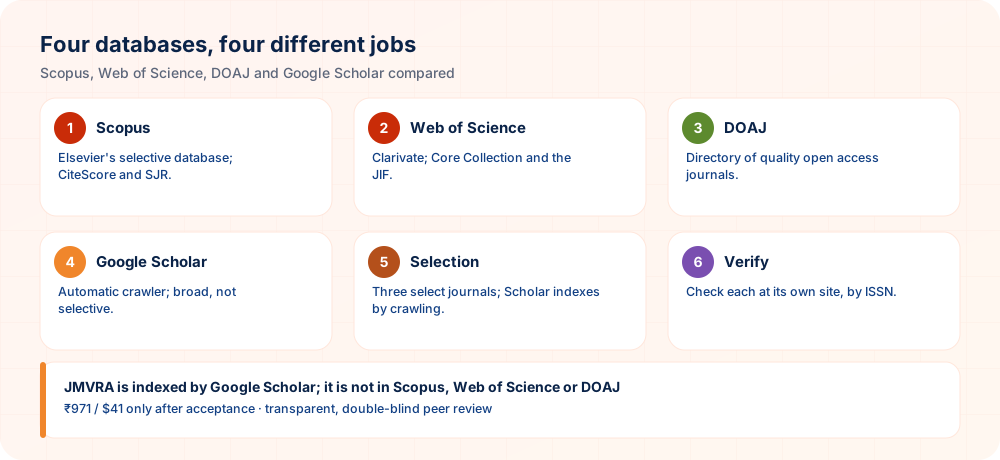
Quick answer: Elsevier and Clarivate run Scopus and Web of Science respectively; both are selective citation databases that apply separate evaluation criteria. DOAJ is a directory of open-access journals that looks at transparency rather than citation impact. Google Scholar is a wide, automated crawler with virtually no selection step. Because none of the four can stand in for another, verify each one separately, using that database's own search page.
What Each One Really Is
Scopus
Elsevier's selective citation index, which judges journals using openly published quality standards.
Web of Science
Clarivate's selective citation index, which applies 28 published criteria covering quality and impact.
DOAJ
A curated listing dedicated to open-access journals; it assesses openness and transparency rather than citation impact.
Google Scholar
A wide-reaching automated crawler without a formal selection step; what it covers depends on how crawlable a site is technically.
Comparison Table
| Database | Purpose | Selection model | Access model | What this does NOT imply | How to verify |
|---|---|---|---|---|---|
| Scopus | Citation & abstract database | Formal, selective evaluation | Subscription (reader-side) | Not proof of UGC Parameters status or DOAJ listing | Scopus Sources list |
| Web of Science | Citation database, Core Collection | 28 published criteria | Subscription (reader-side) | Not the same tier across SCIE/SSCI/AHCI/ESCI | Clarivate Master Journal List |
| DOAJ | Open-access journal directory | Transparency & OA criteria | Fully open access required | Not a citation-impact measure | doaj.org search |
| Google Scholar | Broad scholarly search & citation tracking | Automated crawl, no application | Free to search | Not a quality certification | Search the journal or article directly |
What Each Claim Does Not Imply
Being "indexed in Google Scholar" does not imply Scopus indexing, and a "DOAJ listed" label does not imply Web of Science coverage. Likewise, "Scopus indexed" does not imply UGC-recognised status. Every claim has to be verified separately, at the source that owns it.
Check Any Claim, Ours Included
See our dedicated guides to each database, along with our complete journal authenticity checklist.
Authenticity Checklist Submit PaperCommon Search Terms
Practical Tips for Using Research Database Comparisons
Different databases serve different purposes, so a single listing rarely answers every question. These habits help you interpret comparisons sensibly and avoid being impressed by a database name alone.
- Define your goal first. Decide whether you need a journal for visibility, for an institutional requirement or for a particular readership. The right database to check depends entirely on that purpose.
- Search the database yourself. Do not rely on a badge or logo on a journal website. Type the journal title into the database search page and read what it actually shows.
- Check exact titles and numbers. Similar journal names are common, so compare the identifier, publisher and country in the database record with the journal you plan to use. Look-alike entries cause real confusion.
- Distinguish listing from coverage. A journal may be known to a service without every article being included in it. Learn the difference before you quote any claim in a report or application.
- Ask your library about access. Many university libraries offer guidance on database tools and may provide access you lack personally. A short consultation can clarify what your institution values.
Know your purpose, verify records in the database yourself, and compare exact titles before accepting any claim about coverage.
Choosing the Right Database for Each Purpose
| Purpose | Most relevant |
|---|---|
| Finding literature broadly | Google Scholar |
| Institutional evaluation | Scopus or Web of Science (where required) |
| Checking open access standards | DOAJ |
| Citation metrics | JCR, Scopus metrics or Google Scholar Metrics |
Where JMVRA Sits
Questions Researchers Often Ask
How do Scopus and Web of Science mainly differ?
Each is a selective citation database, operated by a different company with its own evaluation criteria and coverage. A journal may appear in either one, in both, or in neither.
Does a DOAJ listing mean a journal is indexed in Scopus?
No. DOAJ concentrates on open-access transparency, whereas Scopus is a distinct, selective citation database.
Are Google Scholar and Scopus the same thing?
No. Google Scholar crawls broadly and automatically without a formal selection process, while Scopus carries out a formal evaluation.
Can a brand-new journal enter Scopus right away?
No — a steady publication record and proven quality typically have to come first.
Are all four databases equally important for me?
No — find out what your own institution actually requires, because that requirement decides which database counts.
Which database should I search first when reviewing literature?
Begin with Google Scholar for breadth, then move to subject-specific databases for depth.
Does a DOAJ listing measure quality?
DOAJ screens open access journals against its criteria, so it is a quality-checked directory rather than a citation index.
Key References
What This Guide Covers
At-a-Glance Checklist
- Name the databaseNot merely "indexed"
- Verify at the sourceUse each database's own search
- Selective or crawlerUnderstand the distinction
- Matching title and ISSNIn the record you open
- Date the claimCoverage can change
Where JMVRA Appears — With Current Figures
Google Scholar coverage check in one minute
- Title entryType the full article title into the Google Scholar search box.
- Restrict to source:Apply
source:"Journal Name"to see the papers in one journal. - Open the profileView the journal’s citation profile, if there is one.
Every record above is linked on the Indexing & Discovery page (figures as of 30 Sep 2026).
Ready to Publish? Submit to JMVRA
JMVRA is aligned with UGC's Suggested Parameters for Choosing Peer-Reviewed Journals.
JMVRA is a Transparent, Peer-Reviewed, Open Access Journal (Refereed Journal). Following the discontinuation of the UGC and UGC-CARE journal listing, and in alignment with the latest UGC-CARE recommendations and guidelines, JMVRA is aligned with UGC’s Suggested Parameters for Choosing Peer-Reviewed Journals.
Further reading on jmvra.org
Key Terms
Subjects and search phrases this article addresses.
Related Reading
Further reading on the same theme from the JMVRA blog.
Abstract Writing: What Every Sentence Must Do
Read the guide RelatedJMVRA's Transparency Statement in Practice
Read the guide RelatedWeb of Science Quartiles Q1 to Q4 Explained
Read the guide RelatedChecking a Journal's Indexing Claims One by One
Read the guide RelatedWriting an Abstract Editors Accept
Read the guide RelatedWhy Is JMVRA's Impact Factor 11.25? Google Scholar H-Index Explained
Read the guideKeep Reading on the JMVRA Blog
This article sits on the JMVRA journal blog, where practical guidance covering publishing, indexing, metrics and research integrity is written to be verifiable, not promotional.