
For a reader, an editor doing first-round screening, or a search engine's indexing algorithm, the abstract is frequently the only part of a paper that gets fully processed. Yet it is also among the most hurried sections, often drafted in the final minutes before submission — precisely the wrong order, considering how much weight it bears.
The Abstract Matters More Than Authors Tend to Realise
Your abstract is read first by three different audiences: editorial screeners who decide whether the paper fits the scope, reviewers who form a first impression before opening the full manuscript, and search engines such as Google Scholar, which judge how discoverable your paper is largely from abstract text and keywords. Sound research can still be slowed down or derailed by a weak abstract. Reading the abstract aloud to a colleague is a quick way to test whether it stands on its own.
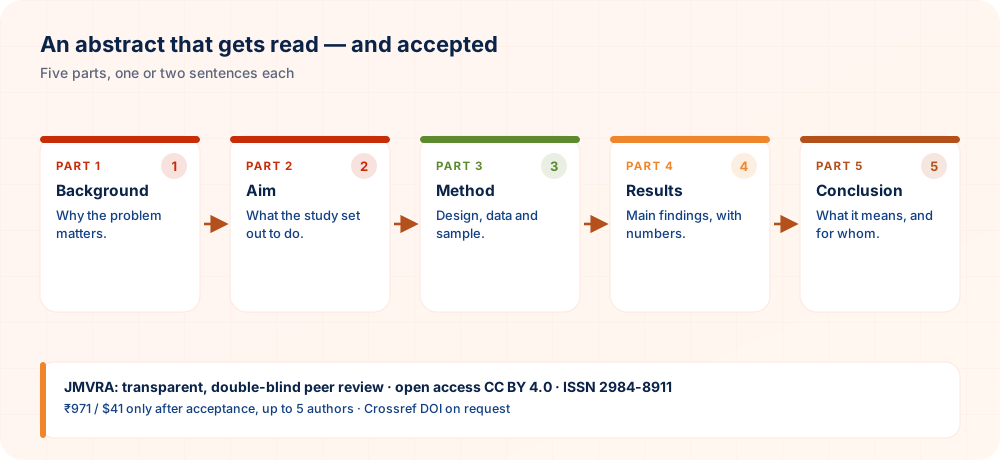
A Five-Part Structure That Works Well
- Context (1 sentence) — the wider problem or gap that your work tackles
- Objective (1 sentence) — exactly what this particular study aimed to do
- Method (1-2 sentences) — a brief account of how you did it
- Results (2-3 sentences) — your real, specific findings, preferably with a number or concrete outcome
- In Summary (1 sentence) — the meaning of the result and the reason it matters
Note that results receive the most room. An abstract that devotes most of its length to background and hardly any to the actual findings has its balance reversed.
Word Count and Formatting Rules
- 150–250 words is the standard range most journals accept, JMVRA among them
- Leave out citations, footnotes and mentions of particular figures or tables
- Describe your actions and findings in the past tense; reserve the present tense for established facts
- A single paragraph, with no subheadings or bullet points inside the abstract itself
Typical Mistakes That Get Abstracts Flagged
| Mistake | Why It's a Problem |
|---|---|
| Describing the topic rather than the findings | Sounds like an introduction instead of a result — reviewers cannot tell what you found |
| Vague outcomes ("the results were analysed and discussed") | Gives a reader or search engine no usable information |
| Falls outside the 150–250 word range | Gets flagged at screening, before a reviewer ever sees it |
| Drafted before the paper is complete | Mirrors what you first intended, not what you actually found |
| Broad keywords ("research," "study," "analysis") | No one searches with such terms, so your paper goes undiscovered |
A Worked Example: Before and After
Selecting Keywords That Get Found
Select 5–8 keywords which an actual researcher looking for work similar to yours might enter in a search engine or database — particular method names, subject terms and techniques, not broad words like "research" or "analysis" that add nothing to discoverability. Look at the terms similar published papers use, and borrow the vocabulary of your field.
Pre-Submission Checklist
- Drafted last, once the whole paper was done
- One paragraph of 150–250 words, without citations
- Reports the actual result, including a figure or concrete outcome if possible
- Understandable without looking at the rest of the paper
- It is followed by 5–8 specific, searchable keywords
At-a-Glance Checklist
- Self-containedClear without the full paper
- Figures givenMain results spelled out
- Citation-freeAnd no unexplained abbreviations
- Consistent with the paperNo fresh content in the abstract
- Length respected150–250 words at JMVRA
Structured and Unstructured Abstracts
| Format | Typical headings | Common in |
|---|---|---|
| Structured | Background, Methods, Results, Conclusions | Medical and health sciences |
| Unstructured | A single paragraph with the same elements | Most other fields |
| Graphical abstract | One image that summarises the paper | Certain science journals, alongside the text |
Follow the format your journal specifies; if it names none, an unstructured abstract containing the same five parts works well.
Wording That Keeps an Abstract Clear
Use specific verbs
“We surveyed 312 teachers” says more than “A study was carried out”.
Give numbers
State key results with figures instead of only “significant improvement”.
Avoid undefined abbreviations
Define terms when first used, or leave them out.
Close with the implication
A single sentence on why the finding matters.
Practical Tips for Polishing Your Research Abstract
Most readers decide from the abstract alone whether to continue. These editing habits help you tighten the summary after the first draft is complete and make every sentence earn its place.
- Write it last, then rewrite. Draft the abstract after the paper is finished so it reflects what you actually found, then revise it again once the discussion has settled in your mind.
- Read it aloud slowly. Spoken delivery exposes long sentences and vague claims. If you run out of breath or stumble, split the sentence or replace the abstract phrase with something more direct.
- Make results concrete. Say what you found in specific terms, such as direction and size of an effect, instead of writing that results were significant or interesting without any detail.
- Keep it self-contained. Avoid citations, undefined abbreviations and references to figures. Someone reading only this paragraph in a search list should still grasp the question, approach and outcome.
- Test it on a non-specialist. Ask a friendly reader from another field to explain your abstract back to you. Any misunderstanding points to wording that needs simplifying before submission.
Treat the abstract as a standalone piece of writing, revise it after everything else, and test it on someone outside your field.
Questions Researchers Often Ask
The Parts of a Research Paper
Usual proportions for an empirical paper — guidance rather than a fixed rule.
- BackgroundA 1–2 sentence statement of the gap.
- ObjectiveYour research question or hypothesis.
- MethodsDesign of the study, data used and tools applied.
- ResultsHeadline findings along with the numbers.
- In SummaryWhat it means.
- Key Terms4–6 searchable terms.
Once the paper is finished, write an abstract of roughly 150–250 words that carries all five parts. JMVRA Publication Guidelines set out the full rules.
Ready to Publish? Submit to JMVRA
JMVRA is aligned with UGC's Suggested Parameters for Choosing Peer-Reviewed Journals.
JMVRA is a Transparent, Peer-Reviewed, Open Access Journal (Refereed Journal). Following the discontinuation of the UGC and UGC-CARE journal listing, and in alignment with the latest UGC-CARE recommendations and guidelines, JMVRA is aligned with UGC’s Suggested Parameters for Choosing Peer-Reviewed Journals.
More useful pages at jmvra.org
Key Terms
Subjects and search phrases this article addresses.
Related Reading
Further reading on the same theme from the JMVRA blog.
How Web of Science Evaluates a Journal
Read the guide RelatedPreparing a Journal for DOAJ: Readiness Checklist
Read the guide Relatedh-index Explained Simply, With Examples
Read the guide RelatedWhy JMVRA Follows Scopus Journal Indexing Standard — Quality Without Compromise at ₹971 INR
Read the guide RelatedWhy Is JMVRA's Impact Factor 11.25? Google Scholar H-Index Explained
Read the guide RelatedWhat Is a Scopus Journal? A Complete Guide for Researchers and Academics
Read the guideKeep Reading on the JMVRA Blog
You are reading part of the JMVRA journal blog, a source of hands-on guidance about publishing, indexing, metrics and research integrity that aims to be verifiable, not promotional.