
Quick answer: DOAJ lists journals that are fully open access and peer-reviewed and that can show transparency in editorial governance, licensing, author fees and archiving. Each application is judged against DOAJ's published criteria; no fast-track route exists, and the current application guide from DOAJ itself is the final authority on exact requirements.
What DOAJ Is
The Directory of Open Access Journals (DOAJ) is an index of quality open-access journals curated by a community, and researchers, funders and institutions commonly use it to spot legitimate open-access publications. Different from Scopus or Web of Science, it concentrates on open access and editorial transparency and not on citation impact. Use it as a screening aid when you compare possible journals.
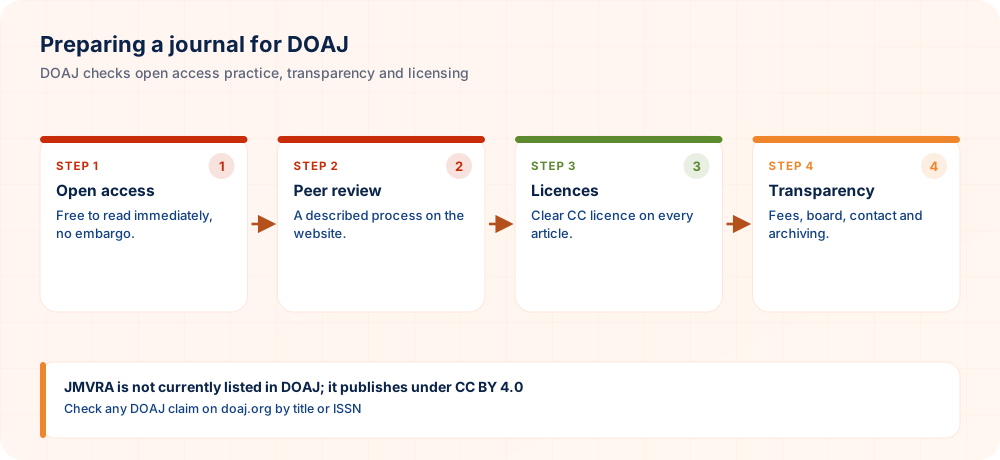
DOAJ Inclusion Criteria
Open access
Complete access straight away, without any paywall for readers or embargo.
Active publication
A real and continuing record of publishing instead of one trial issue.
Peer review
A recorded, authentic editorial review for each article.
Editorial board
Editors who are named and identifiable rather than an unnamed team.
Licensing & copyright
Plain terms stating who owns copyright and what readers are allowed to do with the work.
Fee disclosure
Every author fee disclosed openly in advance, with no surprises.
Archiving
An arrangement to preserve published content over the long term.
Transparency
Genuine details of ownership, management and contacts, stated publicly.
Plagiarism policy
A described procedure for screening manuscripts that are submitted.
DOAJ Readiness Checklist
- Complete open access from the moment of publication, with no paywall for readers
- A registered ISSN that corresponds to the journal's precise title
- A peer-review policy that is public and well documented
- An editorial board listed by name, with affiliations that can be checked
- Copyright and licensing terms spelled out on the website
- Every author fee disclosed in full and in the open
- A declared plan for archiving and preserving published issues
- The true publisher name, address and contact details
- A steady and recent record of publishing
- A public policy on screening for plagiarism
Common Rejection Risks
| Gap | The reason DOAJ cares |
|---|---|
| Peer-review process not documented | DOAJ has no way to confirm that the journal really reviews its content |
| Licensing absent or unclear | Neither readers nor authors can see what reuse is allowed |
| Fees that are hidden or not disclosed | Goes directly against the transparency requirement of DOAJ |
| An editorial board that is anonymous or cannot be verified | Weakens trust in the editorial governance |
| Inconsistent publication history | Casts doubt on whether the journal is truly active |
Submit Your Paper to JMVRA
The journal is peer-reviewed and open access, with ISSN 2984-8911. Go through the present call for papers and then submit.
Submit Paper Online Call for PapersCommon Search Terms
Evaluating an Open Access Journal Against a DOAJ-Style Checklist
Whether you are an editor preparing a directory application or an author judging a venue, the same transparency habits apply. These tips turn the readiness checklist into everyday questions.
- Read the editorial board page. Look for named editors with institutional affiliations and verifiable profiles. A board made of unnamed or unreachable people is a warning sign for any open access title.
- Locate the licence statement. A trustworthy open access journal states clearly which licence applies to articles and shows it on each paper. Missing or contradictory licence wording usually signals careless management.
- Check fee disclosure early. Fees should be written on the journal website before you submit, with the stage at which they are charged. Surprises after acceptance suggest the journal is not being open with authors.
- Look for an archiving plan. Ask where articles are preserved if the website disappears. A journal that names a preservation arrangement shows long-term responsibility toward the scholarly record.
- Test the peer review description. Read the stated review process and compare it with how quickly decisions arrive. Descriptions of careful review combined with very instant acceptance should make you cautious.
A journal that is open about its board, licence, fees, review and archiving has already done most of what a directory expects.
Preparing the Application
- Publish every policy openly — review, fees, licence, archiving
- Demonstrate a publishing history — issues at regular intervals
- Name a genuine editorial board — including affiliations
- Verify the licence is shown — on each article
- File the application — and answer any questions
Following Acceptance by DOAJ
Keep information current
Tell DOAJ whenever policies are altered.
Deposit metadata
Send article metadata to DOAJ.
Maintain standards
DOAJ is able to delist journals.
Display accurately
Represent your DOAJ listing truthfully.
Questions Researchers Often Ask
What is DOAJ?
The Directory of Open Access Journals is a curated directory listing quality peer-reviewed open-access journals from every subject and country.
What is the way for a journal to apply to DOAJ?
By completing the online application on DOAJ itself, showing that the journal meets its criteria for open access, peer review, editorial practice and transparency.
Which inclusion criteria does DOAJ use?
These include an active publishing record, complete and immediate open access, documented peer review, a named editorial board, clear licensing, fees that are disclosed, a policy for archiving, and open information on ownership and contacts.
Is open access a DOAJ requirement?
Yes — DOAJ lists only journals that give complete, immediate open access without a paywall for readers.
May a newly launched journal apply to DOAJ?
Yes, although DOAJ normally looks for an active publishing record and proof that the journal really works the way it says.
How much does peer review count for DOAJ?
It is central, as DOAJ requires a real editorial review process that is documented.
Will having an ISSN ensure DOAJ acceptance?
No — it is just one identifying detail among the whole set of transparency and open-access criteria that are checked.
Is JMVRA included in DOAJ?
Look up a journal's DOAJ status on doaj.org itself rather than accepting what the journal says.
Is JMVRA in DOAJ?
No. DOAJ does not index JMVRA.
Is it possible for DOAJ to delist a journal?
Yes, once it stops meeting the criteria.
Key References
At-a-Glance Checklist
- Licence shown on articlesCC BY or a similar one
- Fees statedEven when there are none
- Review explainedShown on the website
- Archiving organisedPreservation for the long term
- Truthful applicationEach answer can be checked
Where JMVRA Appears — With Current Figures
See whether Google Scholar covers the journal in one minute
- Search the titleCopy the article’s full title into Google Scholar.
- Source search:Enter
source:"Journal Name"to list a journal’s papers. - Visit the profileRead the journal’s citation profile, if one has been created.
The Indexing & Discovery page carries links to all the records above (figures as of 30 Sep 2026).
Ready to Publish? Submit to JMVRA
JMVRA is aligned with UGC's Suggested Parameters for Choosing Peer-Reviewed Journals.
JMVRA is a Transparent, Peer-Reviewed, Open Access Journal (Refereed Journal). Following the discontinuation of the UGC and UGC-CARE journal listing, and in alignment with the latest UGC-CARE recommendations and guidelines, JMVRA is aligned with UGC’s Suggested Parameters for Choosing Peer-Reviewed Journals.
Pages worth visiting on jmvra.org
Key Terms
Subjects and search phrases this article addresses.
Related Reading
Further reading on the same theme from the JMVRA blog.
JMVRA's Transparency Statement in Practice
Read the guide RelatedHow Web of Science Evaluates a Journal
Read the guide RelatedWhy Journal Article Metadata Matters: Title, Authors, Abstract, DOI and References
Read the guide RelatedJMVRA Recognition, Associations & Indexing
Read the guide RelatedWriting an Abstract Editors Accept
Read the guide RelatedIndexing & Abstracting
Read the guideKeep Reading on the JMVRA Blog
As part of the JMVRA journal blog, this guide shares practical help on publishing, indexing, metrics and research integrity, and is written to be verifiable rather than promotional.