
Quick answer: To get into Web of Science, a journal is submitted via Clarivate's Publisher Portal and assessed against 28 published criteria: 24 on quality (peer review, editorial governance, publisher transparency, significance of content) and 4 on citation impact. Clarivate alone decides whether a title is covered and which index it joins.
Web of Science coverage cannot be guaranteed by any service. Regard such a promise, whoever makes it, as a warning sign and not as an advantage.
Understanding What Web of Science Is
Web of Science (WoS) is a citation database run by Clarivate Analytics; through its Core Collection it indexes scholarly journals in many disciplines and offers tools to follow citation data, impact factors and research influence.
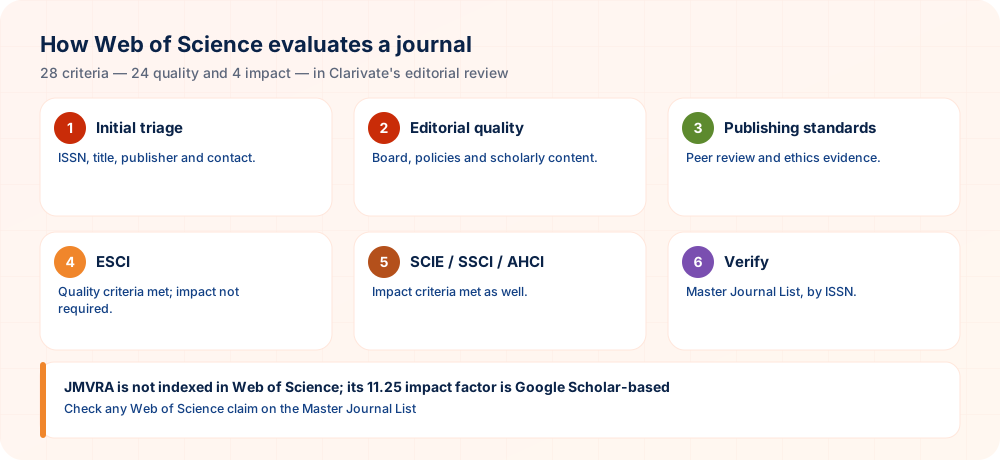
28 Criteria: 24 for Quality and 4 for Impact
24 quality criteria
These look at how rigorous and transparent peer review is, who sits on the editorial board and what expertise they have, whether publisher and contact details are authentic, how good and accessible the website is, compliance with ethical publishing standards, and how significant and readable the published content is. Reading Clarivate's published criteria before applying shows where a journal's records are thin.
4 impact criteria
These measure citation activity using Clarivate's own citation analysis, showing how the journal's content is genuinely used and cited in the wider literature.
Comparing ESCI, SCIE, SSCI and AHCI
SCIE
Science Citation Index Expanded — covers the sciences.
SSCI
Social Sciences Citation Index — covers the social sciences.
AHCI
Arts & Humanities Citation Index — covers arts and humanities.
ESCI
Emerging Sources Citation Index — editorial quality standards are met, while a citation record is still developing.
Each of the four genuinely belongs to "Web of Science", yet they are separate tiers with differing selectivity. Find out exactly which collection a claim refers to, and never take "Web of Science indexed" as one undifferentiated fact. Writing down the collection name alongside the claim keeps comparisons honest.
Verifying Web of Science Coverage Step by Step
- Open the Clarivate Master Journal List (mjl.clarivate.com).
- Look the journal up by its name or ISSN.
- See which collection actually lists it (SCIE, SSCI, AHCI or ESCI), and make sure the publisher is the same.
Submit Your Paper to JMVRA
This journal is peer-reviewed and open access, with ISSN 2984-8911. Check every claim on our site using the method you learned in this guide, then submit.
Submit Paper Online Call for PapersCommon Search Terms
Reading Web of Science Claims Critically as an Author
Many authors meet journals that boast of being covered by a major citation database. These habits help you test such statements calmly before you commit your manuscript.
- Search the database directly. Never rely on a logo or a badge on a journal homepage. Open the database's own journal search yourself and look for the exact title and ISSN.
- Match the ISSN carefully. Cloned sites often copy a real title but print a different ISSN. Compare the number on the journal site with the one in the official record, digit by digit.
- Know which list you are reading. A journal can sit in a broader emerging list without being in a core collection. Read the exact name of the collection stated, rather than the general phrase used in advertising.
- Ask what the claim supports. Coverage of a journal does not prove that any single article is of high quality. Judge your own paper's fit by reading recent articles, their rigour and their reviewing standards.
- Keep a screenshot for your records. Save the page showing the journal's entry, with the date visible, in your submission folder. It helps if your department or funder later asks how you verified the venue.
Verify any coverage claim yourself, at the source, using the exact title and ISSN, before you rely on it for a career decision.
Understanding ESCI
Emerging Sources Citation Index
Journals that satisfy the quality criteria.
Impact Factor
JCR now assigns JIFs to ESCI journals.
Institutional treatment
ESCI is valued differently by certain institutions.
Verification
The Master Journal List reveals the index.
Steps Journals Can Take Prior to Applying
- Keep a regular schedule — free of delays
- Uphold robust peer review — and keep records
- Provide metadata fully in English — titles, abstracts, references
- Demonstrate global diversity — among authors and board members
Questions Researchers Often Ask
How can a journal be submitted to Web of Science?
Via Clarivate's Web of Science Publisher Portal, in which the publisher provides details of the journal and its content for evaluation. The evaluation itself cannot be bypassed.
Which criteria does Web of Science apply to journals?
There are 28 criteria altogether, made up of 24 for quality and 4 for impact, and they address peer review, the editorial board, publisher details, content significance and citation analysis.
What is ESCI?
The Emerging Sources Citation Index is a collection for journals that satisfy editorial quality standards but lack the citation record that SCIE, SSCI or AHCI require.
How do SCIE, SSCI and AHCI differ from each other?
These are distinct Web of Science citation indexes divided by subject: SCIE handles the sciences, SSCI the social sciences and AHCI the arts and humanities.
In what way does Clarivate assess journals?
By a staged process that judges quality criteria and impact criteria drawn from citation analysis, after which it decides on coverage and index placement.
How can I confirm Web of Science coverage?
Look the journal up by name or ISSN in the Clarivate Master Journal List and see which collection actually carries it.
Is JMVRA indexed in Web of Science?
Confirm the status of any journal in the same manner, using the Clarivate Master Journal List with its title or ISSN, instead of relying on the journal's own claim.
Do ESCI journals get an impact factor?
Clarivate has added ESCI journals to JCR, complete with Journal Impact Factors.
Does Web of Science include JMVRA?
No. JMVRA appears in Google Scholar but not in Web of Science.
Key References
At-a-Glance Checklist
- Criteria studiedAll 28
- Index specifiedESCI, SCIE, SSCI or AHCI
- MJL checkedBy ISSN
- JIF taken only from JCRNever from advertisements
- Truthful statusDeclared on the journal website
Where JMVRA Appears — With Current Figures
Google Scholar coverage check in one minute
- Type the titleEnter the whole article title in the Google Scholar search bar.
- Limit by source:Employ
source:"Journal Name"to see articles from one journal only. - Check the profileVisit the journal’s citation profile where it exists.
Links for each record above are given on the Indexing & Discovery page (figures as of 30 Sep 2026).
Ready to Publish? Submit to JMVRA
JMVRA is aligned with UGC's Suggested Parameters for Choosing Peer-Reviewed Journals.
JMVRA is a Transparent, Peer-Reviewed, Open Access Journal (Refereed Journal). Following the discontinuation of the UGC and UGC-CARE journal listing, and in alignment with the latest UGC-CARE recommendations and guidelines, JMVRA is aligned with UGC’s Suggested Parameters for Choosing Peer-Reviewed Journals.
Further reading on jmvra.org
Key Terms
Subjects and search phrases this article addresses.
Related Reading
Further reading on the same theme from the JMVRA blog.
Article Metadata: What the Title, Authors, Abstract, DOI and References Are For
Read the guide RelatedPreparing a Journal for DOAJ: Readiness Checklist
Read the guide RelatedIndexing & Abstracting
Read the guide RelatedJournal Indexing in Plain Language
Read the guide RelatedHow Papers Get Into Google Scholar (and Why Some Don't)
Read the guide RelatedWhy Is JMVRA's Impact Factor 11.25? Google Scholar H-Index Explained
Read the guideKeep Reading on the JMVRA Blog
This article sits on the JMVRA journal blog, where practical guidance covering publishing, indexing, metrics and research integrity is written to be verifiable, not promotional.