
A frank account of what JMVRA's Impact Factor really measures, why a value based on Google Scholar often comes out higher than a Scopus or Web of Science figure for the same body of work, and what JMVRA's indexing position truly is today.
What Is Meant by "Impact Factor Details"?
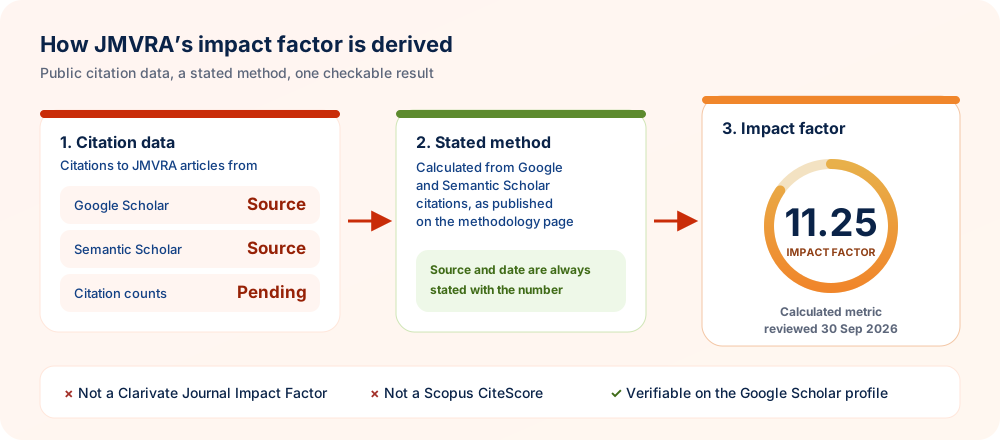
JMVRA's Impact Factor of 11.25 is a calculated metric based on citations from Google Scholar and Semantic Scholar across a two-year citation window. It is neither a Clarivate Journal Citation Reports (JCR) Impact Factor nor a Scopus CiteScore.
- Built on citation counts recorded by Google Scholar and Semantic Scholar
- Worked out over a two-year citation window and refreshed every year
- Counts self-citations, as most citation-based indices normally do
- Should always be quoted as a "Google Scholar-based Impact Factor" and never as a bare "Impact Factor"
- Is a truly calculated metric, not a made-up or arbitrary number
- Measures something other than a JCR Impact Factor and cannot be compared with it directly
The Reason Google Scholar-Based Metrics Often Appear Higher
JMVRA is not alone in this — it is a well-documented pattern throughout academic publishing. Google Scholar and Clarivate/Scopus count citations in very different ways.
A Much Wider Range of Sources
Google Scholar crawls preprints, theses, conference papers, institutional repositories and grey literature, which is far more than the selective, curated lists behind JCR and Scopus. When more sources are counted, more citations turn up. Keep this in mind when you compare figures from different systems.
No Tight "Citable Items" Denominator
The JCR Impact Factor divides citations by a narrowly defined number of "citable items" across exactly two years. Metrics built on Google Scholar do not use that restrictive denominator, and this usually yields larger numbers.
Different Citation Windows
Citation windows and update frequency differ according to methodology, so identical underlying citation activity can give different index values in Google Scholar, Scopus and Web of Science.
Self-Citation Treatment
Databases handle author self-citations differently; counts based on Google Scholar usually include them, which can lift the value above that from more conservative curated databases.
Open, Automated Indexing
Google Scholar's index is assembled automatically and openly, without the manual, multi-year editorial evaluation that Scopus and Web of Science carry out before they admit a journal at all — and this affects what is counted as a "citation" and which journals show up.
Genuinely Accumulated Citations
None of this means the number is invented — it means the number measures real citation activity, only through a wider and less restrictive lens than the one JCR or Scopus use.
How JMVRA's Citation Base Has Expanded Over Time
- JMVRA has published without interruption since June 2023, so every monthly issue adds to the back-catalogue that can gather citations
- Having Growing articles in print offers other researchers a substantial body of work to cite
- Articles reach researchers across Global countries, increasing the pool of potential citing authors
- Open access with CC BY 4.0 licensing takes away the paywalls that would otherwise hold back citations of an article
- A multidisciplinary scope lets articles be found through a wider variety of search queries and fields
- An archive that is larger, older and openly accessible will naturally collect more citations than a brand-new journal — this is true of any journal and not only JMVRA
Is JMVRA Indexed in Scopus, Web of Science, or DOAJ?
No — and JMVRA says so openly instead of allowing a high Google Scholar-based number to give a false impression.
Scopus
JMVRA is not indexed in Scopus (Elsevier) at present.
Web of Science
JMVRA is not indexed in Web of Science (Clarivate) at present.
DOAJ
At present, the Directory of Open Access Journals does not list JMVRA.
JMVRA's indexing covers Google Scholar, Semantic Scholar, Crossref, ResearchGate, Academia.edu, CiteSeerX, Mendeley, BASE and WorldCat. For fuller details, open the Indexing & Abstracting page.
Impact Factor Sources Compared
| Metric Source | Who Runs It | Typical Coverage | Typical Value Pattern |
|---|---|---|---|
| JCR Impact Factor | Clarivate | Curated, selective journal list | Generally lower — strict 2-year "citable items" denominator |
| Scopus CiteScore | Elsevier | Curated, selective journal list | Generally lower to moderate — 4-year window, curated source base |
| DOAJ Listing | DOAJ (non-profit) | Directory of open access journals | Not an impact factor — a directory of quality and openness, with no numeric score |
| Google Scholar-Based (JMVRA's IF) | Google Scholar / Semantic Scholar data | Very wide — preprints, theses, repositories, grey literature | Frequently higher — larger source pool, no strict citable-items denominator |
This table gives a general account of how these metrics differ in method — it does not suggest the exact figures of any particular journal.
Journal Impact Factors Explained — A Complete and Candid Guide
Hardly any number in academic publishing causes as much confusion, and as much justified doubt, as "Impact Factor." Authors notice a journal advertising a high figure and fairly ask whether it is genuine, and why it differs so much from what they have seen for well-known Scopus or Web of Science journals. This guide answers that question frankly for JMVRA in particular, and sets out the wider bibliometric background so that any researcher can assess a journal's claimed metrics critically — for JMVRA or for any other journal. Whenever a figure is quoted, the first thing to find out is who calculated it and how.
A Brief History of "Impact Factor"
Eugene Garfield proposed the original Impact Factor idea in the 1960s, as a way of helping librarians decide which journals to subscribe to, using the average number of citations per article over a set period. The Institute for Scientific Information (ISI) formalized it; that body was later bought by Thomson Reuters and then by Clarivate, and today the figure is released every year in the Journal Citation Reports (JCR). The JCR Impact Factor is computed for a strictly curated set of journals in the Web of Science Core Collection, with a fixed formula: citations in a given year to articles from the two preceding years, divided by the number of "citable items" published in those two years.
Importantly, an official JCR Impact Factor goes only to journals admitted to Clarivate's own curated index after a long and selective editorial evaluation. Most academic journals in the world, including many long-established, legitimate, peer-reviewed titles, have no JCR Impact Factor, simply because they were never assessed for or admitted to that particular list. Lacking one is not, in itself, a sign of poor quality — it reflects Clarivate's selective rules for inclusion.
Scopus and CiteScore
Elsevier's Scopus database operates a parallel selection process of its own, curated separately, and publishes a metric of its own, CiteScore, which is calculated across a four-year citation window against Scopus's own curated journal list. As with JCR, getting into Scopus requires a formal application and editorial review, and CiteScore values, although computed differently from JCR's Impact Factor, are likewise limited by Scopus's own selective coverage.
The Place of Google Scholar Metrics
Google Scholar works in a basically different way. It does not curate a fixed list of "approved" journals; it crawls scholarly material automatically and indexes it wherever it is found — journal websites, institutional repositories, preprint servers, conference proceedings, thesis and dissertation repositories and more. With this automated, non-selective method, Google Scholar's citation counts typically come from a much larger and more varied set of citing documents than JCR or Scopus take into account. If a citation-based metric (such as an H-index or a Google Scholar-derived "Impact Factor") is computed from this wider set, and lacks JCR's specific "citable items only, exactly two years" denominator rule, the result is very often higher than the matching JCR or Scopus figure for similar citation activity. The difference is structural and methodological — it does not show that either number is "wrong." Understanding this saves you from drawing hasty conclusions when two figures differ.
The H-Index Concept
Physicist Jorge Hirsch introduced the H-index in 2005; it captures productivity and citation impact together: a journal (or author) has an H-index of h if h of its articles have each received at least h citations. Through its "Google Scholar Metrics" feature, Google Scholar brought H-index-style metrics into wide use at journal level, and many journals — JMVRA among them — publish a Google Scholar-derived figure built on the same citation-counting idea, adapted into an "Impact Factor" style number that is recalculated each year, for simpler comparison and for listing on a CV.
The Importance of Citing a Journal's Impact Factor Correctly
Since these are truly different measurements, accurate labeling is important. When an author lists "Impact Factor Details" on a CV with no qualification, an evaluator who knows JCR conventions might reasonably take it to mean a JCR Impact Factor, and then run into a mismatch on failing to find the journal in JCR. That is precisely why JMVRA's own policies (see the Impact Factor policy and Disclaimer) tell authors expressly to describe it as a "Google Scholar-based Impact Factor" each time they cite it — the qualifier separates an honest, verifiable claim from a misleading one.
UGC CARE Is Distinct From Scopus, WoS, or DOAJ
It is a frequent mistake to assume that UGC CARE recognition means Scopus or Web of Science indexing, or the reverse. It does not. UGC CARE (Consortium for Academic and Research Ethics) judged journals by criteria of its own — valid ISSN, transparent peer review, disclosure of the editorial board, an anti-plagiarism policy, and others — wholly apart from the commercial indexing decisions of Clarivate or Elsevier. For JMVRA, the relevant statement is alignment with UGC's Suggested Parameters for Choosing Peer-Reviewed Journals. JMVRA does not hold, and does not claim, Scopus, Web of Science or DOAJ status, and authors weighing JMVRA against a particular institutional requirement should find out exactly which recognition that requirement demands.
Ways to Assess Any Journal's Claimed Impact Factor
- Work out who is behind the number: Clarivate (JCR), Elsevier (Scopus), or a separate calculation drawing on Google Scholar
- Look the journal up yourself in the Journal Citation Reports or the Scopus Sources list, and do not simply accept a number the journal reports about itself
- Search for the exact qualifying label — "Google Scholar-based," "JCR," or "CiteScore" — and be wary of a plain "Impact Factor"
- Bear in mind that UGC CARE recognition, DOAJ listing, and Scopus/WoS indexing are three distinct and independent matters, each with different criteria
- Be just as doubtful about unusually high and suspiciously exact numbers that come with no stated methodology — a journal ought to be able to explain, as this page does, exactly how its number was worked out
JMVRA's Position in Plain Terms
JMVRA's Impact Factor of 11.25 is a calculated metric based on citations from Google Scholar and Semantic Scholar to articles published since June 2023; the method is explained on Impact Factor Details. It is not an official Clarivate Journal Impact Factor (JCR), not a JCR Impact Factor and not a Scopus CiteScore, and JMVRA is not at present indexed in Scopus, Web of Science or DOAJ. As a matter of policy, JMVRA keeps up the editorial and ethical standards that these bodies assess — transparent peer review, COPE-based ethics, ISSN registration and open access licensing — whether or when formal indexing in those databases is achieved. Authors are encouraged to cite the figure precisely, as a Google Scholar-based Impact Factor, and to verify any indexing claim for themselves — about JMVRA or any journal — before relying on it for a particular institutional requirement.
Wording That Is Right and Wording That Is Wrong
| Correct | Incorrect |
|---|---|
| Impact factor 11.25 (calculated from Google Scholar data) | Clarivate impact factor 11.25 |
| Google Scholar indexed | Scopus or Web of Science indexed |
| Crossref DOI provided when requested | DOI indexing |
Using the Figure Responsibly
Name the source
State how it was worked out, every time.
Compare similar things only
Use metrics from one source only.
Do not overstate
It is not a JIF.
Look at the papers
Quality lies in the articles themselves.
Reading Impact Factor Claims Critically Before You Rely on Them
Journal metrics come from different sources and methods, which makes headline numbers hard to compare. Applying a few simple questions will help you interpret any such claim fairly.
- Find who calculated it. Look for the organisation and data source behind a figure. A number without a named method cannot be compared with values from established citation databases.
- Check the period covered. Metrics usually describe a particular window of citations. Make sure you understand which publication years and citation dates the figure refers to.
- Never mix different metrics. Do not place values from separate systems in one ranking. They measure different things using different collections of documents.
- Describe numbers accurately. When you mention a metric in a report or application, name its source in the same sentence. Precise wording protects your credibility.
- Prefer article-level evidence. A journal average says little about your own paper. Look at the citations, usage and reception of individual articles, and at the quality of review.
Always ask who produced a metric, what it covers and how it was calculated, and name that source whenever you quote it.
Questions Researchers Often Ask
Why does the Impact Factor Details of JMVRA look higher than that of many Scopus or Web of Science journals?
JMVRA's Impact Factor of 11.25 is a calculated metric based on citations from Google Scholar and Semantic Scholar, not an official Clarivate Journal Impact Factor (JCR) or a Scopus CiteScore. Google Scholar indexes a far wider range of sources and has no strict two-year citable-item denominator like JCR, so metrics based on Google Scholar are commonly higher for the same body of work across academic publishing generally. Always keep the source of a metric in mind before comparing two numbers.
Does a Google Scholar-based Impact Factor count as a real metric?
Yes, it is a truly calculated citation metric, although it measures something other than a JCR Impact Factor. When it is quoted, it must always be labeled a Google Scholar-based Impact Factor.
Does Scopus index JMVRA?
No. JMVRA is not indexed in Scopus at present. It keeps up editorial and ethical standards in line with what Scopus assesses, but it has not been formally admitted to the Scopus database.
Does Web of Science index JMVRA?
No. JMVRA is not indexed in Web of Science (Clarivate) at present. It is indexed in Google Scholar, Semantic Scholar, Crossref, ResearchGate and a number of other open academic databases.
Does DOAJ list JMVRA?
No. The Directory of Open Access Journals (DOAJ) does not currently list JMVRA, even though the journal operates as fully open access with a CC BY 4.0 licence, which matches DOAJ's open access requirements.
Is Scopus or Web of Science indexing a requirement for UGC CARE approval?
No. UGC CARE listing is one thing and Scopus/Web of Science indexing another; each stands alone and uses different criteria. Peer review does not depend on being indexed in Scopus, Web of Science or DOAJ.
Why does JMVRA have a comparatively high citation count?
JMVRA has published monthly without a break since June 2023, and each open access issue adds articles that other researchers can cite. Its citation count and h-index are shown on JMVRA's pages only once verified, and you can check them yourself on JMVRA's Google Scholar profile.
In what way should I cite JMVRA's Impact Factor on my CV?
Name it every time as a "Google Scholar-based Impact Factor" and not a bare "Impact Factor," so that evaluators grasp correctly which metric and methodology is meant.
May I put “IF 11.25” on my CV?
You may, as long as you add a remark that Google Scholar data was used for the calculation.
Is JMVRA found in Journal Citation Reports?
No. JMVRA is not indexed in Web of Science.
Publish at JMVRA With Complete Transparency
UGC Status & Parameters · Google Scholar-Based Impact Factor 11.25 · Affordable publication charges · ISSN 2984-8911
[email protected] · +91 91063 65667
Snapshot of JMVRA Citation Metrics
An impact factor is measured for the journal-level, whereas an h-index can refer to a journal or to an author. The 11.25 figure is a calculated metric based on citations from Google Scholar and Semantic Scholar, not an official Clarivate Journal Impact Factor (JCR). Citation counts and the h-index are shown here only once verified; meanwhile you can check them on the journal’s Google Scholar profile.
At-a-Glance Checklist
- Source givenGoogle Scholar data behind JMVRA’s 11.25
- Window givenThe years that are counted
- Not a Clarivate JIFDo not present it as one
- Check itOpen the Google Scholar profile for yourself
Ready to Publish? Submit to JMVRA
JMVRA is aligned with UGC's Suggested Parameters for Choosing Peer-Reviewed Journals.
JMVRA is a Transparent, Peer-Reviewed, Open Access Journal (Refereed Journal). Following the discontinuation of the UGC and UGC-CARE journal listing, and in alignment with the latest UGC-CARE recommendations and guidelines, JMVRA is aligned with UGC’s Suggested Parameters for Choosing Peer-Reviewed Journals.
Further reading on jmvra.org
Key Terms
Subjects and search phrases this article addresses.
Related Reading
Further reading on the same theme from the JMVRA blog.
Why JMVRA Follows Scopus Journal Indexing Standard — Quality Without Compromise at ₹971 INR
Read the guide RelatedPreparing a Journal for DOAJ: Readiness Checklist
Read the guide RelatedWriting an Abstract Editors Accept
Read the guide RelatedHow Web of Science Evaluates a Journal
Read the guide RelatedIndexing & Abstracting
Read the guide RelatedIs JMVRA in Line with Scopus & Web of Science Standards? The Honest Answer
Read the guide From the blogJournal Impact Factor vs Google Scholar Metrics
Read the article From the blogJMVRA Key Facts — ISSN, Impact Factor, Current Issue and Fees
Read the article From the blogDiscovering Quality Journals: What Every Claim Actually Demonstrates
Read the articleKeep Reading on the JMVRA Blog
This article sits on the JMVRA journal blog, where practical guidance covering publishing, indexing, metrics and research integrity is written to be verifiable, not promotional.