
Academic publishing is a crowded field, and researchers keep looking for journals that combine quality, low cost and recognition. Many people believe that only journals indexed in Scopus uphold high editorial standards, but the reality is subtler: following Scopus Journal Indexing Standard matters far more for your research than whether a journal is indexed. Asking which practices a journal actually follows is a sensible habit before you submit.
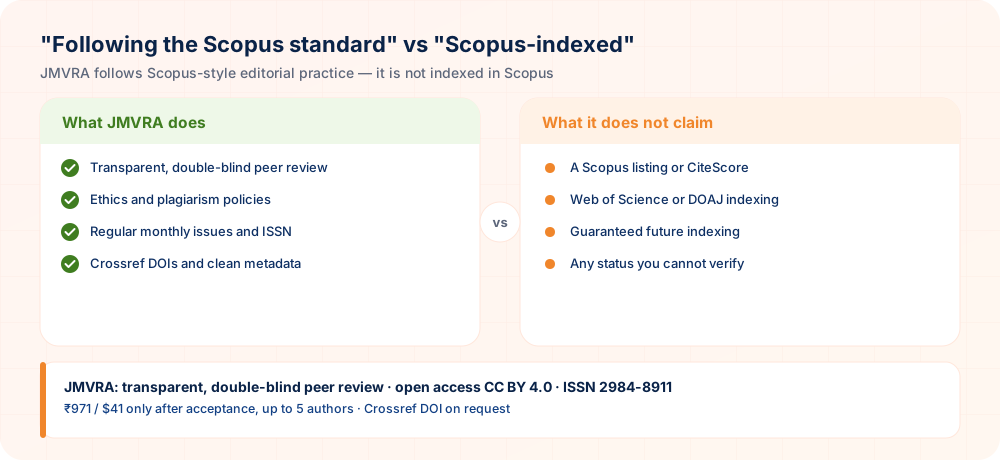
JMVRA and its two network journals, TIJER (TIJER – International Research Journal) and JNRID (Journal of Novel Research and Innovative Development), carefully adhere to the Scopus Journal Indexing Standard protocols and provide Low Cost Journal Publication — ₹971 INR at JMVRA and ₹970 at TIJER and JNRID for Indian authors. In practice, authors receive editorial practice benchmarked against international norms for a small share of the usual publishing cost.
This article sets out what the Scopus Journal Indexing Standard involves, the reason it counts for more than present indexing status, the way our journals put these standards into effect, and how that helps researchers looking for UGC Status & Parameters Journal Publication, Peer Review Journal Publication, Crossref DOI, and High Impact Factor potential. Read each section with your own institution's requirements in mind.
Peer review, together with adherence to UGC's 2025 suggestive parameters.
Important Clarification
- At present, JMVRA and its partner journals are NOT indexed in Scopus.
- Our practice follows the protocols of the Scopus Journal Indexing Standard.
- So we uphold the very quality benchmarks that Scopus demands.
- We keep working toward Scopus indexing as a goal for the long term.
- Meanwhile, we are UGC Status & Parameters and Google Scholar indexed.
- Above all, this quality comes at Affordable publication charges.
Understanding Scopus and the Scopus Journal Indexing Standard
To see why following the Scopus Journal Indexing Standard is important, first make clear what Scopus really is and which standards it expects of a journal.
Understanding Scopus
Scopus, owned and run by Elsevier, is the largest abstract and citation database in the world. Its coverage spans tens of thousands of journals in every major academic field, and it is commonly used for evaluating research, ranking universities and producing Impact Factor–style metrics. It is also very selective: most journals that apply for indexing are turned down, at least at the first review.
Scopus Journal Indexing Standard — Main Requirement Categories
Before a journal can even be considered for Scopus indexing, it has to show strength in eight broad categories:
- Peer Review Excellence — a thorough and open review process, qualified independent reviewers, and recorded timelines.
- Editorial Quality — a competent editorial board whose expertise fits the journal's scope, headed by an Editor-in-Chief with proper credentials.
- Content Quality — original research, sound methodology, clear abstracts and keywords, and thorough referencing.
- Publishing Ethics — adherence to COPE (Committee on Publication Ethics), measures against plagiarism, authorship policies, and disclosure of conflicts of interest.
- Regular Publication — a steady schedule with a minimum article volume and no delays left unexplained.
- Online Presence & Accessibility — a working, professional website offering full-text access, tidy archives and submission details.
- Journal Identification — a valid ISSN registration, Crossref DOI and full bibliographic metadata.
- Citation Potential — relevant research, an international readership, and a real contribution to scientific discussion.
Why Following Standards Counts for More Than Present Indexing
- Being indexed in Scopus is a consequence of quality, not a precondition for it.
- Adhering to the Scopus Journal Indexing Standard makes research meet international benchmarks today.
- Plenty of excellent journals observe these standards while they work toward indexing.
- UGC Status & Parameters Journal Publication values many of these same standards.
- Pairing standards with Affordable publication charges puts quality within reach.
How Our Journals Apply Scopus Journal Indexing Standard
JMVRA and its two network journals, TIJER and JNRID, carefully put the Scopus Journal Indexing Standard protocols into practice. The three journals in the network are listed below, with the way each one upholds these benchmarks:
| Journal | ISSN / Established | Fee | Standard Compliance |
|---|---|---|---|
| JMVRA Journal of Modern and Versatile Research Approach This journal · jmvra.org | ISSN 2984-8911 Est. June 2023 Impact Factor 11.25 (calculated by Google Scholar) | ₹971 INR / $41 USD | Peer Review · Editorial Board · Crossref DOI · Monthly Issues |
| TIJER TIJER – International Research Journal tijer.org | ISSN 2349-9249 Est. 2014 High Impact Factor | ₹970 / $50 | Peer-Reviewed (Refereed) · Crossref DOI · Monthly Issues · Metadata |
| JNRID Journal of Novel Research and Innovative Development jnrid.org | ISSN 2984-8687 Est. 2023 High Impact Factor | ₹970 / $50 | Peer-Reviewed (Refereed) · Crossref DOI · Monthly Issues · Metadata |
Submit to JMVRA through submitpaper.php; TIJER and JNRID papers go through researchwave.org/researchwave_jmvra.html. All three are multidisciplinary, open access and published monthly, so the table is less about which journal is "better" and more about which fee, publishing history and submission route suit you. Before paying any of them, open the ISSN record on portal.issn.org and check that the title and website match what you were sent.
Because every aspect of the Scopus Journal Indexing Standard is applied across the network, JMVRA makes sure a Low Cost Journal Publication at ₹971 INR (or ₹970 at TIJER and JNRID) still meets international benchmarks: the discount is on price, never on quality.
Detailed Standard Implementation
1. Thorough Peer Review Journal Publication
- Subject-matter experts drawn from a panel of 3,000+ reviewers screen and review every paper.
- Open double-blind review keeps authors and reviewers objective toward one another.
- Authors receive well-defined evaluation criteria along with detailed feedback.
- The usual time from review to decision depends on how available reviewers are.
2. Competent Editorial Structure
- Board members come from several institutions, with subject expertise that fits each journal's scope.
- The Editor-in-Chief supervises every manuscript that is accepted.
- Each journal has plain, published editorial policies.
3. Ethical Publishing & COPE Compliance
- Plagiarism checks with Turnitin and iThenticate are compulsory before a paper moves on to review.
- Defined policies on authorship and the disclosure of conflicts of interest.
- Procedures for corrections and retractions that follow COPE (Committee on Publication Ethics) guidance.
4. Monthly Publication on Schedule
- JMVRA has published monthly, without a break, since June 2023.
- Archives are kept in good order, with clear volume and issue numbers.
- The partner journals observe the same steady publishing discipline.
5. Professional Web Presence
- Working, mobile-friendly websites that give full-text access to articles.
- Plain submission guidelines, author information and contact details.
- Past issues sit in archives that are easy to browse.
6. Correct Identification & Metadata
- Every journal in the portfolio holds a valid ISSN registration.
- A Crossref DOI can be requested for each published article.
- Full bibliographic metadata, including author affiliations, keywords and English abstracts.
7. Standards for Content Quality
- Research must be original and clearly structured: Introduction, Methods, Results, Discussion, Conclusion.
- Sufficient references, and figures and tables that are correctly formatted.
- Before review starts, editors screen whether a paper fits the stated scope of each journal.
8. Tracking Citations & Impact
- All journals are actively indexed in Google Scholar.
- Open access widens readership and the chance of being cited.
- A Crossref DOI makes accurate and lasting citation tracking possible.
The Reason We Write "Following Standard" and Not "Scopus Indexed"
Openness lies at the heart of ethical academic publishing. This is the reason we say specifically that our journals follow the Scopus Journal Indexing Standard instead of claiming to be indexed. When you evaluate any journal, notice whether its wording about indexing is precise or deliberately vague.
Standards and indexing are not the same: standards are quality measures that can be adopted right away, whereas indexing is recognition earned after years of demonstrating them. Observing the standard safeguards the quality of your research today, whatever database may eventually list the journal.
| Aspect | Our Journals (Transparent) | Predatory Journals (Deceptive) |
|---|---|---|
| Indexing Claims | Open about present status | Untrue "Scopus indexed" claims |
| Transparency | Standards followed are fully disclosed | Unclear or concealed information |
| Peer Review | Genuine expert reviewers | Sham review, or invented reviewers |
| Cost | Transparent, Affordable publication charges | Charges that are hidden or suspiciously low |
| Editorial Board | Real, qualified academics | Invented names or unauthorised use |
| DOI | Legitimate Crossref DOI | Fake or missing DOI |
Best Value Comes from UGC CARE + International publishing practices
Pairing UGC Status & Parameters Journal Publication status with compliance to the Scopus Journal Indexing Standard gives researchers outstanding value, particularly at Affordable publication charges.
The Importance of UGC CARE for Indian Researchers
- Indian University Recognition — acceptable for PhD submission, faculty promotions and evaluations.
- Ethical Standards — guarantees open peer review, as UGC Parameters Notifications require.
- Academic Validity — counted for NET/SET and API-linked appraisals.
International Recognition Through International publishing practices
- International Quality — worldwide publishing benchmarks are applied to each issue.
- Citation Potential — helps real High Impact Factor growth over time.
- Future-Ready — the journals keep building the publishing record needed for any later Scopus consideration.
The striking difference is price: elsewhere in the market, UGC-parameters alignment together with international publishing practice editorial practice frequently costs ₹5,000–₹15,000. JMVRA and its network journals TIJER and JNRID offer the same rigor starting at ₹970, with none of the standards above compromised.
| Feature | Our Journals (₹970–₹971 INR) | Usual Market Price (₹5,000–₹15,000) |
|---|---|---|
| UGC's Suggested Parameters | Aligned (JMVRA) | Varies |
| International publishing practices | Full Compliance | Varies |
| Peer Review | Expert Panel | Expert Panel |
| Crossref DOI | Available | Included |
| Google Scholar | Indexed | Indexed |
| Publication Cost | ₹971 INR (JMVRA) · ₹970 (TIJER, JNRID) | ₹5,000–₹15,000 |
In Focus: JMVRA, TIJER and JNRID Side by Side
With three journals in the network, the practical question for most authors is not "which one is indexed in Scopus?" (none of them claims that) but "which one fits this particular manuscript?". The parameters below are the verifiable basics for each journal; everything else should be confirmed on the journal's own website before you submit.
| Parameter | JMVRA | TIJER | JNRID |
|---|---|---|---|
| Full name | Journal of Modern and Versatile Research Approach | TIJER – International Research Journal | Journal of Novel Research and Innovative Development |
| ISSN | 2984-8911 | 2349-9249 | 2984-8687 |
| Established | June 2023 | 2014 | 2023 |
| Impact Factor | 11.25 (calculated by Google Scholar) | High Impact Factor | High Impact Factor |
| Publication Fee | ₹971 INR Indian · $41 USD international | ₹970 Indian · $50 international (low cost) | ₹970 Indian · $50 international (low cost) |
| UGC wording | Aligned with UGC's Suggested Parameters for Choosing Peer-Reviewed Journals | UGC CARE Approved, Transparent Peer-Reviewed (Refereed) Journal as per new UGC Notification | UGC CARE Approved, Transparent Peer-Reviewed (Refereed) Journal as per new UGC Notification |
| Scope & frequency | Multidisciplinary, monthly, open access | Multidisciplinary, monthly, open access | Multidisciplinary, monthly, open access |
| Website | jmvra.org | tijer.org | jnrid.org |
| Submit through | submitpaper.php | researchwave.org | researchwave.org |
How to Decide Between the Three
- Fee for Indian authors: ₹970 against ₹971 INR is a one-rupee difference, so price should not drive the choice; scope fit and the papers already published should.
- Fee for international authors: JMVRA's $41 USD is $9 lower than the $50 charged by TIJER and JNRID.
- Publishing history: TIJER has published since 2014, which helps if a committee asks how long a journal has existed; JMVRA (June 2023) and JNRID (2023) are newer.
- Impact factor wording: JMVRA states 11.25 (calculated by Google Scholar), while TIJER and JNRID use the phrase "High Impact Factor". Whatever figure you quote in a CV, say where it comes from.
- Students and first-time authors: any of the three suits a dissertation or project paper; read two or three recent articles in each and pick the closest match.
- PhD scholars and faculty: compare the UGC wording above against your university's current rule, keep a screenshot of the ISSN Portal record, and get written confirmation if your institution keeps its own approved list.
Crossref DOI plus High Impact Factor
Crossref DOI — A Lasting Identity for Research
Each article is given a Crossref DOI (Digital Object Identifier), a unique and permanent alphanumeric code. It does not break, it is recognised worldwide, and it is a core requirement mentioned in the Scopus Journal Indexing Standard. All articles published in JMVRA and its partner journals get one.
- Permanent Citation — your work stays easy to find without a time limit.
- Enhanced Credibility — indicates a legitimate, indexed publication process.
- Citation Tracking — lets you follow the impact of your research as time passes.
- Institutional Recognition — frequently demanded in grant applications and evaluations.
Potential for a High Impact Factor
An Impact Factor expresses the average citations per paper in a set period and reflects how influential a journal is in its field. Our journals encourage real Impact Factor growth by way of:
- Google Scholar indexing, which makes each paper easy to find and cite.
- Open access publishing, which widens readership and the chance of citation.
- Strict peer review, so that only publishable research worth citing is accepted.
- Steady monthly publication, which keeps the content of each journal current and relevant.
At-a-Glance Checklist
- Wording read closelyStandard versus indexed
- Scopus verifiedSearch the Sources list by ISSN
- Practice confirmedPolicies shown on the website
- Institution askedWhat it will accept
- Accurate phrasingIn your own CV
Implications for Your Paper
| Aspect | For you |
|---|---|
| Review | Double-blind review, and comments passed on to you |
| Ethics | Similarity under 15% and policies made public |
| Metadata | Crossref DOI available on request |
| Indexing | Indexed in Google Scholar, but not in Scopus, WoS or DOAJ |
When You Specifically Need Scopus Indexing
- Verify the requirement — get it from your institution in writing
- Search the Scopus Sources list — to locate suitable journals
- Check the journal website — by following the Scopus record
- Choose JMVRA when Google Scholar indexing is enough — for your other papers
Practical Tips for Judging Journals by Editorial Practice
Indexing status can change and is easy to misdescribe, so careful authors look at observable practice as well. These suggestions help you assess any journal's standards without relying on slogans.
- Verify claims at the source. If a journal states that a database lists it, open that database's own search page and look it up directly. Screenshots and badges on a website prove very little.
- Read the review policy closely. Look for a clear description of who reviews, how conflicts are handled and what authors can expect. Vague wording about quick decisions deserves caution.
- Sample the published papers. Read several recent articles for sound methods, clear language and complete references. The quality of what already appears is the best indicator of what editors accept.
- Match the requirement to the goal. If your institution or funder demands a particular listing, confirm that requirement in writing before submitting, so you do not discover a mismatch after publication.
- Document your due diligence. Keep notes of the checks you performed and the date you made them. Should anyone question your choice later, you can show a careful, reasoned process.
Check indexing claims yourself, judge a journal by its visible editorial conduct, and confirm institutional requirements before you submit.
Full FAQ — Scopus Journal Indexing Standard
Q1. What is meant by "following Scopus Journal Indexing Standard"?
Our journals apply the same quality benchmarks that Scopus asks for when it considers a journal for indexing: strict peer review, a qualified editorial board, publishing ethics, correct ISSN/DOI systems and regular publication. These are upheld regardless of whether the journal is indexed at the moment. Such benchmarks are worth checking for any journal you consider, indexed or not.
Q2. Is any of your journals indexed in Scopus at present?
No, and we say so openly. We follow the Scopus Journal Indexing Standard protocols, JMVRA is aligned with UGC's Suggested Parameters for Choosing Peer-Reviewed Journals, and we are indexed in Google Scholar.
Q3. What is the point of following international publishing practices without being indexed?
Observing the standard means research meets international quality benchmarks now, keeps peer review and ethics strict, and builds up the publishing record any future indexing application would need, all with Affordable publication charges for the best value.
Q4. Could following international publishing practices lead to indexing in the end?
Adhering to the standard is the essential first step toward any later Scopus consideration. Before it evaluates a journal, Scopus usually expects several years of steady, high-quality publishing and proven citation impact.
Q5. Does UGC CARE approval carry the same value as Scopus indexing?
Indian researchers often find UGC Status & Parameters Journal Publication more directly useful, because Indian universities specifically recognise it for PhD work, promotions and academic evaluations. Which one matters more ultimately depends on the rules of your own institution or funder.
Q6. May I count these publications toward my PhD?
JMVRA is aligned with UGC's Suggested Parameters for Choosing Peer-Reviewed Journals and runs an open Peer Review Journal Publication process. Universities have mostly accepted UGC CARE publications toward PhD requirements; since UGC discontinued the UGC-CARE list, always verify the current policy of your particular institution.
Q7. How does a ₹971 INR publication manage to keep these standards?
Affordable publication charges are possible thanks to fully digital operations, streamlined editorial workflows and an open-access model; the savings go to authors instead of being collected as profit-maximising fees, and review is never cut short.
Q8. Do any hidden charges apply on top of ₹971 INR?
There are no hidden charges. The fee of ₹971 INR (or the relevant journal's fee) pays for submission, peer review, publication and a digital certificate. Optional extras such as a Crossref DOI or a hard copy certificate carry separate, openly stated prices. Reading the fee page fully before paying is a good habit with any journal.
Q9. How strict is your peer review?
Editorial screening, compulsory plagiarism detection and review by subject-matter experts drawn from a panel of 3,000+ reviewers are applied to every submission, usually completed in a timeline that depends on reviewer availability and accompanied by detailed feedback.
Q10. Is plagiarism checked?
Yes. Turnitin and iThenticate screen each submission before it goes to peer review, forming part of the ethics compliance that the Scopus Journal Indexing Standard expects.
Q11. For what reason is Crossref DOI left out of the base fee?
Crossref membership, DOI registration and continuing metadata upkeep all bring genuine recurring costs. Treating DOI as an optional extra means authors who do not need one pay a lower base publication cost. Decide early whether your institution or funder asks for a DOI, so it is not an afterthought.
Q12. In which places are your journals indexed now?
At present they are indexed in Google Scholar and can be found through Crossref once a DOI has been assigned. They are not listed in Scopus or Web of Science at the moment, and we keep working toward that over time.
Q13. How do JMVRA, TIJER and JNRID differ, and which should I choose?
All three are multidisciplinary, open access, peer-reviewed monthly journals. JMVRA (ISSN 2984-8911, since June 2023) charges ₹971 INR for Indian authors or $41 USD internationally and states an impact factor of 11.25 (calculated by Google Scholar). TIJER – International Research Journal (ISSN 2349-9249, established 2014) and JNRID, the Journal of Novel Research and Innovative Development (ISSN 2984-8687, established 2023), charge ₹970 or $50 and describe themselves as High Impact Factor journals. Indian authors pay almost the same in each, international authors save $9 with JMVRA, and TIJER has the longest publishing record. Choose by fit with recent issues, verify the ISSN on portal.issn.org, and submit to only one journal at a time.
Q14. Is it better to wait for a Scopus-indexed journal or to publish with you now?
That depends on your schedule. With a PhD or promotion deadline close at hand, publishing now in a journal that already follows the standard gets you a quality result without waiting. Many researchers also publish in both kinds of journal during their careers.
Q15. In what way does this differ from a predatory journal?
Predatory journals usually claim indexing falsely, omit real peer review and conceal how they edit. We state our standards in public, admit honestly that we are not currently Scopus-indexed, and supply ISSN details and evidence of alignment with UGC's Suggested Parameters that can be verified.
Q16. Does Scopus index JMVRA?
No. JMVRA keeps to good practices, yet Scopus does not index it.
Q17. What is the reason for mentioning Scopus standards?
They serve as widely accepted benchmarks of editorial practice.
Closing Message & Main Takeaways
As this guide to the Scopus Journal Indexing Standard ends, the key message is simple: the quality of your research and the rigor of the publishing process count for much more than the database that currently lists the journal.
- Standards ≠ Indexing — observing the standard secures quality today, while indexing is recognition that arrives after years.
- Multiple Recognition Pathways — Google Scholar indexing, a Crossref DOI and UGC Status & Parameters standing support one another, all at Affordable publication charges.
- Transparency Builds Trust — we describe where we stand honestly instead of making claims nobody can verify.
- Quality Accessible to All — Affordable publication charges bring internationally benchmarked publishing within reach, with no compromise.
The whole network — JMVRA, TIJER and JNRID — is presented on the Our Journal Network page. Each journal follows the Scopus Journal Indexing Standard, offers Peer Review Journal Publication and Crossref DOI availability, and keeps publication charges affordable: ₹971 INR / $41 USD at JMVRA, and ₹970 / $50 at TIJER and JNRID.
Where JMVRA Appears — With Current Figures
Verify Google Scholar coverage in a minute
- Search by titlePaste the complete article title into the search box at Google Scholar.
- Try source:Type
source:"Journal Name"and Google Scholar will show papers from that journal. - Reach the profileLook to see if the journal has a citation profile, then open it.
The Indexing & Discovery page carries a link to each record listed above (figures as of 30 Sep 2026).
Ready to Publish? Submit to JMVRA
JMVRA is aligned with UGC's Suggested Parameters for Choosing Peer-Reviewed Journals.
JMVRA is a Transparent, Peer-Reviewed, Open Access Journal (Refereed Journal). Following the discontinuation of the UGC and UGC-CARE journal listing, and in alignment with the latest UGC-CARE recommendations and guidelines, JMVRA is aligned with UGC’s Suggested Parameters for Choosing Peer-Reviewed Journals.
Helpful pages on jmvra.org
Key Terms
Subjects and search phrases this article addresses.
Related Reading
Further reading on the same theme from the JMVRA blog.
The Importance of Article Metadata — Title, Authors, Abstract, DOI and References
Read the guide RelatedHow Web of Science Evaluates a Journal
Read the guide RelatedIndexing a New Journal: The Realistic Order
Read the guide RelatedStep-by-Step: Getting Your Research Paper into Google Scholar's Index
Read the guide RelatedJournal Indexing in Plain Language
Read the guide RelatedJMVRA's Transparency Statement in Practice
Read the guideKeep Reading on the JMVRA Blog
This guide belongs to the JMVRA journal blog, which offers practical advice on publishing, indexing, metrics and research integrity, written to be checkable instead of promotional.