
In contrast to Scopus or DOAJ, no application form exists for placing one paper in Google Scholar, because everything happens through automated crawling. The flip side is that nobody can be contacted when a paper fails to appear, so you must understand how the crawler behaves in order to find the cause yourself. Knowing what it looks for makes troubleshooting far less frustrating.
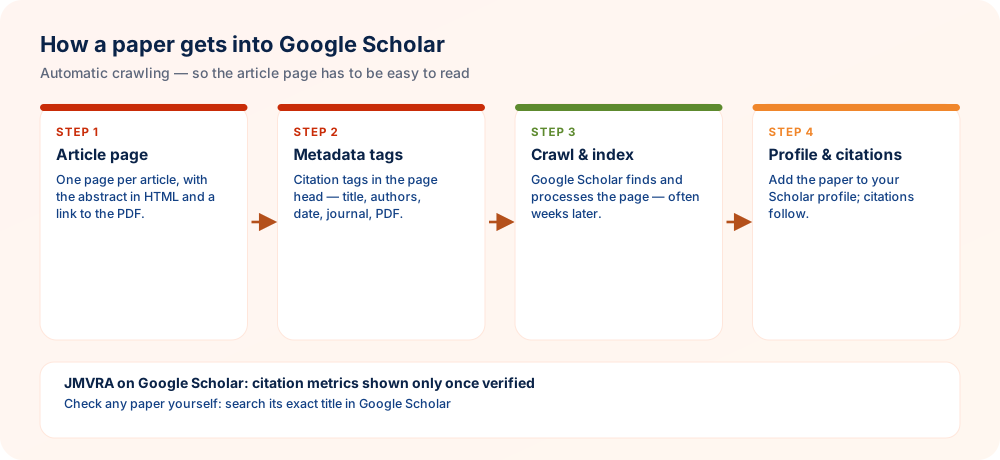
The Real Workings of the Google Scholar Crawler
The Google Scholar crawler visits academic websites from time to time and watches for signs of scholarly content: structured citation metadata tags, PDF files whose text can be extracted, and pages that resemble an academic article more than an ordinary web page. It then indexes the title, authors, publication venue and citation count of the paper on its own, with no manual submission and no direct say over when this takes place.
Possible Reasons Your Paper Is Not Visible Yet
| Cause | What to Check |
|---|---|
| Too recently published | Wait for several days up to a few weeks following publication before you assume something is wrong |
| Crawler blocked | Make sure the robots.txt of the journal site is not keeping search crawlers out |
| Missing scholarly metadata | The page ought to carry correct citation meta tags (title, author, publication date) |
| Non-extractable PDF | A PDF that is only a scanned image, with no selectable text, cannot be indexed correctly — PDFs must contain real text |
| Listings that are duplicates or nearly so | Several versions (a preprint and the published paper) can occasionally divide citations between separate entries |
The Real Meaning of "Good Metadata"
Apart from the text people see, Google Scholar searches the HTML of a page for particular metadata tags (for example citation_title, citation_author and citation_publication_date) that tell the crawler outright that "this is a scholarly article" and not an ordinary web page. A journal whose publishing setup has this metadata configured correctly is indexed much more dependably than one without it. Accurate details supplied at submission feed directly into these tags.
Creating Your Google Scholar Author Profile
- Set up a free profile at scholar.google.com with your institutional or personal email
- List the variations of your name, including other spellings used on different papers, so that all your work is credited to you
- Allow Google Scholar to suggest papers it thinks are yours, then accept or reject each suggestion
- Keep the profile current as new papers get indexed — your h-index and citation count are worked out automatically from whatever is linked to the profile
How a DOI Supports Discoverability
A Crossref DOI does not by itself cause Google Scholar to index a paper, yet it makes the paper more reliably discoverable and citable across other platforms at once, such as OpenAlex, OpenAIRE, Scilit and citation managers, and that indirectly raises its overall visibility and the chance of being cited. The full explanation is in What Is a DOI?.
Where JMVRA Itself Stands on Google Scholar
At-a-Glance Checklist
- Search the exact titlePut the whole title in quotation marks and paste it into Google Scholar
- Allow a few weeksCrawling of new papers takes time
- Inspect the metadataAuthor names and title have to match the PDF precisely
- Add it to your profile yourselfEnter the paper by hand if it was not picked up
- Tell the journalEmail it with your paper ID if the paper never shows up
Metadata That Google Scholar Reads
| Tag | Holds |
|---|---|
| citation_title | The article title |
| citation_author | One tag for every author |
| citation_publication_date | The publication date |
| citation_journal_title | The journal name |
| citation_volume / citation_issue / citation_firstpage | Volume, issue and page numbers |
| citation_pdf_url | The link to the PDF of the full text |
Journals place these tags on each article page, and Google Scholar's inclusion guidelines describe them. Authors cannot insert them, but precise details at submission help make them right.
Correcting Duplicates and Incorrect Details in Your Profile
- Combine duplicate entries — tick the repeated versions on your profile page and apply the merge option
- Correct wrong details on your profile — the copy on your profile can be fixed even when the index entry updates slowly
- Enter a missing paper by hand — do so only if it still has not appeared after a sensible wait
- Keep the article page accurate — Scholar refreshes from the source as time passes
Helping Search Crawlers Understand Your Paper and Profile
Discovery tools read the text and metadata of your paper automatically. Clean structure and a tidy author profile give them the best chance of presenting your work correctly.
- Put the title on the first page. Make sure the full title, author names and abstract appear as plain text at the start of the file. Crawlers rely on this layout to identify the document.
- Use selectable text, not images. Avoid scanned pages or text embedded in pictures. If a reader cannot select the words, an automated system will probably struggle to read them as well.
- Keep reference formats uniform. Consistent, complete references help citation tools match your work with the sources it cites and to link later citations back to your paper.
- Review your profile regularly. Open your author profile now and then to merge duplicates, remove papers that are not yours and correct wrong years or titles.
- Share the official page link. Direct colleagues to the publisher's article page rather than to scattered copies, so that attention is gathered at one verifiable record.
Give crawlers readable text, consistent names and tidy references, and review your profile occasionally so that every record points to the right paper.
Questions Researchers Often Ask
Where JMVRA Appears — With Current Figures
Confirm Google Scholar coverage within one minute
- Look up the titleEnter the exact article title in Google Scholar.
- Use the source: operatorType
source:"Journal Name"to show what a journal has published. - View the profileLook for a citation profile belonging to the journal and read it.
The Indexing & Discovery page links every record shown above; citation figures are listed only once verified.
Ready to Publish? Submit to JMVRA
JMVRA is aligned with UGC's Suggested Parameters for Choosing Peer-Reviewed Journals.
JMVRA is a Transparent, Peer-Reviewed, Open Access Journal (Refereed Journal). Following the discontinuation of the UGC and UGC-CARE journal listing, and in alignment with the latest UGC-CARE recommendations and guidelines, JMVRA is aligned with UGC’s Suggested Parameters for Choosing Peer-Reviewed Journals.
More useful pages at jmvra.org
Key Terms
Subjects and search phrases this article addresses.
Related Reading
Further reading on the same theme from the JMVRA blog.
What Scopus Looks For Before Indexing a Journal
Read the guide RelatedChecking a Journal's Indexing Claims One by One
Read the guide RelatedHow JMVRA Follows DOAJ Open Access Standards
Read the guide RelatedIndexing a New Journal: The Realistic Order
Read the guide RelatedPreparing a Journal for DOAJ: Readiness Checklist
Read the guide RelatedWriting an Abstract Editors Accept
Read the guide From the blogGoogle Scholar for Researchers: Profiles & Visibility
Read the article From the blogCheck a Journal's Google Scholar Coverage Yourself
Read the article From the blogGetting a Published Paper Into Google Scholar
Read the articleKeep Reading on the JMVRA Blog
You are reading part of the JMVRA journal blog, a source of hands-on guidance about publishing, indexing, metrics and research integrity that aims to be verifiable, not promotional.