
JMVRA (ISSN 2984-8911) is measured, point by point, against the three core standards of the Directory of Open Access Journals — the Guide to Applying, the Principles of Transparency and Best Practice, and Copyright & Licensing — together with an account of how JMVRA meets each one at present.
Uses peer review and is guided by UGC's 2025 suggestive parameters.
The DOAJ Directory Does Not Currently List JMVRA — Here Is the Meaning
The Directory of Open Access Journals (DOAJ) is an independent whitelist of open access journals curated by its community. A listing requires a formal application assessed by DOAJ's own editorial team, and JMVRA has neither been submitted for that listing nor been granted it. Nothing on this page should be taken as a claim of DOAJ membership.
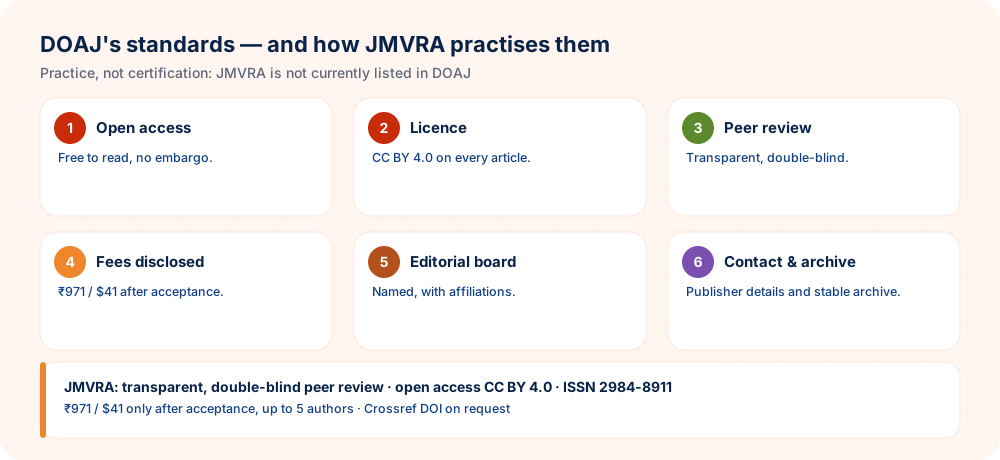
What the page offers in place of that is a walk through standards that DOAJ itself publishes — the Guide to Applying, the Principles of Transparency and Best Practice (put out together with COPE, OASPA and WAME), and the Copyright and Licensing policy — showing criterion by criterion how JMVRA's actual editorial work, licensing and fee disclosure already correspond to them. If a criterion is not yet fully satisfied, that is admitted openly and not glossed over.
Inclusion Criteria — Point by Point
DOAJ's Guide to Applying lays out the baseline criteria that every open access journal must satisfy before an application is even considered. Each criterion from the guide appears below, set against JMVRA's real and verifiable practice. Comparing each criterion with the evidence on a journal's own website is the quickest way to judge it fairly.
Journal Identity, Website and Article URLs
Basic identity and website requirements that each applicant journal must meet
JMVRA runs on its own domain, jmvra.org, secured with HTTPS — it is not a shared page or a third-party listing.
Each published paper has a permanent article page of its own with the full text directly accessible, rather than being included only in one issue-level PDF.
JMVRA carries no third-party advertising on article pages or anywhere in its published content.
As a DORA signatory, DOAJ allows journals to show only certain widely adopted metrics — Clarivate's Journal Impact Factor, Scopus's CiteScore/SJR, national accreditation lists, Eigenfactor, Google Scholar's official h5-index, Altmetric or Crossref Event Data — and forbids showing any other self-styled "Impact Factor." The "Impact Factor Details" figure shown across JMVRA's site is a metric JMVRA calculates itself from Google Scholar citation data; it is neither the official Google Scholar h5-index nor a Clarivate/Scopus metric. To be frank, meeting this specific rule fully would require re-labelling that figure or replacing it with a DOAJ-recognised metric.
The Research Areas page lists JMVRA's whole multidisciplinary scope (engineering, sciences, management, medical, humanities, law and others), allowing authors to judge suitability ahead of submitting.
JMVRA has a valid ISSN — 2984-8911 — shown on the website, on every certificate and on every published article, and matching the journal's registered name.
Publisher Information
Who runs the journal and how to contact them
Publisher: JMVRA Publication. The editorial email [email protected] and WhatsApp support appear in the footer of every page and in the Contact Us policy.
Quality Control Process — Editorial Board and Peer Review
How review integrity and editorial oversight are shown
An Editor-in-Chief and an editorial board oversee JMVRA, backed by a panel of 3000+ subject-matter reviewers from many disciplines who assess manuscripts.
To be candid: JMVRA's website currently refers to an Editor-in-Chief and an editorial board structure but does not yet list an individually named roster with institutional affiliations for each member. This is a real shortfall against this particular DOAJ requirement, and not something to gloss over.
Nothing about the five-stage review workflow (screening, similarity check, double-blind review, revision, final acceptance) is left vague, because it is described in detail in the Peer Review Policy and the Documentation.
Before an editorial decision is made, each submission is assessed under double-blind conditions by at least two independent subject-matter experts, consistent with DOAJ's minimum (DOAJ permits an exception only for arts & humanities titles that are reviewed editorially).
Each manuscript is screened by JMVRA with Turnitin / iThenticate against an accepted similarity threshold of 20%, which goes beyond DOAJ's baseline recommendation.
Every submission at JMVRA, including those from members of the editorial team, goes through the same independent, double-blind review workflow. JMVRA does not yet publish an audited per-issue statistic that confirms the 25% ceiling, so it is offered as a policy commitment and not as a verified figure.
Standard metadata for articles includes publication dates, which are recorded and shown.
Publishing History & Volume
Evidence of a genuine, continuous publishing record
JMVRA publishes far beyond this baseline — monthly since June 2023, with Growing articles live, many times over DOAJ's stated minimum.
A new journal applying to DOAJ needs >1 year of history or ≥10 published OA research articles. Having kept to a 12-issues-a-year schedule since its founding, with its archive unbroken, JMVRA exceeds that requirement comfortably.
Type of Open Access and Fee Transparency
Real open access without hidden costs
From the moment of publication, every article can be read, downloaded, copied, distributed, printed and searched freely — with no embargo, no registration requirement and no reader-side paywall. JMVRA is not a hybrid journal (DOAJ does not index journals that combine open access with subscription-only articles); all JMVRA articles are open access, without exception.
Authors can see the whole charge — ₹971 INR for Indian authors or $41 USD for foreign authors — on the Publication Charges Policy, and break it down with the Cost Calculator before paying a single rupee. It spans submission through publication, and there are no undisclosed processing or colour charges.
No submission fee is charged. The publication fee is requested only after a paper passes peer review and is accepted editorially — an author whose paper is rejected pays nothing.
JMVRA's COPE Ethics & Malpractice Statement states the accepted similarity threshold (20%) and explains how flagged manuscripts are dealt with before they reach reviewers.
AI and Automated Tools (DOAJ Best Practice)
Not required for DOAJ inclusion, but recommended and more and more expected
JMVRA's ethics policy obliges authors to disclose any AI assistance used in preparing a manuscript; generative AI may not be credited as an author or cited as a source, and AI-generated content that goes undisclosed is handled as an ethics violation — see the COPE Ethics & Malpractice Statement.
Understanding the 16 Principles of Transparency and Best Practice
DOAJ wrote these 16 principles together with COPE, OASPA and WAME to serve as a common yardstick for what a trustworthy scholarly journal should disclose publicly. Below, each principle appears with a note on how JMVRA handles it.
Four themes organise the 16 principles in DOAJ's scheme: principles 1–6 cover Journal Content, 7–9 cover Journal Practices, 10–12 cover Organisation, and 13–16 cover Business Practices.
| # | Principle | How JMVRA Meets It | Status |
|---|---|---|---|
| 1 | Name of journal | Journal of Modern and Versatile Research Approach — a unique name, used consistently, that cannot be confused with another title or organisation. | Met |
| 2 | Website | Own domain (jmvra.org) with HTTPS security, no copied design, and aims/scope/readership/authorship criteria plus separate print/online ISSNs all on display. | Met |
| 3 | Publishing schedule | Monthly, 12 issues a year, published on a consistent schedule since June 2023 with no gaps. | Met |
| 4 | Archiving | Articles are hosted online permanently and are never removed. JMVRA does not yet take part in a formal digital preservation scheme (e.g. Keepers Registry member, Internet Archive, PubMed Central) — that is an honest gap, not a present fact. | Partial |
| 5 | Copyright | Copyright terms (author retains copyright, CC BY 4.0) are clearly stated, kept apart from website copyright, and named in the full text of every article. | Met |
| 6 | Licencing | Unmodified CC BY 4.0 licence terms, disclosed in the Open Access Policy and the Author Rights section. | Met |
| 7 | Publication ethics and related editorial policies | Authorship, conflicts of interest, handling of misconduct and corrections/retractions are documented in the COPE Ethics & Malpractice Statement and the Copyright Infringement Claims policy. | Met |
| 8 | Peer review | Double-blind with at least two independent reviewers across five documented stages, fully published in the Peer Review Policy — covering who reviews, how identities are hidden and how a decision is reached. | Met |
| 9 | Access | Entirely open access — each article is free to read and download at once, with no embargo, registration or paywall. | Met |
| 10 | Ownership and management | The publisher, JMVRA Publication, is named in the footer of every page and on the publisher page. | Met |
| 11 | Advisory body | An Editor-in-Chief and editorial board lead editorial oversight, as noted on the About JMVRA page. DOAJ requires the full names and affiliations of all board members to be shown on the website — JMVRA has not yet published such an individually named roster, which is a real gap. | Partial |
| 12 | Editorial team and contact details | The editorial email ([email protected]) and WhatsApp support appear in every page footer and in the Contact Us policy. | Met |
| 13 | Author fees | The complete fee (₹971 INR / $41 USD) is stated upfront on the Publication Charges Policy, alongside a live Cost Calculator, before anything is submitted. | Met |
| 14 | Other revenue | Income comes solely from publication fees (₹971 INR / $41 USD per paper), so no reader subscriptions, sponsorships or special-issue revenue sway editorial decisions. | Met |
| 15 | Advertising | Since JMVRA carries no third-party advertising on article pages or in published content, there is no advertising policy to state. | Met |
| 16 | Direct marketing | Bulk, unrequested "call for papers" emails are not something JMVRA sends; its own predatory-journal red flags guide warns authors about precisely that behaviour. | Met |
Copyright and Licensing — Point by Point
DOAJ's guidance on copyright and licensing concentrates above all on one point: licence terms and copyright terms must never contradict each other, and open access content must never carry an "all rights reserved" label. This is how JMVRA's licensing measures up to that standard.
Licensing Practice
Which licence is used and how plainly it is disclosed
Every article in JMVRA appears under CC BY 4.0, a standard Creative Commons licence of the kind DOAJ recommends, and the choice is uniform and never made article by article.
JMVRA uses the standard, unmodified CC BY 4.0 terms. The licence's own permissions are not narrowed by any added restriction.
Plain-language explanations of the licence and its permissions are available in Documentation — Author Rights & Open Access Licence as well as the Open Access Policy.
Author Copyright Retention
Who owns the work after publication
DOAJ recommends that journals let authors retain copyright without restriction and give the publisher only the right of first publication and other non-exclusive rights, instead of demanding exclusive publishing rights or a transfer of commercial rights, which DOAJ advises against. Under CC BY 4.0, authors publishing in JMVRA hold on to the copyright in their own work at all times; JMVRA receives only a non-exclusive right to publish.
Since JMVRA authors keep their copyright without restriction, the CC BY 4.0 licence applies in full to readers and to the publisher — precisely the clean arrangement DOAJ's guidance describes, as opposed to journals requiring copyright transfer or exclusive rights.
Authors need not sign any copyright transfer form. They can place their published paper in an institutional repository, ResearchGate or a personal site straight away, with no embargo.
Consistency & No Contradiction
The central compatibility requirement of DOAJ
JMVRA never labels a published open access article "all rights reserved" — DOAJ rightly regards that phrase as fundamentally incompatible with true open access, and JMVRA's licensing avoids the contradiction altogether.
Each article bears a CC BY 4.0 notice that agrees with the open access policy stated elsewhere on the site, so what is promised and what is printed on the paper never conflict.
DOAJ does not accept free-to-read journals that limit reuse to "fair use" without any real open licence. JMVRA gives every article an explicit CC BY 4.0 licence instead of a bare "free to read" promise.
Journals that mix open access articles with subscription-only or paywalled ones are not indexed by DOAJ. At JMVRA every article is open access under the same licence, and there is no paywalled tier.
Why DOAJ's Standards Matter to Every Open Access Journal
The Directory of Open Access Journals exists because badly run open access publishing looks just like a scam. Anyone can register a domain, label it a "journal," collect a fee and publish whatever arrives with no review whatsoever. The whole purpose of DOAJ is to tell journals that behave like genuine, accountable publications from those that do not — and it does so by making its criteria wholly public, so any journal (and any author sizing one up) can check compliance line by line without asking DOAJ's permission to look.
That is just what this page does for JMVRA. Instead of asking authors to trust a badge, JMVRA openly publishes its compliance with DOAJ's three foundational documents, with links to the policy pages that support each claim above. A claim on this page that cannot be checked against a real, linkable policy on this website is left out.
The Guide to Applying, Explained Simply
DOAJ's Guide to Applying is the checklist a journal has to pass before DOAJ will even look at its application. Its job is to screen out journals without real editorial infrastructure — no named board, no disclosed review process, no fee transparency, no publishing record. Meeting every item in the guide does not ensure a DOAJ listing (DOAJ's own reviewers still assess the application), but missing any item ensures rejection.
The full account of JMVRA's practice against this guide appears above: a dedicated website, a registered ISSN, a declared multidisciplinary scope, a named editorial structure, a documented double-blind review process with at least two reviewers, nearly a decade of uninterrupted monthly publication with thousands of articles, truly immediate open access, and upfront fee disclosure with no submission charge. Any author or institution can check each of these independently — which is exactly why this page is published.
Why "minimum two reviewers" matters more than it seems
One reviewer brings one set of blind spots. DOAJ insists on at least two independent reviewers per manuscript because disagreement between reviewers is itself valuable information for an editor — it exposes the kind of methodological or interpretive weakness that a lone reviewer might overlook or let through for lack of familiarity with a sub-field. JMVRA's review panel of 3000+ subject-matter experts is there so that two truly independent, subject-appropriate reviewers can be found for nearly any submission in nearly any discipline.
A finer point: an "Impact Factor" compared with a DOAJ-recognised metric
DOAJ signed DORA (the San Francisco Declaration on Research Assessment) and holds a precise, narrow position on impact metrics. Only a fixed set may be displayed — Clarivate's Journal Impact Factor, Scopus's CiteScore or SJR, official national accreditation lists, the Eigenfactor, Google Scholar's own h5-index, Altmetric, or Crossref Event Data — while any other self-styled "Impact Factor" or ranking claim is off limits. JMVRA's "Impact Factor 11.25", visible site-wide, is derived from Google Scholar data and based on citations, but it comes from a custom calculation; it is not the official h5-index from Google Scholar and not a Clarivate/Scopus figure. Under DOAJ's exact wording that gap matters, so it is spelled out here and not blurred.
The 16 Principles: A Common Language for Trust
COPE, DOAJ, OASPA and WAME did not draw up the 16 Principles of Transparency and Best Practice to rival one another's standards. They did so because four organisations, viewing scholarly publishing from four angles (ethics, open access directory curation, publisher membership and medical editing respectively), kept reaching one conclusion: readers and authors cannot judge whether a journal is trustworthy unless very specific facts are disclosed, in specific places, in specific terms. A vague "we follow international standards" line meets none of the 16 principles. A named editor with a working email address fully meets one of them.
This explains how JMVRA's compliance table above is written — each of the 16 rows links to a real policy page on this site rather than offering a general reassurance. Where JMVRA does not yet fully meet a principle — archiving and the public roster of the advisory body, in particular — those rows say so openly instead of being worded around the problem.
Why archiving counts as a gap and not a checkbox
Long-term digital preservation through the Keepers Registry, Internet Archive or PubMed Central answers one specific worst-case question: if a journal's publisher vanishes entirely — through bankruptcy, acquisition, or simply no longer maintaining its servers — do the articles already published survive independently of that publisher? Permanent hosting on JMVRA's own infrastructure answers "yes, for as long as JMVRA operates," which is a genuinely different and weaker assurance than formal third-party archiving, which answers "yes, whatever happens to JMVRA." Stating that difference candidly is itself part of following DOAJ's transparency principle, even though the underlying infrastructure is not yet in place.
Why a named editorial board counts for more than the idea of one
Saying "JMVRA has an editorial board" is a different claim from saying "JMVRA has published the name, affiliation and credentials of every editorial board member." DOAJ's Principle 11 (Advisory body) and the Guide to Applying both ask for the latter, more specific statement — at least five named editors, preferably not all at one institution, with the list kept current. The reasoning is straightforward: a board without names might be a single person or might not really exist, and without names to check, readers cannot know. At present JMVRA's site describes the structure (an Editor-in-Chief and editorial board, supported by a 3000+ reviewer panel) but does not publish the individually named roster DOAJ's criteria require — a concrete gap that can be fixed, not a vague one.
Copyright and Licensing: The One Rule That Really Counts
Beneath all the detail, DOAJ's guidance on copyright and licensing rests on one non-negotiable rule: the licence and the copyright notice must say the same thing. A journal that grants a Creative Commons licence yet stamps "All Rights Reserved" on its PDFs is not being extra careful — it is publishing a legal contradiction, since "all rights reserved" is exactly the opposite of what a CC licence grants. DOAJ treats this contradiction as disqualifying, and rightly so: authors or readers who cannot tell what they may do with a paper face exactly the situation that open access licensing is meant to prevent.
JMVRA applies its CC BY 4.0 licence consistently and unmodified, with no parallel copyright notice that contradicts it. Authors keep their copyright outright; JMVRA holds only a non-exclusive right to publish. The publication workflow contains no copyright transfer form, no embargo on self-archiving, and no separate "all rights reserved" wording anywhere.
What CC BY 4.0 Allows in Practice
- Anyone may read, download and share your paper's full text, permanently and free of charge.
- Anyone may reuse, remix or build on your work — commercially too — as long as they credit you and link to the licence.
- You may deposit your own published paper wherever you like — your institutional repository, ResearchGate, Academia.edu or a personal website — straight away, without any waiting period.
- You may reuse figures, tables and text from your published article in later work, as long as you cite the original.
Why This Counts for More Than a Directory Badge
It would be easy to treat "not currently DOAJ-listed" as a weakness to conceal. In fact it is the more useful piece of information on this page: a directory badge is a single point-in-time judgement by DOAJ's own reviewers, and an individual author cannot independently re-check it in five minutes. Every item in the three checklists above can be re-checked. An author choosing where to submit a paper need not rely on JMVRA's word or DOAJ's badge — they can open the actual Peer Review Policy, Open Access Policy and Publication Charges Policy and verify each claim against the real page in under a minute. That is the whole value of publishing standards in this way: verifiability that depends on nobody's say-so, JMVRA's own included.
Applying DOAJ Principles as an Author
Check transparency
These principles can be used to judge any journal.
Look for evidence
Policies, the review process and fees are what to check.
Do not mix up practice and listing
Following principles is not the same as DOAJ indexing.
Check listings at doaj.org
Search by journal title or ISSN.
JMVRA's Position, Stated Plainly
| Item | JMVRA |
|---|---|
| DOAJ | Not listed |
| Scopus, Web of Science | Not indexed |
| Google Scholar | Indexed |
| Licence | CC BY 4.0 |
| DOI | A Crossref DOI upon request |
Using Open Access Standards to Assess a Journal
Published open access principles give authors a practical yardstick. Applying them step by step helps you judge any publication, whether or not it appears in a directory.
- Find the licence statement first. Look for a clear licence on the website and on article pages. Vague language about rights, or a mismatch between pages, is a reason to ask the editors questions.
- Check who owns copyright. Read whether authors keep copyright and what reuse is allowed. Understanding this before submission avoids disputes when you later share or republish your own work.
- Look for named editorial contacts. A transparent journal lists real editors and a working address. Test the address with a short question and note whether you receive a courteous, informative reply.
- Read the stated review process. The journal should describe how manuscripts are assessed and who decides. Descriptions that are specific and consistent suggest a process that is actually followed.
- Do not rely on one badge. A directory entry is helpful but never replaces your own reading. Combine it with sample articles, policies and conversations with colleagues in your field.
Standards are most useful when you apply them yourself, using visible policies and honest answers rather than a single badge as proof.
Questions Researchers Often Ask
Is JMVRA in the DOAJ listing?
It is not. The DOAJ directory does not currently include JMVRA. What this page demonstrates is that the journal's editorial practice, licensing and transparency already line up with DOAJ's published standards, regardless of listing status.
Is being "aligned with DOAJ standards" the same as being "DOAJ indexed"?
No, and this page takes care not to confuse the two. DOAJ indexing needs a formal application that DOAJ's own team reviews and approves. Being "aligned with DOAJ standards" means that JMVRA's real editorial and licensing practice matches the criteria DOAJ publishes — a factual, checkable statement about practice, not a claim of directory membership. When reading any journal's claims, check whether the wording describes practice or an actual listing.
Which licence does JMVRA use, and can I check it?
It is Creative Commons Attribution 4.0 International (CC BY 4.0), named on both the Open Access Policy and Documentation pages. You can read the licence's standard terms yourself at creativecommons.org.
Do I retain the copyright of my paper?
Yes. JMVRA never requests a copyright transfer. You keep full copyright, and JMVRA is given only a non-exclusive right to publish under CC BY 4.0.
Where can I read JMVRA's real peer review process rather than a summary?
You will find all five stages documented in the Peer Review Policy and again in Documentation Section 6.
Are JMVRA's fees genuinely disclosed before I submit anything?
Yes. The full fee schedule is on the Publication Charges Policy, and an exact, itemised total can be generated on the Cost Calculator with no need to submit a paper or create an account.
Why does this page admit that JMVRA does not meet every principle fully?
The yardstick used here is DOAJ's own set of transparency principles, so concealing places where compliance is only partial would contradict transparency itself. Two shortcomings are openly acknowledged: there is no formal third-party digital archiving (Keepers Registry / Internet Archive / PubMed Central), and no publicly named editorial board roster giving every member's institutional affiliation. These are future development areas and not present-day claims.
Does DOAJ allow journals to show a metric like JMVRA's "Impact Factor 11.25"?
Not in the same sense. DOAJ, a DORA signatory, accepts a particular named set of metrics (Clarivate's JIF, Scopus's CiteScore/SJR, national accreditation lists, Eigenfactor, Google Scholar's official h5-index, Altmetric, Crossref Event Data) and requests that journals avoid other self-styled "Impact Factor" claims. The JMVRA number comes from a custom calculation on Google Scholar citation data, so it is neither Google Scholar's own official h5-index nor a Clarivate/Scopus metric — and this page says that plainly instead of blurring the difference.
Are the names of JMVRA's editorial board members published?
Not at present, at least not as individually named people with their affiliations, which is what DOAJ's criteria require (a minimum of five named editors, preferably from more than one institution). JMVRA's website currently outlines an Editor-in-Chief, an editorial board structure and a 3000+ reviewer panel, yet it does not publish a complete named list — a real gap, openly acknowledged.
In what way does this page connect to JMVRA's UGC CARE compliance page?
They cover different standards bodies. This page benchmarks JMVRA against DOAJ, COPE, OASPA and WAME's open-access and transparency criteria. The UGC Status & Parameters Journal Standards page covers India's UGC’s Suggested Parameters for peer-reviewed journals separately.
If JMVRA follows DOAJ principles, does that put it in DOAJ?
No. JMVRA does not appear in DOAJ.
How do I find out whether a journal is in DOAJ?
Look up its title or ISSN on doaj.org.
Want to Publish in a Transparently-Run, Open Access Journal?
ISSN 2984-8911 · CC BY 4.0 · Crossref DOI available on request · ₹971 INR / $41 USD, stated openly from the start with nothing hidden.
What This Guide Covers
At-a-Glance Checklist
- Practice reviewedMeasured against DOAJ's criteria
- Listing status clearAbsent from DOAJ
- Licence shownDisplayed on articles
- Fees openVisible before submitting
- Accurate claimsSays "aligned with", never "indexed in"
A Comparison of Open Access Models
Under CC BY 4.0, JMVRA is gold open access: readers pay nothing and face no embargo, while authors owe ₹971 INR / $41 USD only once the paper is accepted.
Ready to Publish? Submit to JMVRA
JMVRA is aligned with UGC's Suggested Parameters for Choosing Peer-Reviewed Journals.
JMVRA is a Transparent, Peer-Reviewed, Open Access Journal (Refereed Journal). Following the discontinuation of the UGC and UGC-CARE journal listing, and in alignment with the latest UGC-CARE recommendations and guidelines, JMVRA is aligned with UGC’s Suggested Parameters for Choosing Peer-Reviewed Journals.
Where to go next on jmvra.org
Key Terms
Subjects and search phrases this article addresses.
Related Reading
Further reading on the same theme from the JMVRA blog.
Journal Indexing in Plain Language
Read the guide RelatedScopus, Web of Science, DOAJ & Google Scholar Compared
Read the guide RelatedWhat Is a Scopus Journal? A Complete Guide for Researchers and Academics
Read the guide RelatedTitle, Authors, Abstract, DOI and References: Why Article Metadata Counts
Read the guide RelatedWeb of Science Quartiles Q1 to Q4 Explained
Read the guide RelatedWhat Scopus Looks For Before Indexing a Journal
Read the guideKeep Reading on the JMVRA Blog
Find this guide on the JMVRA journal blog, a collection of practical guidance on publishing, indexing, metrics and research integrity that favours verifiable content over promotion.