
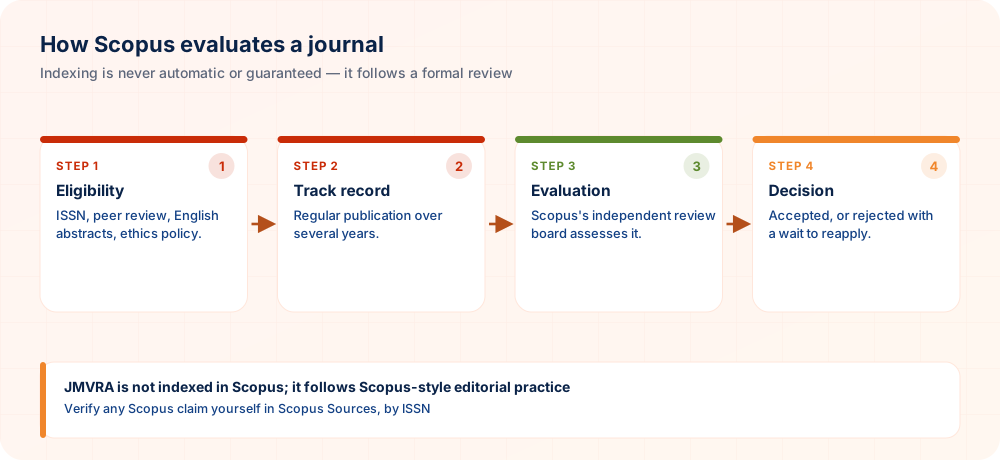
Quick answer: To be indexed in Scopus, a journal must first clear a minimum eligibility bar — genuine peer review, a described review policy, regular publication, a registered ISSN, English titles/abstracts and a published ethics statement — and then pass a formal evaluation of its journal policy, content, standing, regularity and online availability. Paying a fee, knowing someone or receiving a promise cannot bypass this process.
Inclusion in Scopus cannot be guaranteed by any publisher, consultant or service. Scopus alone decides through its own evaluation, so a claim to the contrary is itself a red flag. Ask anyone offering such a promise to show you the evidence in the official source list.
What Scopus Is
Scopus is an Elsevier-owned database that holds abstracts and citations for peer-reviewed literature, taking in journals, conference proceedings and books from the sciences, technology, medicine, the social sciences, and the arts and humanities. Being Scopus-indexed signals that a title was evaluated and then admitted as a source there; the status is selective and keeps being reviewed, so it is no one-off badge.
Minimum Eligibility
Peer-reviewed content
Real, recorded peer review rather than editorial screening passed off as review.
Publicly stated peer-review process
Readers and authors can see an explanation of how review works.
Regular publication
Issues are released on a steady, announced timetable.
Registered ISSN
The title is identical on the website and in every indexing record.
English titles/abstracts
This keeps the work readable worldwide, even when the full text is written in another language.
Publication ethics statement
A publicly available policy dealing with misconduct, authorship and conflicts.
Areas the Formal Evaluation Examines
| Category | What it looks at |
|---|---|
| Journal policy | How the journal is governed editorially, how rigorous peer review is, and how diverse the editorial board and authors are |
| Content | Scholarly contribution, ease of reading, and relevance for an international readership |
| Journal standing | How often the journal's papers and its editors are cited inside Scopus |
| Regularity | If the journal really keeps to the publication schedule it states |
| Online availability | A reliable, reachable website that has a functioning archive |
Why Journals Don't Pass Scopus Evaluation
Ways to Verify a Scopus Claim
- Open the Scopus Sources list itself.
- Look it up using the journal name or ISSN.
- Read the publisher name, years of coverage and active status listed there, instead of trusting a logo on the journal's own website.
Submit Your Paper to JMVRA
Our journal is peer-reviewed and open access, with ISSN 2984-8911. Use the method from this guide to verify each claim on our site, then submit your paper.
Submit Paper Online Call for PapersCommon Search Terms
Preparing a Journal for Citation Database Review
Large citation databases evaluate journals on sustained, observable practice rather than promises. These suggestions are for editors who want their publishing habits to be ready for scrutiny at any time.
- Publish on a regular rhythm. Release issues or articles consistently and avoid long unexplained gaps. A steady record shows that the editorial process is organised and the journal is reliably maintained.
- Keep the website fully transparent. Show editors, policies, contact details and publisher information plainly on the site. Evaluators and authors alike need to see who is responsible for the journal.
- Maintain ethical processes. Handle complaints, corrections and suspected misconduct according to written procedures, and keep records. Visible, consistent handling is a mark of editorial seriousness.
- Encourage a diverse author base. Draw authors from many institutions and regions instead of relying on a small circle. Variety indicates that the journal serves the wider research community.
- Attend to reference quality. Ask authors to cite relevant, accessible literature accurately and discourage unnecessary self-citation. Careful referencing reflects a thoughtful review process.
Build habits of regular publishing, open information and documented ethics now, because an evaluator can only judge what is visible.
Preparation Before Applying
- Keep a regular publishing rhythm — over a span of years
- Supply abstracts in English — for every article
- Make ethics statements public — and abide by them
- Earn citations organically — through good work and visibility
Re-Evaluation After Indexing
Ongoing monitoring
Scopus keeps monitoring titles it has indexed.
Flags
Unusual self-citation or abnormally fast growth.
Discontinuation
A journal may be dropped.
Author impact
Material published after removal might not be indexed.
Questions Researchers Often Ask
What does it take for a journal to be indexed in Scopus?
It must first satisfy the minimum eligibility bar — peer review, a review policy described in public, regular publication, a registered ISSN, English titles and abstracts, and a published ethics statement — and then succeed in a formal evaluation. No shortcut exists around this process.
Which minimum requirements apply before Scopus evaluates a journal?
The journal needs peer-reviewed content, a public explanation of its peer-review process, a regular publication schedule, a registered ISSN, titles and abstracts in English, and a published ethics statement. Reviewing these points carefully before applying helps you spot gaps early.
Is an ISSN enough to make a journal eligible for Scopus?
An ISSN counts as a minimum requirement, but it is not enough alone, since journal policy, content quality, standing, regularity and online availability are assessed as well.
How can I confirm that a journal is Scopus-indexed?
Find the journal on the Scopus Sources list by name or ISSN, then read the publisher, years of coverage and status displayed. Compare the title carefully, since similar names are easy to confuse.
What causes journals to be rejected in Scopus evaluation?
Common causes are peer review without records, irregular publishing, poor editorial governance, limited readability worldwide, and an unclear scholarly contribution or citation record.
Is a journal's quality assured by Scopus permanently?
No. Scopus keeps monitoring titles, so coverage may stop if a journal later falls below the standard.
Is it possible for a journal to lose Scopus coverage?
Yes — titles are re-evaluated from time to time, and coverage may end because of falling quality or ethical issues.
Is JMVRA indexed in Scopus?
Verify the status of any journal in the same manner, using the official Scopus Sources list with its title or ISSN, instead of accepting what the journal says about itself.
Is it possible to pay for a place in Scopus?
No — Scopus assesses journals itself, and money cannot purchase indexing.
Is JMVRA in Scopus?
No. JMVRA appears in Google Scholar but is not in Scopus.
Key References
At-a-Glance Checklist
- Eligibility satisfiedPrior to applying
- Publishing historyYears of issues released on time
- Citations won honestlyNever manufactured
- Honest claimsNever say "Scopus-indexed" until it is true
- Proof of verificationHow readers can confirm
Where JMVRA Appears — With Current Figures
Verify Google Scholar coverage in a minute
- Search by titleCopy the full article title into Google Scholar’s search box.
- Try source:Enter
source:"Journal Name"to see the papers from a journal. - Reach the profileFind out whether the journal has a citation profile, and view it.
All records above are linked on the Indexing & Discovery page (figures as of 30 Sep 2026).
Ready to Publish? Submit to JMVRA
JMVRA is aligned with UGC's Suggested Parameters for Choosing Peer-Reviewed Journals.
JMVRA is a Transparent, Peer-Reviewed, Open Access Journal (Refereed Journal). Following the discontinuation of the UGC and UGC-CARE journal listing, and in alignment with the latest UGC-CARE recommendations and guidelines, JMVRA is aligned with UGC’s Suggested Parameters for Choosing Peer-Reviewed Journals.
Helpful pages on jmvra.org
Key Terms
Subjects and search phrases this article addresses.
Related Reading
Further reading on the same theme from the JMVRA blog.
What Article Metadata Does: Title, Authors, Abstract, DOI and References Explained
Read the guide RelatedIndexing a New Journal: The Realistic Order
Read the guide RelatedScopus, Web of Science, DOAJ & Google Scholar Compared
Read the guide RelatedWhy Is JMVRA's Impact Factor 11.25? Google Scholar H-Index Explained
Read the guide RelatedQuality Without Compromise at ₹971 INR: JMVRA and the Scopus Journal Indexing Standard
Read the guide RelatedStep by Step: How to Have Your Research Paper Added to Google Scholar’s Index
Read the guideKeep Reading on the JMVRA Blog
This guide belongs to the JMVRA journal blog, which offers practical advice on publishing, indexing, metrics and research integrity, written to be checkable instead of promotional.