
Your paper is published — but when will Google Scholar show it, and what can you do if it never appears, or appears with the wrong title or authors? Most problems have simple causes and straightforward fixes. This guide explains how Scholar discovers new articles and what authors and journals can do to ensure it happens correctly. Identifying the cause first saves a lot of back-and-forth with the journal.
How Scholar Finds New Articles
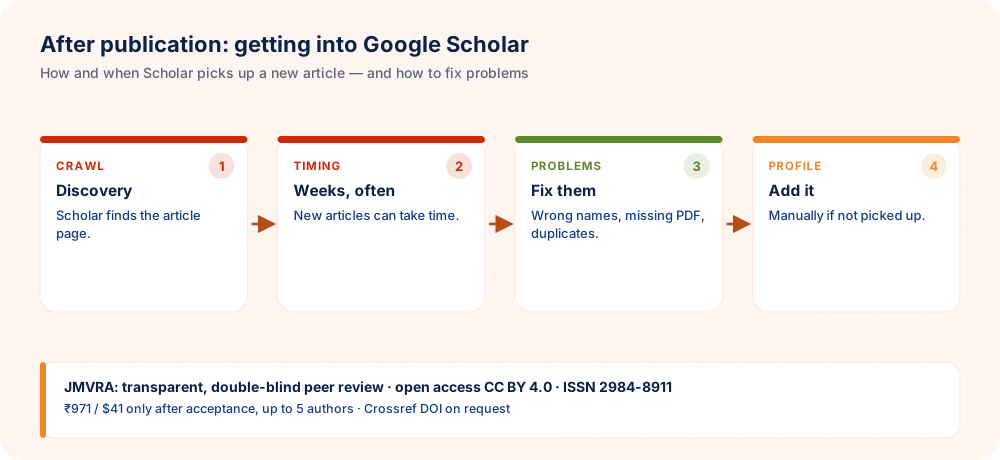
Google Scholar’s crawler visits journal websites and reads every article page. It depends on bibliographic meta tags — title, authors, publication date, journal name and PDF link — as well as the text of the PDF. When the metadata and the PDF match, the article is listed with the right details, usually within weeks.
Typical Timing
| Step | Typical time |
|---|---|
| Article published online | Day 0 |
| Visited by the Google Scholar crawler | Days to a few weeks |
| Shown in search results | Usually within weeks |
| Automatically added to your profile | Shortly after it is listed |
| First citations | Over months, as citations arrive |
Typical Problems and Solutions
| Problem | Likely cause | Fix |
|---|---|---|
| Still missing after two months | Absent meta tags, a scanned PDF or blocked crawling | Request that the journal inspect its article page |
| Wrong author names | Error in the metadata or on the PDF’s first page | Request that the journal fix the metadata |
| Duplicate entries | One paper on multiple sites | Combine the versions in your profile |
| Wrong journal shown | Scholar linked to a repository copy | The journal page should carry complete metadata |
Steps You Can Take as an Author
- Write your name in one consistent format on every paper
- Check that the PDF’s first page presents the title and authors clearly
- If necessary, add the paper to your profile by hand
- Share the journal link (or DOI) instead of uploading many copies
What a Journal Ought to Do
- Provide a separate HTML page for every article
- Put citation meta tags on every page
- Release text-based PDFs rather than scans
- Keep URLs stable
- Register DOIs so links remain permanent
Adding a Paper by Hand: What to Fill In
| Field | Enter |
|---|---|
| Title | Exactly as published |
| Authors | Every author in order, one per line or joined by “and” |
| Publication date | Year (plus month, if you know it) |
| Journal | Full journal name |
| Volume / issue / pages | As printed |
An entry you add by hand is visible only on your profile until Google Scholar locates the article on the journal’s website too; once it does, the two normally combine. Look at the merged result later to be sure the details came out right.
The 10 Most-Searched Questions on This Topic
Here are the ten questions researchers search for most on this subject, each with a direct answer.
research paper publication with Google Scholar indexing
Publishing with a journal whose article pages can be crawled and read by Google Scholar.
how long for paper to appear in Google Scholar
Typically a few weeks after the paper goes online.
paper not showing in Google Scholar
The cause is often absent metadata or crawling trouble; ask the journal to investigate.
Google Scholar meta tags
Tags like citation_title and citation_author, which pass the article’s details to Scholar.
wrong author name Google Scholar
Typically a problem with the metadata or PDF; ask the journal to fix it.
add article to Google Scholar profile manually
In your profile, choose “Add articles” and then “Add article manually”.
Google Scholar duplicate paper
Combine duplicate entries in your profile.
Google Scholar indexing time
From a few days to a few weeks after publication, depending on when crawling happens.
Google Scholar inclusion guidelines
Technical requirements for publishers, as published by Google.
PDF requirements Google Scholar
PDFs built from real text, with title and authors shown on the first page.
How JMVRA Fits In
JMVRA is a Transparent, Peer-Reviewed, Open Access Journal (Refereed Journal). Following the discontinuation of the UGC and UGC-CARE journal listing, and in alignment with the latest UGC-CARE recommendations and guidelines, JMVRA is aligned with UGC’s Suggested Parameters for Choosing Peer-Reviewed Journals. UGC public notice (PDF)
Every JMVRA article sits on its own open-access page carrying citation metadata for Google Scholar, and optional Crossref DOIs are registered so that links stay permanent.
- ISSN
- 2984-8911 (online) · publishing since June 2023
- Issues
- Monthly issues across many disciplines
- Review
- Two-way anonymous review by specialists
- Access
- Openly accessible under CC BY 4.0
- Fee
- ₹971 INR for Indian and $41 USD for foreign authors, due only after acceptance
- DOI
- Crossref — available as an optional extra
- Indexing
- Google Scholar yes; not Scopus, Web of Science or DOAJ
- Impact factor
- 11.25, derived from Google Scholar data
Screening begins the moment a paper arrives and each decision is sent as soon as it is reached, yet JMVRA never promises a set number of days: actual review time depends on the reviewers and on how much revision the paper needs.
At-a-Glance Checklist
- Full title searchedOnce a few weeks have passed
- Details checkedOn the article page
- Profile refreshedAdd by hand if required
- Duplicates combinedWithin your profile
- Journal informedWhen it never shows up
Making Your PDF Easy for Crawlers to Read
Text, not images
Indexing cannot see text that sits inside scanned pages.
Title and authors placed at the top
Written as text on the first page, with clear separation.
A references section
Given a clear heading so that citations can be pulled out.
Reasonable file size
Extremely large files might not be fully processed.
Looking After Your Google Scholar Profile
- Check new additions — delete any papers that are not yours
- Combine duplicates — so that citation counts are joined
- Fix errors — wrong titles, authors or venues on your profile
- Set the profile to public — and include a verified institutional email address
Practical Tips for Making Papers Easier for Scholar to Find
Discovery services rely on clean, consistent information, so authors can influence how findable their work is. These steps improve the odds that readers locate and correctly credit your published article.
- Write a descriptive, keyword-aware title. Place the main concept early in the title and use the terms researchers in your field actually search for. Clever or vague titles are harder for both people and crawlers to match.
- Use one name format everywhere. Choose a single consistent form of your name and affiliation and use it in every manuscript. Variations split your work across several author entries and weaken your visible record.
- Check your PDF's text layer. Make sure the title, authors and abstract sit as selectable text at the top of the first page. Scanned images and unusual layouts can prevent automated tools from reading details correctly.
- Link a stable copy of your paper. Where the publisher permits, deposit a version in an institutional or subject repository and link to it from your profile. Additional legitimate copies help readers reach the work.
- Review your profile regularly. Visit your profile now and then to confirm that listed papers are yours and details are accurate. Remove wrong entries promptly and merge duplicates so your record stays trustworthy.
Findability starts with clear titles, consistent names and readable files, and it is maintained by checking your profile regularly.
Questions Researchers Often Ask
Where JMVRA Appears — With Current Figures
Confirm Google Scholar coverage within one minute
- Search by titleType the full article title into Google Scholar.
- Try the source: operatorEnter
source:"Journal Name"to list what a journal has published. - Open the profileSearch for the journal's own citation profile and read through it.
The Indexing & Discovery page has links to each record listed above (figures as of 30 Sep 2026).
Ready to Publish? Submit to JMVRA
JMVRA is aligned with UGC's Suggested Parameters for Choosing Peer-Reviewed Journals.
JMVRA is a Transparent, Peer-Reviewed, Open Access Journal (Refereed Journal). Following the discontinuation of the UGC and UGC-CARE journal listing, and in alignment with the latest UGC-CARE recommendations and guidelines, JMVRA is aligned with UGC’s Suggested Parameters for Choosing Peer-Reviewed Journals.
More useful pages at jmvra.org
Key Terms
Subjects and search phrases this article addresses.
Related Reading
Further reading on the same theme from the JMVRA blog.
Journal Impact Factor vs Google Scholar Metrics
Read the guide RelatedFast Publishing and Google Scholar Visibility
Read the guide RelatedWhat Google Scholar Indexing Means for a Journal
Read the guide RelatedA Guide to Making a Research Paper Appear in Google Scholar
Read the guide RelatedWhy Journal Article Metadata Matters: Title, Authors, Abstract, DOI and References
Read the guide RelatedMaking Your Research Paper More Discoverable Online with DOI, Metadata, Google Scholar and OpenAlex
Read the guideKeep Reading on the JMVRA Blog
You are reading part of the JMVRA journal blog, a source of hands-on guidance about publishing, indexing, metrics and research integrity that aims to be verifiable, not promotional.