
“Google Scholar indexed” ranks among the claims journals make most often. It is generally true, and generally misread. Being indexed in Google Scholar means your paper can be found and its citations tallied. Unlike Scopus or Web of Science indexing, it does not show that the journal has been assessed for quality. Understanding this helps you judge whether a Google Scholar indexed journal fits your goals.
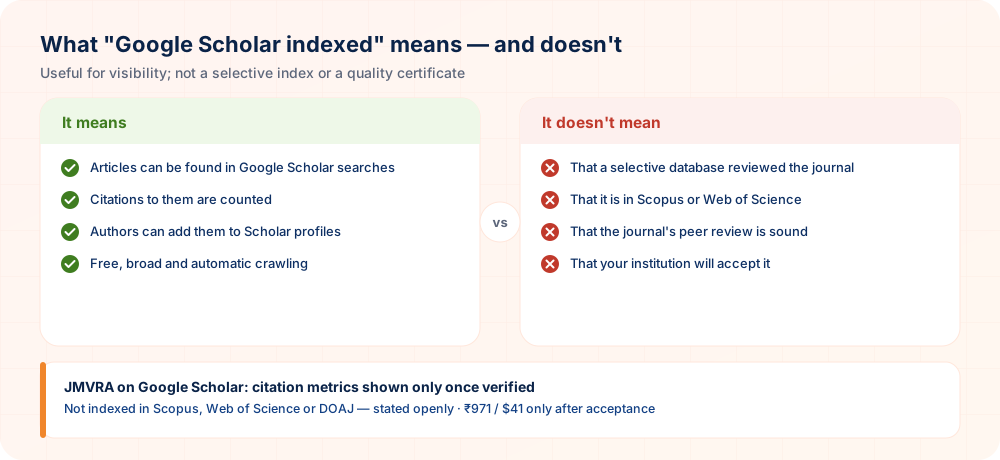
What It Means
- Google Scholar crawls the journal’s articles and makes them searchable
- Their citations are counted and displayed
- Authors are able to put them on their Scholar profiles
- Anyone around the world can find them at no cost
What It Does Not Mean
- That the journal was assessed for quality
- That peer review happened
- That your institution accepts the journal
- That the journal appears in Scopus or Web of Science
Google Scholar Compared with Selective Indexes
| Google Scholar | Scopus / Web of Science | |
|---|---|---|
| Selection | Automatic crawling | Assessment by experts against set criteria |
| Journal list | None published | Public lists |
| Coverage | Very broad | Selective |
| Metrics | h5-index; citations | CiteScore, SJR, JIF |
| Cost to search | Free | Searching sources is free; complete access needs a subscription |
Does It Suffice for You?
| Goal | Does Google Scholar indexing suffice? |
|---|---|
| Visibility and citations | Frequently, if the journal is genuine |
| Student project or first paper | Generally yes, provided the journal does review papers |
| PhD or promotion requirement naming particular indexes | Only where the rule allows it |
| Ranking contributions (NIRF) | No; these depend on selective databases |
Verifying the Claim
- Look up recent article titles. Use quotation marks on scholar.google.com.
- Use the journal filter. Advanced search → “Return articles published in”.
- Examine the citations. Do people cite the articles?
Does a Google Scholar-Indexed Journal Suit This Paper?
- Does your requirement list particular databases? If so, only those count — verify them.
- If it does not, does the journal truly use peer review? Look for evidence of review.
- Is the visibility genuine? Look up recent articles in Google Scholar.
- Are fees and identity clear? Look for published fees, ISSN and contact details.
- If every answer is yes: it may be a sound and visible choice for this paper.
The 10 Most-Searched Questions on This Topic
Here are the ten questions researchers search for most on this subject, each with a direct answer.
Google Scholar indexed journal for publication of research papers
A journal whose articles show up in Google Scholar; separately check that it reviews papers.
what is Google Scholar indexed journal
A journal whose articles Google Scholar has crawled and listed.
Google Scholar vs Scopus indexing
Scholar gathers articles automatically, whereas Scopus assesses journals before including them.
is Google Scholar indexing enough for PhD
Only when your university’s rule allows it.
Google Scholar indexed journals with low publication fee
There are plenty; verify the review process, DOI and transparency.
Google Scholar journal coverage
Very wide; takes in journals, theses, preprints and reports.
how to check Google Scholar indexing
Search for recent titles and apply the “published in” filter.
Google Scholar citation count
Citations that Google Scholar finds in many kinds of documents.
Google Scholar vs Web of Science
Scholar is wide and automatic, while Web of Science is selective and curated.
benefits of Google Scholar indexing
Visibility across the world at no cost, citation tracking and integration with profiles.
How JMVRA Fits In
JMVRA is a Transparent, Peer-Reviewed, Open Access Journal (Refereed Journal). Following the discontinuation of the UGC and UGC-CARE journal listing, and in alignment with the latest UGC-CARE recommendations and guidelines, JMVRA is aligned with UGC’s Suggested Parameters for Choosing Peer-Reviewed Journals. UGC public notice (PDF)
To be exact about indexing: Google Scholar indexes JMVRA articles and Crossref holds their registration, whereas Scopus, Web of Science and DOAJ do not index the journal.
- ISSN
- 2984-8911 (online) · publishing since June 2023
- Issues
- Monthly issues across many disciplines
- Review
- Two-way anonymous review by specialists
- Access
- Open access published under CC BY 4.0
- Fee
- ₹971 INR for Indian and $41 USD for foreign authors, due only after acceptance
- DOI
- Crossref — available as an optional extra
- Indexing
- Discoverable through Google Scholar; Scopus, Web of Science and DOAJ do not list it
- Impact factor
- 11.25, derived from Google Scholar data
Screening begins the moment a paper arrives and each decision is sent as soon as it is reached, yet JMVRA never promises a set number of days: actual review time depends on the reviewers and on how much revision the paper needs.
At-a-Glance Checklist
- Claim testedLook up recent article titles
- Selective indexes checkedScopus and Web of Science confirmed at source
- Requirement knownThe standard your institution accepts
- Review policy readBeing indexed is no proof of review
- Right journal for this paperVisibility that fits your aim
Checking a Google Scholar Claim Step by Step
- Put the journal name in quotation marks and search — limited to recent years
- Open a few articles — confirm they link back to the journal’s own pages
- Search for a title you know — it should show up as one correct record
- Check coverage across time — earlier issues should be included as well
Using Google Scholar Together with Other Indexes
| Source | Adds |
|---|---|
| Google Scholar | Wide discovery and citation counts |
| Crossref | Reference linking and DOI metadata |
| OpenAlex | Openly available scholarly metadata for analytics |
| Selective databases | Curated coverage that certain institutions require |
Practical Tips for Reading Scholar Inclusion Claims Wisely
Appearing in a search tool is helpful for discovery, but it does not describe quality on its own. These habits help you interpret such claims and choose a venue that suits your goals.
- Search the journal title yourself. Enter the journal's name in the search tool and see whether its articles show up with correct titles and links. Personal verification is more reliable than an advertisement.
- Look beyond discoverability. Ask separately about peer review, editorial transparency, ethics policies and long-term preservation. Findability alone says little about how carefully papers are examined.
- Match the venue to your requirement. Check what your institution or funder expects for promotion, degree rules or grants. Some purposes need more than discoverability, so confirm the requirement before choosing.
- Inspect article pages for completeness. Good records show clear titles, author affiliations, abstracts and stable links. Sparse or inconsistent pages may weaken how readers find and trust your paper.
- Combine sources of evidence. Use the journal's policies, its editorial board, sample articles and independent directories together. No single signal should decide your choice.
Treat search visibility as one helpful signal, and verify review quality and institutional fit through several independent checks.
Questions Researchers Often Ask
Where JMVRA Appears — With Current Figures
Look up Google Scholar coverage in a single minute
- Find by titlePaste the article’s title, exactly as it was published, into Google Scholar.
- Source filter:Type
source:"Journal Name"to list the papers that a journal contains. - Read the profileIf the journal has a citation profile, look through it.
Every record listed above can be reached from the Indexing & Discovery page; citation figures are added only once verified, and Crossref Search and OpenAlex open search results.
Ready to Publish? Submit to JMVRA
JMVRA is aligned with UGC's Suggested Parameters for Choosing Peer-Reviewed Journals.
JMVRA is a Transparent, Peer-Reviewed, Open Access Journal (Refereed Journal). Following the discontinuation of the UGC and UGC-CARE journal listing, and in alignment with the latest UGC-CARE recommendations and guidelines, JMVRA is aligned with UGC’s Suggested Parameters for Choosing Peer-Reviewed Journals.
Quick links across jmvra.org
Key Terms
Subjects and search phrases this article addresses.
Related Reading
Further reading on the same theme from the JMVRA blog.
Referred or Refereed Journal? The Real Meaning
Read the guide RelatedPeer Reviewed and Google Scholar Indexed: Check Both
Read the guide RelatedGoogle Scholar for Researchers: Profiles & Visibility
Read the guide RelatedGoogle Scholar and Your Research Paper: Getting It Indexed Step by Step
Read the guide RelatedScopus, Web of Science, DOAJ & Google Scholar Compared
Read the guide RelatedUGC-CARE Status & 10 Databases to Verify Journals
Read the guideKeep Reading on the JMVRA Blog
Our JMVRA journal blog carries this guide along with other practical advice on publishing, indexing, metrics and research integrity, all written so that claims can be verified and nothing is promotional.