
Every month, thousands of people type “referred journal” into search engines. What they nearly always mean is refereed: a journal whose papers are judged by independent referees, in other words a peer-reviewed journal. The spelling slip is minor; what counts is whether a journal really uses referees or merely says it does. When in doubt, ask to see the review process described in writing.
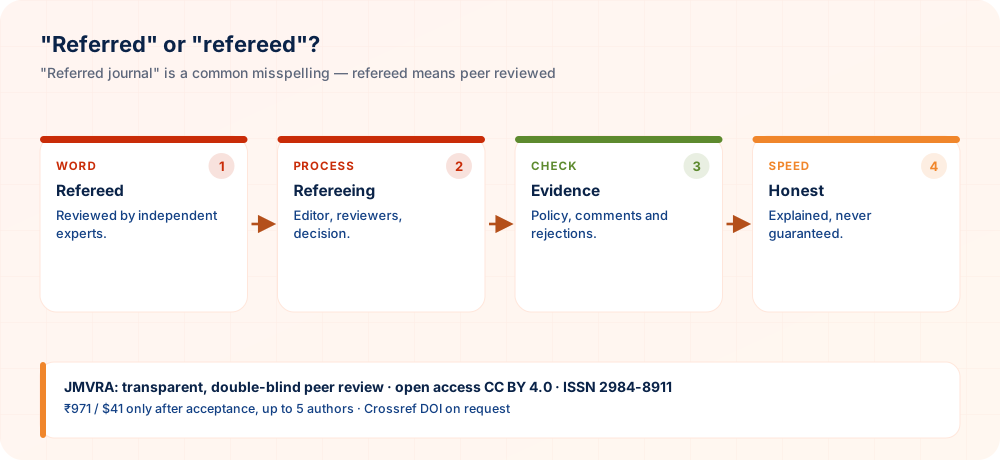
Refereed = Peer Reviewed
A referee is an independent expert who assesses a manuscript on behalf of a journal. A refereed journal passes submissions to referees before it decides whether to publish. In practice “refereed” and “peer reviewed” are interchangeable, and “referred journal” is just a frequent misspelling rather than a distinct category.
How Refereeing Works
- Editor screening. The editor looks at scope and baseline quality.
- Referee assignment. Typically two or more independent experts.
- Referee reports. Comments plus a recommendation for the editor.
- Editor’s decision. Accept, revise or reject, and the authors get the reports.
Ways to Confirm a Journal Is Really Refereed
- A refereeing policy that is published and names the review model
- Referee reports that reach the authors in practice
- Proof that papers are revised and rejected
- An editorial board made up of subject specialists
- Fees due only once a paper is accepted
Related Terms
| Term | Meaning |
|---|---|
| Refereed / peer reviewed | Judged by independent experts ahead of publication |
| Scholarly journal | Scholarly journal, normally refereed |
| Indexed journal | Listed in a database — a separate matter from refereeing |
| Open access | Free access for readers — also a separate matter |
Refereed and Fast?
Being refereed does not rule out efficiency. What no journal can do is referee a paper properly in a matter of hours or promise acceptance. Claims of speed that leave referees no time to read the manuscript contradict the very term “refereed”. A realistic timeline is a better sign than a dramatic promise.
Roles in the Refereeing Process
| Role | Responsibility |
|---|---|
| Author | Provides original work and answers the referees |
| Editor | Screens papers, picks referees and decides |
| Referee (reviewer) | Assesses the paper and suggests a decision |
| Editorial office | Handles correspondence, records and production |
Referees give advice, while the editor takes the decision. A journal with nobody in the referee role is not refereed, whatever label it uses.
The 10 Most-Searched Questions on This Topic
Here are the ten questions researchers search for most on this subject, each with a direct answer.
referred journal meaning
A frequent misspelling of “refereed journal”, meaning a peer-reviewed journal.
refereed journal meaning
A journal that passes submissions to independent expert referees before it publishes them.
referred vs refereed journal
Both are meant to say the same thing; “refereed” is the right spelling.
refereed journal vs peer reviewed
In practice the two terms are synonyms.
referee report
A written assessment and recommendation about a manuscript from an expert.
how to check refereed journal
Look for a review policy, referee reports, revisions and rejections.
refereed journal Google Scholar indexed
A peer-reviewed journal whose articles are also found in Google Scholar.
UGC refereed journal
Journals that satisfy institutional peer-review criteria; UGC no longer maintains a list.
refereed journal fast publication
Achievable through efficient handling, but never by bypassing referees.
non refereed journal meaning
A publication that has no independent expert review before it is published.
How JMVRA Fits In
JMVRA is a Transparent, Peer-Reviewed, Open Access Journal (Refereed Journal). Following the discontinuation of the UGC and UGC-CARE journal listing, and in alignment with the latest UGC-CARE recommendations and guidelines, JMVRA is aligned with UGC’s Suggested Parameters for Choosing Peer-Reviewed Journals. UGC public notice (PDF)
JMVRA is a refereed (peer-reviewed) journal: all submissions go to subject-expert referees through double-blind review, and authors are sent the decision together with comments.
- ISSN
- 2984-8911 (online) · publishing since June 2023
- Issues
- Monthly issues across many disciplines
- Review
- Two-way anonymous review by specialists
- Access
- Open access published under CC BY 4.0
- Fee
- ₹971 INR for Indian and $41 USD for foreign authors, due only after acceptance
- DOI
- Crossref — available as an optional extra
- Indexing
- You will find it through Google Scholar; Scopus, Web of Science and DOAJ do not include it
- Impact factor
- 11.25, derived from Google Scholar data
Screening begins the moment a paper arrives and each decision is sent as soon as it is reached, yet JMVRA never promises a set number of days: actual review time depends on the reviewers and on how much revision the paper needs.
At-a-Glance Checklist
- Spelling correctRefereed
- Process documentedPolicy page
- Comments realSpecific feedback
- Visibility checkedGoogle Scholar
- JMVRATransparent, peer-reviewed, refereed
Overview of Peer Review Models
| Model | Who knows whom | Notes |
|---|---|---|
| Single-blind | Reviewers can see author identities; authors cannot see reviewers | Widespread in many sciences |
| Double-blind | Neither party knows who the other is | Adopted by JMVRA; limits bias based on names and institutions |
| Open review | Identities, and at times reports, are disclosed | Gaining ground in some fields |
| Transparent review | Reports or process details are made public | JMVRA provides a transparent peer review report if requested |
Phrases You May Encounter and Their Meaning
“Refereed” / “peer reviewed”
Independent experts assess papers before they are accepted.
“Referred”
Normally a misspelling of refereed; examine the review policy rather than the label.
“Reviewed by editor”
Review by the editors alone, with no outside reviewers — this is not peer review.
“Guaranteed acceptance”
Cannot coexist with real peer review; treat it as a red flag.
Practical Tips for Verifying a Refereed Journal Claim
Many journals describe themselves as refereed, and the word alone proves little. These steps help you test the claim yourself and avoid confusing quick turnaround with proper scrutiny of your manuscript.
- Look for a described review process. A trustworthy journal explains who reviews papers, how many opinions are sought and how decisions are made. Vague phrases without any process description deserve extra caution.
- Check the editorial board independently. Search a few board members by name on their institutional pages and confirm that they really serve the journal. Unverifiable or irrelevant names are a warning sign.
- Treat speed with healthy suspicion. Fast decisions can be perfectly legitimate, but a promise of acceptance within days leaves no room for careful reading. Meaningful peer review takes time from volunteers.
- Expect substantive reviewer comments. Genuine refereeing produces specific remarks about methods, evidence and clarity. If you receive only generic praise or none at all, question what review actually took place.
- Spell the term correctly everywhere. Use refereed or peer reviewed in your CV and reports. Consistent, accurate wording avoids confusion with evaluation committees who may read your publication list closely.
Verify the review process, the board and the reviewer feedback yourself instead of relying on how a journal describes itself.
Questions Researchers Often Ask
Where JMVRA Appears — With Current Figures
Look up Google Scholar coverage in a single minute
- Look up the titlePut the article title, exactly as published, into the Google Scholar search field.
- Source filter:Type
source:"Journal Name"to show the papers that a journal contains. - View the profileStudy the journal’s citation profile, if available.
You can reach each record above from the Indexing & Discovery page, where the figures are dated 30 Sep 2026.
Ready to Publish? Submit to JMVRA
JMVRA is aligned with UGC's Suggested Parameters for Choosing Peer-Reviewed Journals.
JMVRA is a Transparent, Peer-Reviewed, Open Access Journal (Refereed Journal). Following the discontinuation of the UGC and UGC-CARE journal listing, and in alignment with the latest UGC-CARE recommendations and guidelines, JMVRA is aligned with UGC’s Suggested Parameters for Choosing Peer-Reviewed Journals.
Quick links across jmvra.org
Key Terms
Subjects and search phrases this article addresses.
Related Reading
Further reading on the same theme from the JMVRA blog.
Peer Reviewed and Google Scholar Indexed: Check Both
Read the guide RelatedGoogle Scholar for Researchers: Profiles & Visibility
Read the guide RelatedCheck a Journal's Google Scholar Coverage Yourself
Read the guide RelatedOpen Access, Peer Review, Impact Factor & UGC Parameters Norms — A Complete Guide
Read the guide RelatedRecognising a Predatory Journal
Read the guide RelatedGetting Your Research Paper into Google Scholar: The Indexing Process, Stage by Stage
Read the guideKeep Reading on the JMVRA Blog
Our JMVRA journal blog carries this guide along with other practical advice on publishing, indexing, metrics and research integrity, all written so that claims can be verified and nothing is promotional.