
Technical Access, Identifiers and Metadata
Three elements working in combination make a research paper easier to locate online: complete metadata (a correct title, abstract, keywords, authors and affiliations), persistent identifiers (a DOI, plus an ORCID iD for the author), and technical accessibility (an article page that crawlers can read, an accessible PDF, a canonical URL and structured data). No single one of them guarantees indexing in a particular database, but together they greatly raise the odds that automated discovery tools will find your work, describe it accurately and link it correctly. Checking each of these before you submit saves far more effort than trying to repair them afterwards.
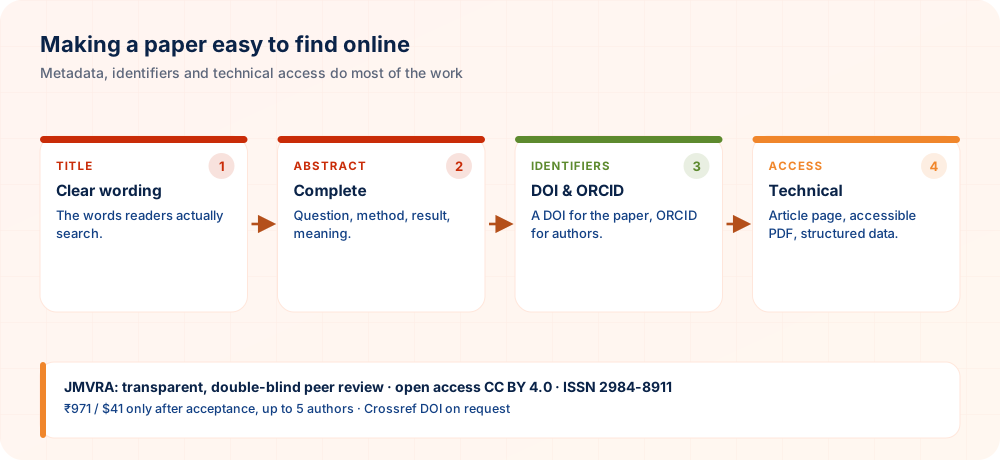
What Truly Drives Discoverability
Metadata
Every tool relies on this raw material: the title, abstract, keywords, authors, affiliations and a full reference list.
Identifiers
An article DOI and an author ORCID give lasting links that hold up through website changes and variations in names.
Technical access
HTML that crawlers can read, PDF text that is accessible, a canonical URL, a place in the sitemap, and structured data markup.
Discoverability Checklist
- The article page carries a visible HTML title, abstract, list of authors and keywords rather than offering just a PDF
- A complete reference list, each entry with full citation details
- Affiliations of authors written in full and in the same form each time
- A DOI registered along with full and correct metadata
- An ORCID iD attached for each author that holds one
- A canonical URL defined so duplicate addresses cause no confusion
- The article listed in the website's XML sitemap
- Robots meta tags permit indexing and have not been set to noindex by mistake
- Accurate structured data (schema.org markup) is in place
- The PDF has text you can select and extract, instead of being a flat scan
- Your name spelled identically in every one of your publications
Helping Readers Discover Your Published Paper
Publishing is only the first step; readers must also be able to find and trust your article. These actions are within every author's control and cost little time.
- Front-load the title's key terms. Place the main subject near the start of the title, using words that a researcher would actually type. Avoid clever wordplay that searchers and indexing tools cannot interpret.
- Write an abstract that stands alone. Many readers see only the abstract, so state the problem, method, result and implication clearly. Repeat natural keyword phrases instead of stuffing in unrelated terms.
- Keep your profile current. Maintain an up-to-date ORCID record and institutional page, and link them to your paper. A consistent identity connects your works and helps readers explore your other outputs.
- Share responsibly after publication. Post the article link on your academic profile and mention it in talks or newsletters. Respect the licence and avoid sending unsolicited messages to large groups of strangers.
- Make the PDF accessible. Use real text instead of scanned images, add descriptive captions and keep a logical heading structure. Accessible files serve screen reader users and also work better for search tools.
Clear titles, helpful abstracts, a consistent author identity and accessible files make your paper easier for the right readers to reach.
Rewriting a Title to Be Findable: Before and After
| Weak | Stronger |
|---|---|
| A Study on Water | Groundwater Nitrate Levels in Rural Gujarat: A Seasonal Analysis |
| New Approach for Detection | Lightweight CNN for Leaf Disease Detection on Mobile Devices |
| Impact of Social Media | Instagram Use and Sleep Quality Among Undergraduate Students |
Promoting Your Paper Once It Is Published
- Circulate the DOI or article link — instead of a copy of the PDF
- Draft a simple summary — two or three sentences
- Share it where your readers are — on professional networks and mailing lists
- Refresh your profiles — ORCID and Google Scholar
Discoverability FAQs
Which one factor matters most?
Full and correct metadata, because almost every discovery tool further along the chain relies on it.
Does having a DOI boost discoverability directly?
Not directly; it passes structured metadata on to registries that discovery tools draw from.
What is the point of an accessible PDF?
Crawlers can only process real text, so a scanned image is practically invisible to them.
Does ORCID help?
Yes — it brings all your publications together under a single lasting identifier.
What does canonical URL mean?
It is the one official address of an article, so no duplicate URL can cause confusion.
Is structured data really useful?
It lets tools read metadata dependably, but it does not promise a better ranking.
Is it possible to improve discoverability once a paper is out?
Yes — fixing metadata where it originates still improves how the paper is represented later.
Is sharing on social media useful?
It may boost visibility, yet it cannot take the place of accurate metadata and identifiers.
Is it wise to put keywords in my title?
Yes — precise terms that people actually search for guide readers and search engines to your paper.
May I post the PDF on social media?
Yes for CC BY 4.0 articles, provided you credit the source, though pointing people to the article page remains the better option.
Related Searches
Get the Metadata Right From the Moment of Submission
Taking care over the title, abstract, keywords and author details when you submit eases every later discovery step.
Submit Paper OnlineAt-a-Glance Checklist
- Title easy to searchMain terms up front
- Abstract finishedResults included
- Registration of the DOIThen sharing it
- ORCID connectedEach author included
- PDF made accessibleReal text, no scans
Anatomy of a JMVRA DOI
Resolver → prefix 10.5555 (an example Crossref prefix) → suffix: journal, volume 14, issue 9, article identifier. A format example: doi.org/10.5555/12345678
Search for any JMVRA DOI in Crossref Search or in the Crossref journal record, whichever suits you.
Ready to Publish? Submit to JMVRA
JMVRA is aligned with UGC's Suggested Parameters for Choosing Peer-Reviewed Journals.
JMVRA is a Transparent, Peer-Reviewed, Open Access Journal (Refereed Journal). Following the discontinuation of the UGC and UGC-CARE journal listing, and in alignment with the latest UGC-CARE recommendations and guidelines, JMVRA is aligned with UGC’s Suggested Parameters for Choosing Peer-Reviewed Journals.
Quick links across jmvra.org
Key Terms
Subjects and search phrases this article addresses.
Related Reading
Further reading on the same theme from the JMVRA blog.
Crossref DOI for Your Published Paper: What It Is For and How to Get One
Read the guide RelatedHow DOI, ISSN & Metadata Drive Citations
Read the guide RelatedORCID iD: The Researcher ID Everyone Needs
Read the guide RelatedISBN, ISSN and DOI: Three Identifiers Compared
Read the guide RelatedFree Zenodo DOIs: Uses and Limits
Read the guide RelatedCrossref DOI: How Registration and Metadata Work
Read the guideKeep Reading on the JMVRA Blog
Our JMVRA journal blog carries this guide along with other practical advice on publishing, indexing, metrics and research integrity, all written so that claims can be verified and nothing is promotional.