
Three Layers, Each With Its Own Identifier
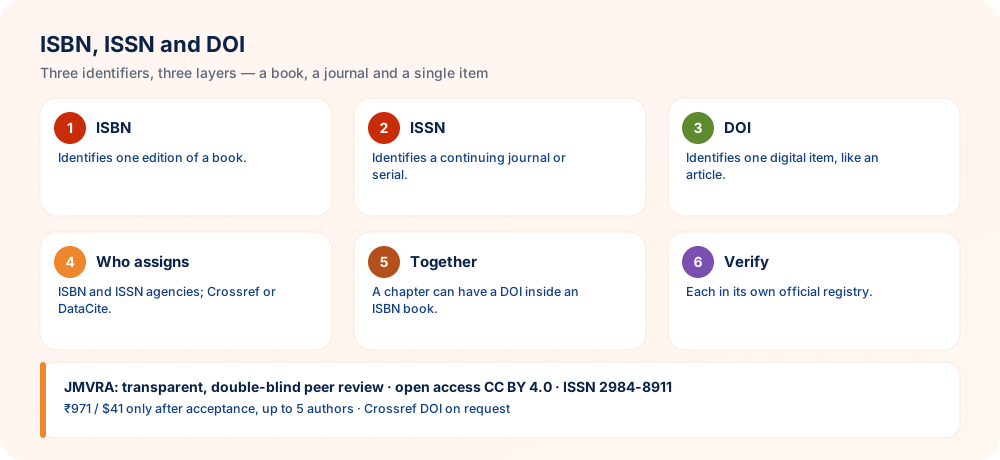
ISBN marks one particular book edition. ISSN marks a continuing serial publication, meaning a journal title and not a single issue or article. DOI marks one particular digital object, such as an article, book chapter, dataset or, less often, a whole book, and it is designed to keep resolving even when the underlying web address changes. The three cannot stand in for one another, and none of them alone vouches for quality, peer review or indexing status. Quote whichever identifier fits the thing you are citing.
The Comparison Table
| Identifier | What it identifies | Assigned by | Assigned to | Example use |
|---|---|---|---|---|
| ISBN | One book edition | National ISBN agency | Assigned once for each edition/format | Academic book, monograph, textbook |
| ISSN | A serial title that continues | National ISSN centre | Assigned once for each journal title (print and/or online) | Journal, magazine, annual report |
| DOI | One particular digital object | Registration agency (Crossref, etc.) | For each article/chapter/dataset, or sometimes for a whole book | Journal article, book chapter, dataset |
ISBN, in Detail
978Prefix93Country/region groupXXXXXPublisher + title codeXCheck digitAn ISBN (International Standard Book Number) is a 13-digit number that points to one particular edition and format of a book, so a hardcover, a paperback and an ebook of the same title each normally carry a separate ISBN. It reveals nothing about the quality of the content; its role is to let booksellers, libraries and distributors refer to that exact edition without ambiguity.
ISSN, in Detail
An ISSN (International Standard Serial Number) is an 8-digit code for a continuing publication, which means a journal and not an individual issue or article inside it. A journal that has both print and online editions may hold a separate print ISSN and eISSN. The ISSN does not signal peer review, indexing or institutional recognition on its own; it only identifies a serial title. Treat it as a way to find the right record, not as a measure of standing.
The ISSN of JMVRA is 2984-8911.
DOI, in Detail
A DOI (Digital Object Identifier) points to one particular digital object, most often a single journal article but also book chapters, datasets, conference papers and, less frequently, entire books. A plain web URL can break, but a DOI is built to resolve permanently: when the article's real web address changes years afterwards, the DOI link goes on working because the registration agency updates its target.
Agencies such as Crossref (the standard route for journal and scholarly publishing) and DataCite (often used by repositories, Zenodo included) handle DOI registration. For the full detail, see our dedicated Crossref DOI guide and Zenodo/DataCite guide.
How the Three Fit Together for One Work
Journal article
The journal holds an ISSN, and the individual article may have a DOI of its own. No ISBN is involved.
Academic book
The book holds an ISBN, and separate chapters may each receive a DOI if the publisher registers one.
Conference proceedings
Might hold an ISBN (as a book-style volume) or an ISSN (if issued as a continuing series), with DOIs for single papers where arranged.
An ISBN, ISSN or DOI assures a reader only that a work is properly identified and can be cited; it does not show that the work was peer reviewed, that it is indexed anywhere, or that anyone will cite it. Judge the real publishing practices on their own. Look at the policies and the editorial record, not the number printed on the page.
Using ISBN, ISSN and DOI Correctly in Your Work
Identifiers are small details that cause large problems when entered wrongly. Use these checks when you cite, submit or register scholarly outputs so each identifier points to the right thing.
- Match the identifier to the object. Use an ISBN for a book, an ISSN for a continuing publication and a DOI for a single article or chapter. Mixing them in a reference list confuses readers and indexing tools.
- Copy identifiers instead of retyping. Paste identifiers from the official source to avoid transposed characters. A single wrong character can send readers to a different work or to nothing at all.
- Test every link before submission. Open each DOI link in your reference list and confirm it lands on the intended item. Fixing broken references yourself is quicker than waiting for a copyeditor to find them.
- Verify at the issuing body. Confirm an identifier through the register that issued it, not through the publication's own claim. This habit quickly reveals invented or mismatched numbers on unfamiliar websites.
- Keep formats consistent. Follow your target style guide for displaying identifiers, including punctuation and the use of full link form. Consistency makes your references look careful and helps software read them properly.
Use the right identifier for each kind of work, copy it exactly, and verify it at the register that issued it.
Examples Gathered on a Page
| Identifier | Value |
|---|---|
| ISSN | 2984-8911 (the journal) |
| DOI | https://doi.org/10.5555/… (the article, on request) |
| ORCID | Each author’s iD, where provided |
Common Mix-Ups
ISBN for a journal
Journals use ISSNs.
ISSN taken as proof of quality
It is just an identifier.
A DOI for an entire journal
A DOI normally points to single items.
Leaving out the https link
Cite DOIs as links.
FAQs on ISBN / ISSN / DOI
What is the easiest way to keep the difference in mind?
ISBN = a single book edition. ISSN = a journal title that continues. DOI = one particular digital object that resolves permanently.
Is it necessary for a journal to hold both an ISSN and a DOI?
The ISSN marks the journal title, while DOIs are usually registered article by article, so a journal can have either without the other.
Is an ISSN needed for a book?
No. Books take an ISBN, and an ISSN is meant only for continuing serials.
Is it possible for a book chapter to have its own DOI?
Yes, when the publisher registers one, next to the ISBN of the book itself.
Does an ISBN or ISSN bring a DOI along automatically?
No. Each is a separate registration process run by a different organisation.
Which ISSN does JMVRA have?
2984-8911; consult the current documentation page for the authoritative figure.
Are DOIs provided by JMVRA for published articles?
Yes, as an optional extra that is separate from the basic publication fee.
Is a DOI equal to a web URL?
No. A URL can stop working, but a DOI is designed to go on resolving even once a site is reorganised.
Which bodies assign ISBN, ISSN and DOI?
ISBNs come from national ISBN agencies, ISSNs from national ISSN centres, and a DOI from a DOI registration agency such as Crossref.
Is indexing or citation assured by registering any of these?
No. They are identifiers and carry no guarantee of quality or indexing.
Is a DOI possible for a book chapter?
Yes. Chapter DOIs are often registered by publishers.
Is an ISBN or ISSN given to a conference proceedings volume?
It may hold either one or both, according to the way it is published.
Related Searches
Verification From the Source
Publishing a Paper? Make Every Identifier Correct
JMVRA issues ISSN 2984-8911 to every article, with optional Crossref DOI registration on request.
Submit Paper OnlineAt-a-Glance Checklist
- Correct identifierMatched to what you publish
- Format rightISBN 13 digits, ISSN 8
- Registry consultedOfficial record located
- DOI worksAt doi.org
- Full citationWith every relevant identifier
Anatomy of a JMVRA DOI
Resolver → prefix 10.5555 (an example Crossref prefix) → suffix: journal, volume 14, issue 9, article identifier. A format example: doi.org/10.5555/12345678
Doubt whether a JMVRA DOI is genuine? Check it using Crossref Search or the Crossref journal record.
Ready to Publish? Submit to JMVRA
JMVRA is aligned with UGC's Suggested Parameters for Choosing Peer-Reviewed Journals.
JMVRA is a Transparent, Peer-Reviewed, Open Access Journal (Refereed Journal). Following the discontinuation of the UGC and UGC-CARE journal listing, and in alignment with the latest UGC-CARE recommendations and guidelines, JMVRA is aligned with UGC’s Suggested Parameters for Choosing Peer-Reviewed Journals.
Pages worth visiting on jmvra.org
Key Terms
Subjects and search phrases this article addresses.
Related Reading
Further reading on the same theme from the JMVRA blog.
What Is a DOI? Crossref and DataCite Explained, with Deposit and Resolution
Read the guide RelatedORCID iD: The Researcher ID Everyone Needs
Read the guide RelatedZenodo DOI or Journal Crossref DOI? Choosing Right
Read the guide RelatedCrossref DOI: How Registration and Metadata Work
Read the guide RelatedFree Zenodo DOIs: Uses and Limits
Read the guide RelatedPublishing an Academic Book: ISBN, DOIs & Process
Read the guideKeep Reading on the JMVRA Blog
As part of the JMVRA journal blog, this guide shares practical help on publishing, indexing, metrics and research integrity, and is written to be verifiable rather than promotional.