
Two Routes to a DOI: Zenodo (Free) or Crossref (via JMVRA)
Researchers often wonder whether a "free DOI" can replace one paid for through a journal. The honest reply is that it all hinges on what the DOI is for. Zenodo does give out DOIs at no cost, but for a purpose different from that of a Crossref DOI issued to your published journal article. Mixing the two up can cost you academic credit if you treat one as a stand-in for the other.
What Is Zenodo?
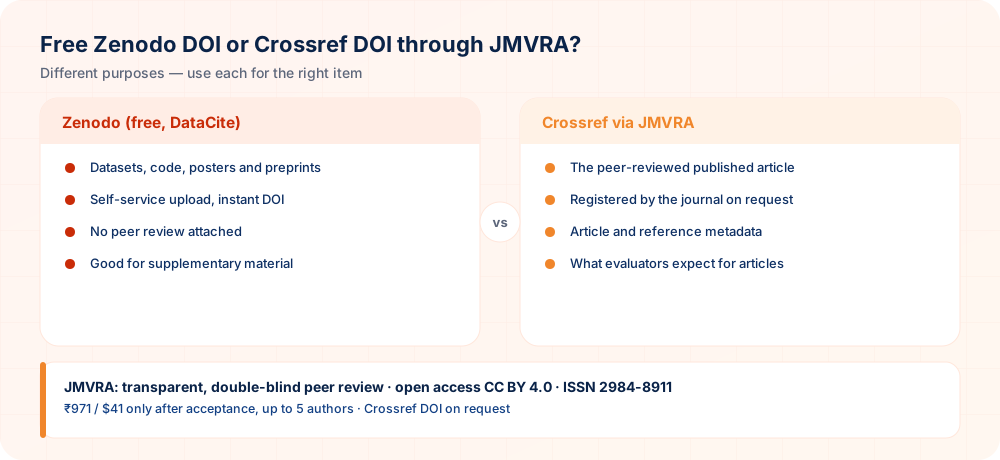
Zenodo is an open-access repository, free to use and operated by CERN (the European Organization for Nuclear Research). Researchers upload their own datasets, software, code, preprints, slides and similar outputs, and every deposit gets a no-cost DOI that comes from the repository's own DOI agency instead of Crossref.
Crossref in Brief
Crossref is the official DOI Registration Agency that journals around the world, JMVRA included, use to register DOIs for published, peer-reviewed scholarly literature. In contrast to Zenodo's free self-deposit model, the Crossref DOI for a journal article is issued by the publisher (the journal) and tied to that journal's own Crossref membership, metadata standards and editorial record. The complete technical explanation of Crossref DOI registration is in What is a DOI? Crossref DOI Explained.
Comparison Table: Zenodo and Crossref DOI
| Factor | Zenodo | Crossref (via JMVRA) |
|---|---|---|
| Cost | Free | a small optional charge (ask the editorial office), on request |
| Who issues it | You, through self-deposit | JMVRA, as the journal publishing the paper |
| Registration agency | the DOI agency of the repository | Crossref |
| Represents peer review? | No | Yes — linked to a published, peer-reviewed article |
| Best for | Datasets, code, preprints and supplementary material | Your final article, published after peer review in a journal |
| Does it count for UGC CARE / API / PhD? | No, on its own | Yes, as a component of genuine journal publication |
When Is Zenodo the Right Choice?
- When you want your raw dataset or code repository to be permanently citable next to your published paper.
- When a preprint should be made public ahead of, or while undergoing, peer review to gain early exposure.
- When you need to archive conference slides, posters or supplementary files that a journal does not host itself.
It is common for authors to combine the two. The underlying dataset gets a Zenodo DOI, the final published article gets a Crossref DOI via the journal, and each record refers to the other. Readers can then move easily between data and paper.
Obtaining a Free DOI on Zenodo — Step by Step
- Visit zenodo.org and log in (institutional or ORCID login is supported).
- Press "New Upload" and choose the fitting resource type (dataset, software, presentation and so on).
- Add your file and fill in the metadata: title, authors, description and license.
- Publish the deposit, and Zenodo at once assigns a free DOI automatically.
Obtaining a Crossref DOI for Your JMVRA Paper — Step by Step
- Send your paper in via JMVRA Call for Papers – ISSN 2984-8911 and go through peer review in the usual way.
- Ask for DOI registration as an add-on at submission or following acceptance.
- Pay the base publication fee (₹971 INR / $41 USD) plus the a small optional charge (ask the editorial office) DOI add-on — see the cost calculator for an itemised quotation.
- After publication, JMVRA deposits the metadata of your article with Crossref and your DOI becomes active, normally within 24–72 hours of registration.
- Confirm that your DOI resolves properly at doi.org.
Mistakes to Steer Clear Of
- Taking a Zenodo DOI as evidence of publication — it shows a deposit was made, not that peer review took place or a journal accepted the work.
- Assuming every DOI carries equal weight for UGC CARE/API purposes — only a DOI linked to genuine peer-reviewed journal publication does.
- Skipping cross-references — if you use both, cite your Zenodo dataset DOI within the published paper (and the reverse) so readers can find each.
At-a-Glance Checklist
- Item type settledData or article
- Zenodo licence chosenFor uploads
- Article DOI asked forOnce accepted
- Records connectedZenodo ↔ article
- Both verifiedAt doi.org
Citing a DOI the Right Way
- Write the complete link — https://doi.org/10.xxxx/xxxxx
- Put it last in the reference — which is what most styles ask for
- Make sure it resolves — prior to submitting
- Leave out “Retrieved from” — when giving DOIs in APA 7
Common DOI Mistakes
| Mistake | Fix |
|---|---|
| Offering the dataset DOI in place of the article's | Cite every output using its own DOI |
| Keying in the DOI manually | Paste it from the record |
| Citing a preprint's DOI once the paper is published | Cite the version that was published |
| Assuming a DOI shows the work is indexed | A DOI identifies; it does not signal indexing |
Deciding Where Your Data or Article Identifier Should Come From
Not every research output needs the same type of identifier. A little planning at the start helps you avoid duplicate registrations and citations that confuse readers.
- Classify your output first. Decide whether you are sharing a data set, a code package, a preprint or a refereed article. The type of output usually points to the most suitable registration route.
- Avoid two identifiers for one version. Registering the same final article in two places creates competing citations. If you must deposit copies, clearly link them and name which record is the version of record.
- Describe files thoroughly. When depositing material in a repository, write a full description, licence and author list. Rich descriptions make the item understandable long after you stop working on it.
- Reference your data in the paper. Cite the data identifier inside the article's data availability statement so readers can move easily between the paper and its underlying files.
- Read the terms before uploading. Check what each service allows regarding versions, deletions and licences. Some choices are difficult to reverse once an identifier has been issued.
Match the identifier to the kind of output, avoid registering the same version twice and link related records so citations stay clear.
Questions Researchers Often Ask
Anatomy of a JMVRA DOI
Resolver → prefix 10.5555 (an example Crossref prefix) → suffix: journal, volume 14, issue 9, article identifier. A format example: doi.org/10.5555/12345678
Use Crossref Search or the Crossref journal record and a JMVRA DOI can be verified in seconds.
Ready to Publish? Submit to JMVRA
JMVRA is aligned with UGC's Suggested Parameters for Choosing Peer-Reviewed Journals.
JMVRA is a Transparent, Peer-Reviewed, Open Access Journal (Refereed Journal). Following the discontinuation of the UGC and UGC-CARE journal listing, and in alignment with the latest UGC-CARE recommendations and guidelines, JMVRA is aligned with UGC’s Suggested Parameters for Choosing Peer-Reviewed Journals.
Helpful pages on jmvra.org
Key Terms
Subjects and search phrases this article addresses.
Related Reading
Further reading on the same theme from the JMVRA blog.
Does This DOI Work? Resolution & Metadata Checks
Read the guide RelatedDOIs Explained: Crossref, DataCite, Deposit & Resolve
Read the guide RelatedFree Zenodo DOIs: Uses and Limits
Read the guide RelatedDOI Explained
Read the guide RelatedORCID iD: The Researcher ID Everyone Needs
Read the guide RelatedISBN, ISSN and DOI: Three Identifiers Compared
Read the guideKeep Reading on the JMVRA Blog
This guide belongs to the JMVRA journal blog, which offers practical advice on publishing, indexing, metrics and research integrity, written to be checkable instead of promotional.