
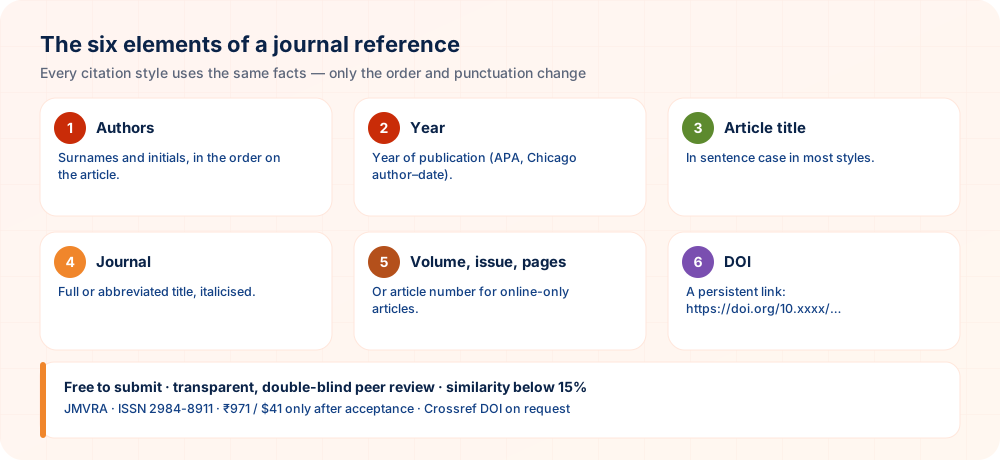
Citing a journal article properly serves three purposes: it gives credit to the authors, helps readers locate the source, and shields you from accusations of plagiarism. All citation styles rely on the same core details — authors, year, title, journal, volume, issue, pages and DOI — and vary only in sequence and punctuation. Here you will find the parts of a full reference, one article shown in four major styles, and a method for checking your reference list before submission.
Why Accurate Citation Matters
- Credit: citations are the way researchers recognise one another’s work, and they underpin citation counts and metrics.
- Verifiability: every source must be findable and checkable by readers and reviewers.
- Integrity: drawing on ideas, data or text without a citation counts as plagiarism, even if it happens by accident. Read the plagiarism guidelines.
- Discoverability: citation databases automatically match complete references that include DOIs, so the authors you cite get the credit.
The Parts of a Complete Reference
| Element | Where to find it | Notes |
|---|---|---|
| Authors | Article header | Every author in printed order; look up the style’s cap for long author lists |
| Year | Article heading or citation line | Year in which the version of record appeared |
| Article title | Article header | Reproduce it exactly; sentence case is used by most styles |
| Journal title | Journal masthead | Either the full name or the official abbreviation, as the style dictates |
| Volume and issue | Citation line or the journal’s page | Certain journals give article numbers rather than page ranges |
| Page range or article number | PDF or citation line | Write ranges with an en dash: 100–110 |
| DOI | Article page or PDF | Most current styles write it in the form https://doi.org/… |
One Article Shown in Four Styles
The patterns that follow contain placeholder details, which you should swap for the actual information of the article you are citing.
| Style | Pattern |
|---|---|
| APA 7 | Author, A. A., & Author, B. B. (2024). Title of the article. Journal Name, 12(3), 100–110. https://doi.org/10.xxxx/xxxxx |
| IEEE | [1] A. A. Author and B. B. Author, “Title of the article,” Abbrev. J. Name, vol. 12, no. 3, pp. 100–110, 2024, doi: 10.xxxx/xxxxx. |
| Vancouver | 1. Author AA, Author BB. Title of the article. Abbrev J Name. 2024;12(3):100-10. doi:10.xxxx/xxxxx |
| Chicago (author–date) | Author, Anna A., and Ben B. Author. 2024. “Title of the Article.” Journal Name 12 (3): 100–110. https://doi.org/10.xxxx/xxxxx. |
APA is the standard in the social sciences, education and psychology, IEEE in engineering and computing, Vancouver in medicine and health sciences, and Chicago in history and the humanities. Follow whichever style your journal prescribes; our guides to APA format and IEEE format explain more.
In-Text Citations
| System | Example | Used by |
|---|---|---|
| Author–date | (Author & Author, 2024) or Author and Author (2024) | APA, Chicago author–date, Harvard |
| Numbered, brackets | …as reported earlier [1]. | IEEE |
| Numbers, superscripts or parentheses | …as reported earlier.1 or (1) | Vancouver |
When a work has three or more authors, APA shortens to “et al.” starting at the first citation. Numbered systems give a source one number that it keeps whenever it is cited again.
Citing DOIs
A DOI (Digital Object Identifier) is an article’s lasting identifier. Add it whenever the article has one: as a link such as https://doi.org/10.5555/… in APA and Chicago, or as “doi: 10.xxxx/xxxxx” in IEEE and Vancouver. If a DOI is missing, search for the article title at Crossref to find it. Copy the DOI from the article page rather than retyping it, which avoids small typing errors. More detail is in DOI explained and citing DOIs correctly.
Special Cases
- Online-first articles: include the DOI together with “Advance online publication” (APA) or the year it appeared online, then revise the reference once a volume and pages are assigned.
- Preprints: name the preprint server and identifier and state that the work is a preprint; once a published version exists, cite that instead.
- Retracted articles: do not use them as evidence, and if you need to discuss one, cite the retraction notice too.
- Secondary citations: cite the work you really read, and refer to the original with “as cited in”.
- Articles in other languages: provide the original title and, when the style asks for it, an English translation inside square brackets.
Citing a JMVRA Article
The page of each JMVRA article lists the authors, title, volume, issue, pages and paper ID. A full reference in APA style takes this form:
Author, A. A., & Author, B. B. (Year). Title of the article. Journal of Modern and Versatile Research Approach (JMVRA), Volume(Issue), pages. https://doi.org/10.5555/… (if a DOI has been registered)
JMVRA’s ISSN is 2984-8911. A Crossref DOI under the Crossref DOI on request is available on request; where one exists, include it.
Checking Your References
- Each in-text citation should correspond to a reference entry, and each entry to a citation.
- Compare author name spellings and years with the original.
- Click every DOI link once to test it.
- Look for retractions before depending on a source.
- Keep punctuation and capitalisation in line with the style.
Most of this work can be handled by a reference manager; compare options in Mendeley vs Zotero vs EndNote.
Citation Checklist
- Style confirmedThe style the journal prescribes
- All elements presentEvery item: authors, year, title, journal, volume and pages
- DOIs includedWritten in the style’s format
- Citations matchedText and list correspond in both directions
- Sources readNothing taken from other reference lists without reading it
- Retractions checkedNo withdrawn paper used as evidence
Reference Managers
| Tool | Notes |
|---|---|
| Zotero | Free and open source, with a browser connector |
| Mendeley | Free reference manager |
| EndNote | Paid product, widely used by institutions |
| JabRef | Free option for users of BibTeX and LaTeX |
Compare any generated reference with the article page every time.
Citing Material You Found in Another Paper
Avoiding Common Mistakes When Citing Journal Articles
Most citation errors come from haste rather than ignorance. These tips build routines that keep your reference list accurate, consistent and easy for readers to follow.
- Copy details from the article itself. Take author names, title and publication details from the published article, not from a secondary list. Secondary sources sometimes contain typing mistakes that then spread through your paper.
- Cite as you write. Add each reference at the moment you use an idea. Rebuilding citations at the end invites missing entries and mismatches between text and list.
- Keep one style throughout. Follow the style required by your target journal for every reference, including punctuation and capitalisation. Mixed styles look careless and may delay acceptance.
- Match each in-text citation to an entry. Compare the body text against the reference list in both directions. Remove entries nobody cited and add any that are missing.
- Read the cited source yourself. Cite only works you have actually consulted. If you rely on a secondary mention, say so honestly, as misattributed claims can mislead readers and embarrass authors.
Cite while writing, copy details carefully and cross-check text against the list, so readers can trust and trace every source.
Questions Researchers Often Ask
In Summary
Each reference rests on the same essential facts: authors, year, title, journal, volume, issue, pages and DOI. Pick the style your journal requests, use it consistently, add DOIs and verify each entry against the original. Careful citation takes little effort yet protects your credibility and acknowledges the work you build on. Check the list one final time before submitting, because small slips are easy to miss.
Ready to send in your paper?
Submitting a paper to JMVRA happens online and costs nothing. After screening, your manuscript receives transparent, double-blind peer review, and the ₹971 INR (Indian authors) or $41 USD (foreign authors) fee applies only once it is accepted.
References and Sources
How a Draft Becomes a Published Paper
- PrepareUse the template and observe the author guidelines
- Submit onlineFree of cost; keep your paper ID
- ScreeningFit with scope, required declarations, similarity of less than 15%
- Double-blind reviewDecision by email and WhatsApp
- AcceptedFee of ₹971 INR / $41 USD, and then publication in open access
Further information: Publication guidelines · Peer review · Publication charges.
Ready to Publish? Submit to JMVRA
JMVRA is aligned with UGC's Suggested Parameters for Choosing Peer-Reviewed Journals.
JMVRA is a Transparent, Peer-Reviewed, Open Access Journal (Refereed Journal). Following the discontinuation of the UGC and UGC-CARE journal listing, and in alignment with the latest UGC-CARE recommendations and guidelines, JMVRA is aligned with UGC’s Suggested Parameters for Choosing Peer-Reviewed Journals.
Quick links across jmvra.org
Key Terms
Subjects and search phrases this article addresses.
Related Reading
Further guides for writing and publishing your research paper.
Keep Reading on the JMVRA Blog
Our JMVRA journal blog carries this guide along with other practical advice on publishing, indexing, metrics and research integrity, all written so that claims can be verified and nothing is promotional.