

IEEE style is standard across electrical and electronics engineering, computer science, communications and other technical areas. Its hallmarks are numbered citations in square brackets, compact references and, for conferences and many journals, two-column pages. Here is the IEEE format for a research paper, from the template to equations and figures, so reviewers in technical fields see a manuscript that looks right.
When IEEE Style Is the Right Choice
Choose IEEE style when the journal or conference calls for it, or when your readers are engineers or computing specialists who expect numbered references. When submitting to JMVRA, follow the author guidelines and the journal template; numbered (IEEE-style) references are acceptable provided they are complete and applied consistently. Whichever style you use, check every reference against its source before submitting.
If your target is an IEEE conference, read our IEEE conference paper submission guide too, which deals with PDF eXpress, registration and IEEE Xplore.
The IEEE Template
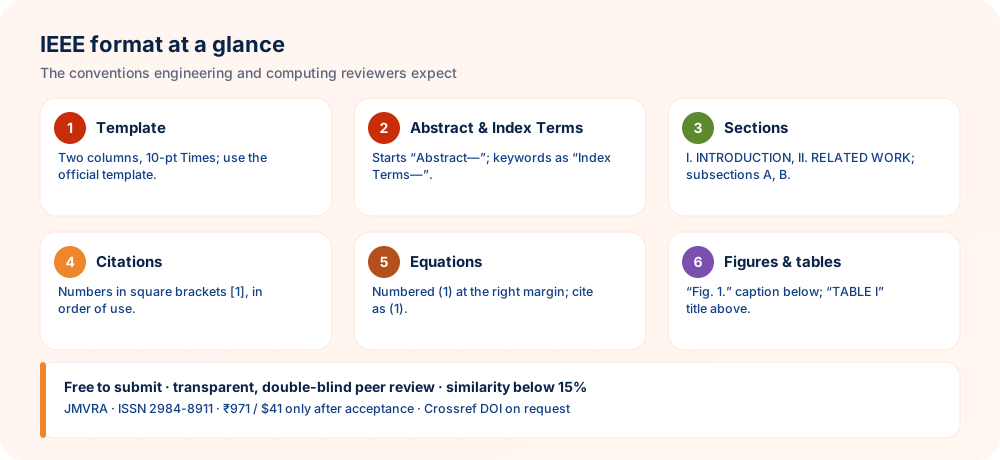
IEEE provides official Word and LaTeX templates for conferences and journals. Download the one your venue names and write directly inside it instead of imitating its appearance. The usual conference settings are:
| Element | Typical setting |
|---|---|
| Layout | Two columns on US Letter or A4, depending on the venue |
| Body text | Times New Roman (or Times) 10 pt, single line spacing, justified text |
| Title | Big (around 24 pt), centred, in title case |
| Section headings | Roman numerals in small capitals, centred: I. INTRODUCTION |
| Subsection headings | Capitals and italics: A. Data Collection |
| Page limit | Decided by the conference; often 4 to 8 pages with references included |
Title, Authors, Abstract and Index Terms
- Title: specific and easy to search; skip abbreviations unless everyone knows them.
- Authors: full names, departments, institutions, cities, countries and email addresses, laid out in the block format the template gives. Take them out for double-blind review.
- Abstract: one paragraph opening with “Abstract—”, generally no longer than about 250 words, free of citations, figures and undefined abbreviations.
- Index Terms: a brief set of keywords starting with “Index Terms—”, arranged alphabetically.
Section Structure
A typical IEEE paper is organised as I. Introduction, II. Related Work, III. Methodology (or Proposed System), IV. Experiments and Results, V. Discussion and VI. Conclusion, and it closes with Acknowledgment (unnumbered, and spelled the American way) and References (also unnumbered). Subsections take the letters A, B, C, while sub-subsections use 1), 2), 3). Sticking closely to this order makes it easier for reviewers to find what they are looking for.
State your contribution plainly. Close the introduction with a brief list of what the paper adds, and confirm that the experiments section puts every claim to the test.
Citation Rules in IEEE Style
Sources are numbered in square brackets according to the order of their first citation, and a source keeps its original number each time it is cited later.
- For one source, write “…as shown in [3].”
- Multiple sources: list the numbers as [2], [5], [7], or give a range, [2]–[5].
- Used as a noun phrase: “In [4], the authors propose…”; still, naming them tends to read better: “Rao et al. [4] propose…”
- Put the bracketed number within the sentence, ahead of the period.
The Reference List
Arrange the reference list by number, following the order of citation rather than alphabetically. Names appear with initials first, and normally as many as six authors are named before “et al.” takes over. Whatever the order, the list should match the in-text numbers one for one.
Journal article (pattern):
[1] A. B. Author, C. D. Author, and E. F. Author, “Title of the article in sentence case,” Abbrev. Title of Journal, vol. 12, no. 3, pp. 100–110, Mar. 2024, doi: 10.xxxx/xxxxx.
Conference paper (pattern):
[2] A. B. Author, “Title of the paper,” in Proc. Abbrev. Name of Conf., City, Country, 2024, pp. 1–6, doi: 10.xxxx/xxxxx.
- Abbreviate journal titles using IEEE’s standard list and set them in italics.
- Put article titles in sentence case and enclose them in quotation marks.
- Add the DOI wherever one is available, since it lets readers verify the reference and supports automatic citation matching.
Handling Equations, Units and Symbols
Displayed equations are numbered in sequence, with the number in parentheses at the right margin; in the text, cite them as “(1)”, or write “Equation (1)” when starting a sentence. Prefer an equation editor or LaTeX to pictures of equations. Variables go in italics, whereas units and standard functions (sin, log) stay upright. Use SI units with a space separating the number from the unit (10 mm), and explain each symbol where it first appears. Consistent notation from start to finish spares reviewers from guessing what a symbol means.
Figures and Tables
- Figures: place the caption beneath the figure, starting with “Fig. 1.”, and mention it as “Fig. 1” in the running text.
- Tables: the title sits above the table and is labelled with a capitalised Roman numeral, as in “TABLE I”, then the title text.
- Name each axis by its quantity and unit, such as “Frequency (GHz)”.
- Choose text sizes that stay legible after the figure is shrunk to a single column.
Our page on preparing figures and tables covers resolution, file formats and image-integrity rules.
Frequent IEEE Formatting Errors
- Ordering the reference list alphabetically instead of by order of citation.
- Citing sources missing from the reference list, or listing works that are never cited.
- Pasting screenshots of equations or tables rather than editable versions.
- Altering margins or font sizes in the template to meet the page limit.
- Leaving out DOIs, page numbers or volume numbers from references.
IEEE Formatting Checklist
- Official templateObtained from the venue, layout left untouched
- Abstract & Index TermsProper labels and a word count inside the limit
- SectionsNumbered with Roman numerals, subsections with letters
- CitationsNumbers follow first appearance
- ReferencesInitials before surnames, shortened journal names, DOIs
- Figures & tablesCaption “Fig. 1.” underneath; title “TABLE I” on top
Writing IEEE Papers in LaTeX
- Start from the IEEEtran class, which is the official template
- Handle references through BibTeX — applying the IEEE style
- Position figures using float options — then verify where they land
- Compile and read the warnings — watch for missing references and overfull lines
Working With the Word Template
Use built-in styles
Apply them to headings, captions and references.
Leave the margins alone
Retain the layout the template provides.
Insert equations properly
Through the equation editor.
Check numbering
Keep figures, tables and references in sequence.
Avoiding Formatting Slips When Using an IEEE Template
Most IEEE formatting problems come from fighting the template instead of working inside it. Adopt these working habits and your document will stay tidy as it grows.
- Start from the official template. Open the template provided by the conference or journal and write directly in it. Pasting text from another document often brings hidden styles that break spacing and fonts.
- Use styles instead of manual formatting. Apply the built-in heading, caption and body styles rather than changing fonts by hand. Consistent styles keep the layout uniform and make later corrections far simpler.
- Make figures readable at column width. Check each figure at its printed size, because two-column pages shrink detail. Labels, legends and line weights should stay legible without zooming in.
- Define symbols where they first appear. Explain every variable and abbreviation when it is introduced, and keep units consistent throughout. Equations are much easier to follow when notation never changes quietly.
- Check the final file before upload. Convert to the required format and read the resulting file page by page. Fonts, references and special characters sometimes shift during conversion.
Work inside the template, use its styles, and inspect the exported file closely before you upload it.
Questions Researchers Often Ask
In Summary
Precision pays off in IEEE style: use the official template, number citations in the order you use them, give complete references with DOIs, number equations properly and keep figures clear. If you set this up at the outset, technical reviewers will see a polished paper. Checking the formatting against a short list before submission also avoids avoidable corrections later.
Ready to send in your paper?
Papers are submitted to JMVRA online, and it costs nothing. Following screening, the manuscript undergoes transparent, double-blind peer review, and the fee of ₹971 INR (Indian authors) or $41 USD (foreign authors) is due only after acceptance.
References and Sources
How a Draft Becomes a Published Paper
- PrepareUse the template and observe the author guidelines
- Submit onlineFree of cost; keep your paper ID
- ScreeningMatch with scope, mandatory declarations, similarity under 15%
- Double-blind reviewDecision by email and WhatsApp
- Accepted₹971 INR / $41 USD fee, then open access publication
See also: Publication guidelines · Peer review · Publication charges.
Ready to Publish? Submit to JMVRA
JMVRA is aligned with UGC's Suggested Parameters for Choosing Peer-Reviewed Journals.
JMVRA is a Transparent, Peer-Reviewed, Open Access Journal (Refereed Journal). Following the discontinuation of the UGC and UGC-CARE journal listing, and in alignment with the latest UGC-CARE recommendations and guidelines, JMVRA is aligned with UGC’s Suggested Parameters for Choosing Peer-Reviewed Journals.
Quick links across jmvra.org
Key Terms
Subjects and search phrases this article addresses.
Related Reading
Additional guides on writing and publishing your research paper.
Keep Reading on the JMVRA Blog
Our JMVRA journal blog carries this guide along with other practical advice on publishing, indexing, metrics and research integrity, all written so that claims can be verified and nothing is promotional.