
For numerous postgraduate students of engineering and computer science, an IEEE conference paper is the first genuine publication. It also involves a host of small rules — the two-column template, PDF eXpress checks, copyright forms, registration and presenting — that can catch out a first-time author. This guide leads you through every step, from choosing a conference to finding your paper in IEEE Xplore. Reading the conference instructions fully at the start saves many avoidable corrections later.
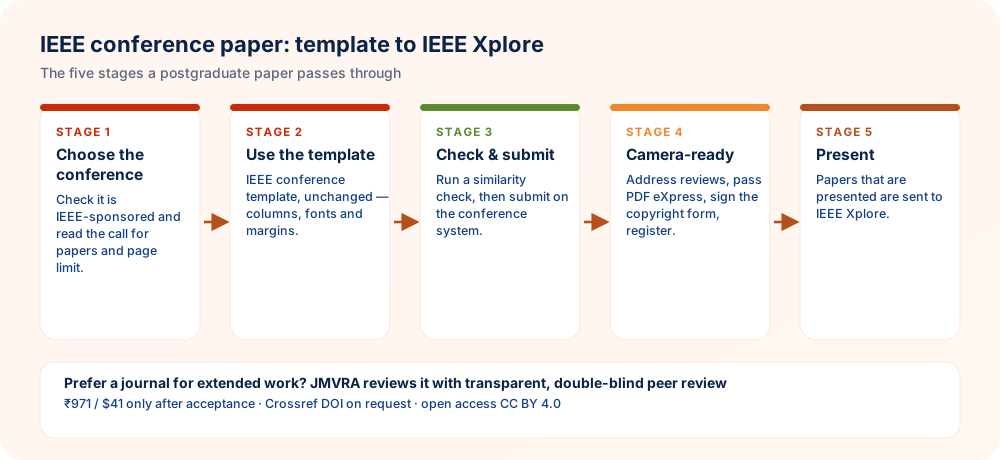
The Value of IEEE Conferences for PG Students
- Experts comment on your research while it is still early.
- You present your work, get practice explaining it and meet others in your field.
- IEEE Xplore normally carries accepted papers from IEEE-sponsored or technically co-sponsored conferences, which many institutions recognise.
- It strengthens your profile for PhD admissions, job applications and scholarships.
Step 1: Pick a Suitable Conference
- Fit the scope. Go through the call for papers and the track topics; your work should belong in one particular track.
- Verify the IEEE status. Real IEEE conferences are listed in IEEE’s conference search. Find out whether it is IEEE-sponsored or technically co-sponsored, and how publication is arranged.
- Record every deadline. Dates for paper submission, notification, camera-ready copy and registration are firm.
Step 2: Follow the IEEE Template Precisely
Get the IEEE conference template (Word or LaTeX) from IEEE’s template page or the conference website. A full paper usually follows a two-column layout of 4–6 pages. Leave margins, fonts and spacing alone, and use the IEEE reference style, with numbered citations inside square brackets.
Step 3: Keep the Paper Focused
| Section | PG student tip |
|---|---|
| Abstract | 150–250 words: problem, method, main result |
| Introduction | Set out the problem and 2–3 contributions plainly |
| Related work | Recent IEEE, ACM and journal papers, fairly compared |
| Proposed method | Block diagram or algorithm, detailed enough to be reproduced |
| Results | Simulation or hardware results set against existing methods |
| In Summary | What was accomplished, plus one clear direction for future work |
Step 4: Test Originality Then Submit
- Run a similarity check. Reword anything lifted from your project report or other papers, and cite your sources properly.
- Comply with the conference’s AI-use policy. Declare any help from AI in writing wherever this is expected.
- Upload via the portal. Conferences often rely on Microsoft CMT, EasyChair or EDAS; list each author exactly as they appear in the paper.
- Save your paper ID. Every later step will ask for it.
Step 5: Review, Camera-Ready Copy and Registration
Reviews end in accept, reject or accept-with-changes. If your paper is accepted, you typically need to: revise in line with the reviews, test the final PDF with IEEE PDF eXpress (using the conference ID), file the IEEE copyright form (eCF), and complete a full registration — most conferences want at least one full registration per paper and a presentation, in person or online. A paper that goes unpresented may be kept out of IEEE Xplore under IEEE’s no-show policy.
Step 6: Present, Then Locate Your Paper in IEEE Xplore
Put together a short, focused talk — typically 10–15 minutes — with one slide per idea and results shown as figures. Once the conference ends, IEEE processes the proceedings; the paper usually shows up in IEEE Xplore within weeks to a few months. It then receives its own DOI.
Camera-Ready Checklist for IEEE Papers
- Reviewers’ comments handled in the final version
- Author names and affiliations identical to the registration
- No page numbers, headers or footers unless the conference requests them
- Every font embedded; the PDF clears IEEE PDF eXpress
- Figures legible when printed; references complete in IEEE style
- IEEE electronic copyright form (eCF) filed
- A minimum of one author registered at the correct rate
- Presentation slot and format (oral, poster, virtual) confirmed
Any missing item may hold up your paper’s place in the proceedings, so go through the list ahead of the camera-ready deadline instead of on the day.
The 10 Most-Searched Questions on This Topic
Here are the ten questions researchers search for most on this subject, each with a direct answer.
IEEE conference paper submission
Select a genuine IEEE conference, write using the IEEE template, submit through its portal, and, if accepted, complete the camera-ready, copyright and registration steps.
IEEE conference template
The official two-column Word or LaTeX template supplied by IEEE or the conference site; leave its formatting as it is.
IEEE PDF eXpress
IEEE’s tool for confirming that your final PDF meets Xplore requirements; each conference provides a conference ID for it.
IEEE copyright form eCF
The electronic copyright form filed for every accepted paper ahead of publication.
how to find IEEE conferences
Use IEEE’s conference search and look at the sponsorship and publication details of each event.
IEEE conference registration fee students
Depends on the conference and on membership; IEEE student members often pay less. Look at the official site.
IEEE no-show policy
A paper that is not presented at the conference may be left out of IEEE Xplore.
how long for paper to appear in IEEE Xplore
Normally between a few weeks and a few months after the conference.
IEEE paper format for M.Tech students
Two columns, 4–6 pages, IEEE layout, numbered references, and clear figures and results.
EasyChair Microsoft CMT EDAS
Widely used conference submission systems; each conference names the one it uses.
How JMVRA Fits In
JMVRA is a Transparent, Peer-Reviewed, Open Access Journal (Refereed Journal). Following the discontinuation of the UGC and UGC-CARE journal listing, and in alignment with the latest UGC-CARE recommendations and guidelines, JMVRA is aligned with UGC’s Suggested Parameters for Choosing Peer-Reviewed Journals. UGC public notice (PDF)
When your institution wants a peer-reviewed journal article rather than a conference paper, JMVRA publishes extended and substantially revised work by PG students in engineering and computer science, provided the conference version is declared and cited.
- ISSN
- 2984-8911 (online) · publishing since June 2023
- Issues
- Monthly issues across many disciplines
- Review
- Two-way anonymous review by specialists
- Access
- Free to read, CC BY 4.0 licence
- Fee
- ₹971 INR for Indian and $41 USD for foreign authors, due only after acceptance
- DOI
- Crossref — available as an optional extra
- Indexing
- Indexed by Google Scholar; not indexed by Scopus, Web of Science or DOAJ
- Impact factor
- 11.25, derived from Google Scholar data
Screening begins the moment a paper arrives and each decision is sent as soon as it is reached, yet JMVRA never promises a set number of days: actual review time depends on the reviewers and on how much revision the paper needs.
At-a-Glance Checklist
- Conference verifiedIEEE sponsorship confirmed on both the conference’s site and IEEE’s
- Template untouchedPage limit, columns and fonts exactly as provided
- Similarity checkedReused text quoted and cited prior to submission
- Camera-ready passedIEEE PDF eXpress check finished
- Paperwork doneCopyright form signed, registration paid on schedule
- Ready to presentSlides prepared — presenting is necessary for Xplore
Preparing the Presentation
- Plan around the time limit — typically 10–15 minutes
- A single idea per slide — with large figures
- Rehearse with your supervisor — and time yourself
- Anticipate questions — limitations and future work
After the Conference
Verify the published record
Title and authors as listed in the proceedings.
Update your CV
With full citation.
Prepare an extended version
Aimed at a journal, with substantial new work.
Thank reviewers’ feedback
Apply what you learned in your next paper.
Study-Planning Advice for Postgraduate IEEE Conference Authors
Postgraduate students juggle coursework, project work and deadlines, so a conference submission needs careful scheduling. These suggestions help you protect both the quality of the paper and your academic commitments.
- Talk to your supervisor early. Discuss the idea, the target conference and authorship before writing. Your guide can advise on suitability, approvals and whether your results are mature enough to present.
- Work backwards from the deadline. List each stage, from draft to internal review, and assign dates leaving a comfortable margin. Late submissions often suffer from rushed figures and unchecked formatting.
- Present one clear contribution. A conference paper has limited space, so focus on a single well-supported idea rather than your entire dissertation. Save extra material for a later, fuller article.
- Prepare for travel and registration. Check registration requirements, visa needs and institutional permissions in good time. Papers can be dropped from a programme when nobody is able to present them.
- Practise answering questions. Ask classmates to challenge your method and results. Calm, honest answers, including admitting what you do not yet know, leave a better impression than defensive ones.
Plan your timetable with your supervisor, focus on one contribution, and prepare the logistics of presenting well before the deadline.
Questions Researchers Often Ask
The Parts of a Research Paper
Usual proportions for an empirical paper — guidance rather than a fixed rule.
- BackgroundThe gap, set out in 1–2 sentences.
- ObjectiveThe hypothesis or question the study addresses.
- MethodsDescribe design, data and tools.
- ResultsReport key findings and include numbers.
- In SummaryWhat it means.
- Key Terms4–6 searchable terms.
Aim for an abstract of about 150–250 words that covers all five parts, and draft it at the end. For the full rules, consult JMVRA Publication Guidelines.
Ready to Publish? Submit to JMVRA
JMVRA is aligned with UGC's Suggested Parameters for Choosing Peer-Reviewed Journals.
JMVRA is a Transparent, Peer-Reviewed, Open Access Journal (Refereed Journal). Following the discontinuation of the UGC and UGC-CARE journal listing, and in alignment with the latest UGC-CARE recommendations and guidelines, JMVRA is aligned with UGC’s Suggested Parameters for Choosing Peer-Reviewed Journals.
Pages worth visiting on jmvra.org
Key Terms
Subjects and search phrases this article addresses.
Related Reading
Further reading on the same theme from the JMVRA blog.
Writing a Review Article and Picking the Right Journal
Read the guide RelatedPhD Paper Publication: Rules, Timing & Journal Choice
Read the guide RelatedProceedings Volume or Journal Special Issue?
Read the guide RelatedIs Your Conference Paper Published on JMVRA?
Read the guide RelatedFormatting a Manuscript for Submission
Read the guide RelatedPlagiarism in Research Papers: Its Types, Detection and Staying Beneath the Threshold
Read the guide From the blogProceedings Volume or Journal Special Issue?
Read the article From the blogStructuring a CS Paper for an International Journal
Read the article From the blogSubmitting to Computer Science Journals: Checklist
Read the articleKeep Reading on the JMVRA Blog
As part of the JMVRA journal blog, this guide shares practical help on publishing, indexing, metrics and research integrity, and is written to be verifiable rather than promotional.