
Many PhD scholars see the first journal paper as a hurdle to clear before the thesis can be submitted. Universities have different rules, deadlines are close, and the market is crowded with offers aimed at scholars under pressure. This guide lays out what really governs PhD publication in India, how to plan for it, and how to pick a journal that is quick and affordable without endangering your degree.
The Rules Behind PhD Publication
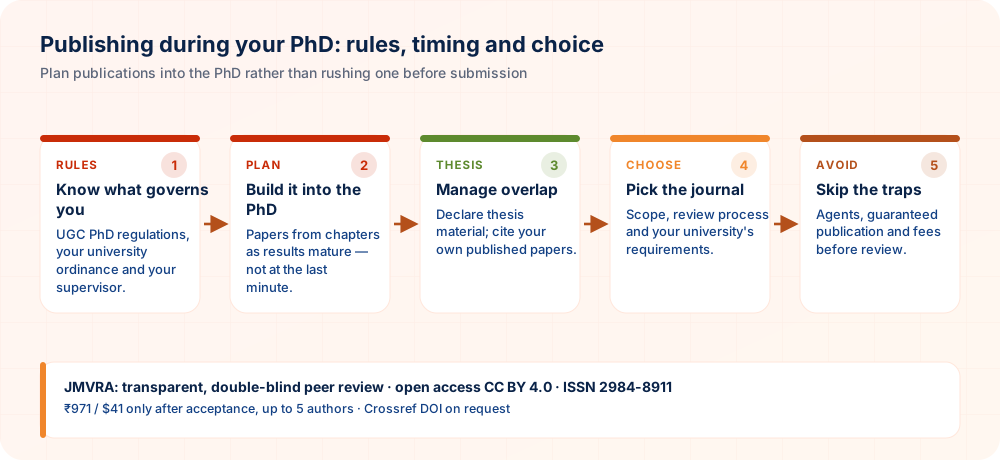
The UGC (Minimum Standards and Procedures for Award of Ph.D. Degree) Regulations, 2022 form the national framework, and every university layers its own ordinance on top. Since publication requirements before thesis submission are now mostly decided by universities, what counts is your university’s current ordinance together with advice from your research advisory committee. Study it, and have your supervisor confirm how your department applies it.
Build Publications Into Your PhD
- Year 1–2: a review or methods paper. Turn early work into a literature review or a paper on methods.
- Middle years: papers on results. Write one for each main objective or chapter.
- Final year: a synthesis paper. Bring the results together in one paper, time permitting.
- Leave some margin. Try to get papers accepted several months ahead of the thesis deadline.
Your Thesis and Your Papers
Thesis chapters are frequently assembled from published papers, and papers are likewise drawn from thesis chapters. This is normal, but handle the overlap with care: read your university’s rules on including published work, cite the papers within the thesis, and rewrite instead of copying when you convert chapters into papers, because similarity checks will flag reuse. Keep dated copies of each version so you can show how the text evolved.
Picking a Journal for Your PhD Work
- Meets your university’s present rule
- Truly peer reviewed, with reports that you can present to your committee
- Suits your subject — with reviewers who know your field
- Open fees that are due after acceptance
- A lasting record: an ISSN, an archive and preferably a DOI
Pitfalls Targeting PhD Scholars
- “Guaranteed publication before your pre-submission seminar”
- Badges saying “UGC approved” that have no current list to back them
- Middlemen who submit for you or offer co-authorship for sale
- Fees requested prior to any review
Collaborate With Your Supervisor
Your supervisor usually appears as a co-author and has to approve submissions arising from your PhD work. Settle the author order early, copy your supervisor on all correspondence with the journal, and give your institutional affiliation precisely as your university demands.
An Example PhD Publication Plan
| Chapter / objective | Planned paper | Target submission |
|---|---|---|
| Literature review | Review article | End of year 1 |
| Objective 1 | Research article 1 | Mid year 2 |
| Objective 2 | Research article 2 | End of year 2 |
| Objective 3 | Conference paper or research article 3 | Mid year 3 |
| Synthesis | Optional integrative paper | Before thesis submission |
Review the plan with your supervisor every six months, and agree it up front; that way the thesis deadline does not turn into a publication crisis.
The 10 Most-Searched Questions on This Topic
Here are the ten questions researchers search for most on this subject, each with a direct answer.
best journal to publish PhD research paper
A journal your university recognises, that truly peer reviews your paper, suits your subject and states its fees openly.
PhD publication requirement UGC 2022
Under the 2022 UGC PhD regulations, publication requirements mostly rest with individual universities, so read your own ordinance.
PhD paper publication before thesis submission
Stick to what your university currently prescribes, and aim to get papers accepted long before the submission date.
PhD research paper fast publication
Sending a finished paper early to a journal that suits it is the quickest route that stays safe.
low cost journal for PhD scholars
Budget-friendly peer-reviewed journals that your university recognises and that collect fees only once a paper is accepted.
thesis and paper similarity
Reword the material and cite it, and confirm what your university allows for including already published work.
supervisor as co-author
Common for PhD papers; settle the order of authors at the start.
PhD pre-submission seminar publication
Several universities ask for published papers ahead of this stage, so look up your regulations.
UGC approved journal for PhD 2026
No UGC approved list exists at present; universities assess journals using evidence.
PhD publication agent risk
Agents frequently rely on fake journals, which can endanger your degree.
How JMVRA Fits In
JMVRA is a Transparent, Peer-Reviewed, Open Access Journal (Refereed Journal). Following the discontinuation of the UGC and UGC-CARE journal listing, and in alignment with the latest UGC-CARE recommendations and guidelines, JMVRA is aligned with UGC’s Suggested Parameters for Choosing Peer-Reviewed Journals. UGC public notice (PDF)
At JMVRA, PhD scholars’ papers in any discipline get double-blind review, an acceptance letter and an invoice for your records, with the ₹971 INR fee charged only after acceptance.
- ISSN
- 2984-8911 (online) · publishing since June 2023
- Issues
- Monthly issues across many disciplines
- Review
- Two-way anonymous review by specialists
- Access
- Open access, licensed CC BY 4.0
- Fee
- ₹971 INR for Indian and $41 USD for foreign authors, due only after acceptance
- DOI
- Crossref — available as an optional extra
- Indexing
- For PhD work: Google Scholar picks it up, but Scopus, Web of Science and DOAJ do not
- Impact factor
- 11.25, derived from Google Scholar data
Screening begins the moment a paper arrives and each decision is sent as soon as it is reached, yet JMVRA never promises a set number of days: actual review time depends on the reviewers and on how much revision the paper needs.
At-a-Glance Checklist
- Regulations studiedThe present PhD publication rule at your university
- Supervisor on boardChoice of journal, authors and schedule
- Thesis overlap disclosedMentioned in the cover letter
- Journal checkedMeasured against UGC's parameters and your university's list
- Agents avoidedSubmit personally through the journal's own website
Converting a Thesis Chapter into a Journal Paper
- Pick a single clear finding — a paper has a tighter focus than a chapter
- Trim the literature review — retain just what sets up the research question
- Redraft the introduction — aimed at journal readers rather than examiners
- Show results concisely — only the essential tables and figures
- Review thesis regulations — on publication ahead of submission
Drawing on Your Publications at the Viva
Show the contribution
Published papers show that your findings have passed peer review.
Explain overlap
The link between every paper and the thesis chapters.
Address reviewer comments
Expect examiners to raise comparable questions.
Keep documents ready
Letters of acceptance and links to the articles.
Coordinating PhD Papers With Your Research Committee
Doctoral scholars publish under rules set by their university, department and supervisor. These practical habits keep your papers useful for the thesis and acceptable to the people who will assess it.
- Read your ordinance personally. Obtain the current rules from the research cell and highlight what they say about publications, authorship and acknowledgements. Relying on hearsay from seniors can leave you with papers that your university does not recognise.
- Map papers to thesis chapters. Draw a simple table linking each planned article to a chapter. This shows where chapters can be shared as papers and where you must avoid duplicating text across your final thesis.
- Ask about authorship order early. Discuss with your supervisor whether the guide appears as co-author and in which position. Settling this before drafting avoids tension when the paper is nearly ready.
- Keep thesis overlap disclosed. When a published article forms part of the thesis, cite it properly and mention it in the declaration pages. Open acknowledgement is better than a similarity report that surprises your examiners.
- File proof of publication promptly. Save the final article, acceptance email and journal details in one folder as soon as they arrive. Your department will request them at pre-submission, and tracing them later is tiresome.
Treat each paper as part of a planned thesis journey, agreed with your supervisor and documented against your university's rules.
Questions Researchers Often Ask
Your Paper's Journey at JMVRA, From Submission to Publication
- SubmitA paper ID is issued
- ScreenScope & similarity
- ReviewDouble-blind
- DecideEmail & SMS
- ReviseAnswer every point
- AcceptCopyright & fee
- ProduceDOI available on request
- PublishMonthly issue
How long review takes depends on the reviewers and on any revision required, so no set turnaround is promised; you are told of acceptance or rejection by email and WhatsApp.
Ready to Publish? Submit to JMVRA
JMVRA is aligned with UGC's Suggested Parameters for Choosing Peer-Reviewed Journals.
JMVRA is a Transparent, Peer-Reviewed, Open Access Journal (Refereed Journal). Following the discontinuation of the UGC and UGC-CARE journal listing, and in alignment with the latest UGC-CARE recommendations and guidelines, JMVRA is aligned with UGC’s Suggested Parameters for Choosing Peer-Reviewed Journals.
Helpful pages on jmvra.org
Key Terms
Subjects and search phrases this article addresses.
Related Reading
Further reading on the same theme from the JMVRA blog.
Proceedings Volume or Journal Special Issue?
Read the guide RelatedStudent First Paper: Choosing a Visible, Safe Journal
Read the guide RelatedWhy a DOI Helps a Student's First Research Paper
Read the guide RelatedPhD Thesis to Journal Article: How to Make the Conversion
Read the guide RelatedUGC-CARE Discontinued — Points Researchers Should Know
Read the guide RelatedFind Published Theses & Dissertations on JMVRA
Read the guideKeep Reading on the JMVRA Blog
This guide belongs to the JMVRA journal blog, which offers practical advice on publishing, indexing, metrics and research integrity, written to be checkable instead of promotional.