
Applicants to master’s programmes, PhD positions or jobs find that reviewers more and more often follow the links on their CVs. A paper with a DOI opens at once and speaks for itself, whereas a broken link or a PDF attachment invites doubt. The DOI is a minor detail that lends a student’s research record credibility; this page explains why and how to use it.
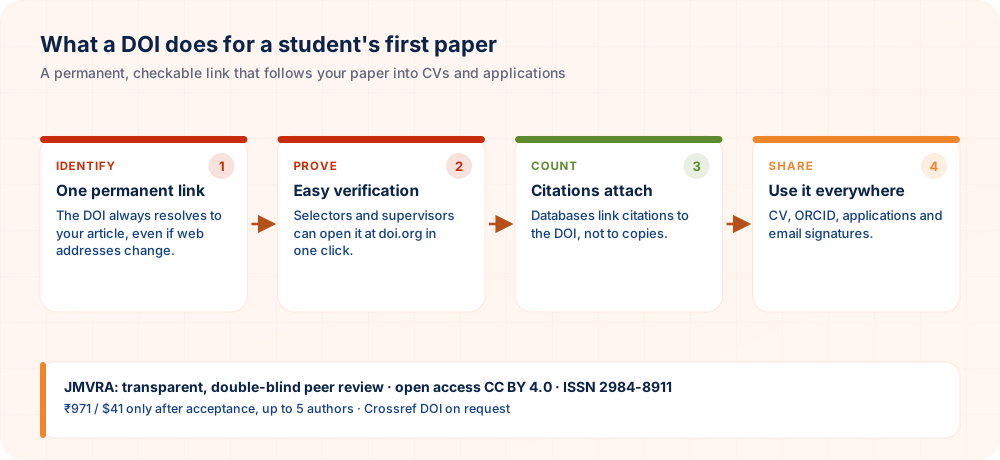
How a DOI Helps You
Instant verification
When a reviewer clicks the DOI, your published article opens.
Permanent link
It stays valid even if the journal moves to a new website.
Clean citations
Anyone can cite your paper correctly using only the DOI.
Profile linking
ORCID and reference managers can pull in your paper using its DOI.
Putting DOIs on Your CV and in Applications
Give each publication’s authors, year, title, journal, volume/issue and the DOI as a link: https://doi.org/10.5555/…. Test every link before you send the CV. If an accepted paper has no DOI yet, label it “accepted” or “in press”. Consistent formatting across entries also makes the list easier for reviewers to scan.
What “International Journal” Ought to Mean for Students
- An editorial board drawn from several countries
- Contributors from various institutions and countries
- Genuine peer review that includes comments
- Visible through Google Scholar, with a Crossref DOI
- Reasonable, transparent charges suited to student budgets
Confirm the DOI Is Genuine
- Try the DOI of a published article. Via doi.org it ought to lead to that article’s page.
- Look it up on Crossref. Go to search.crossref.org to verify the record exists.
- Compare prefixes. Articles from a single journal normally carry the same prefix.
When Your Journal Sells DOI as an Optional Extra
Certain journals bundle the DOI into the fee, while others sell it as an optional extra. For a student building a record, it is generally worth paying for — it separates a citation that keeps working permanently from one that may break. Ask about the cost before you submit so there are no surprises later.
A Sample CV Entry Containing a DOI
Sharma, P., & Rao, K. (2026). Low-cost IoT monitoring of soil moisture for smallholder farms. Journal Name, 14(9), 112–120. https://doi.org/10.5555/abcd.2026.0912
Follow whichever citation style your field favours, keep the authors in their published order, and make sure the DOI is clickable in the PDF version of your CV.
The 10 Most-Searched Questions on This Topic
Here are the ten questions researchers search for most on this subject, each with a direct answer.
best international journal for students with DOI
An international journal with real peer review, Crossref DOI registration and prices that suit students.
why DOI is important for research paper
It gives the paper a permanent identity that anyone can find, cite and verify.
how to write DOI in CV
Write it as a complete link: https://doi.org/ with the DOI after it.
DOI for student paper
Issued by the journal when the paper is published, and either included in the fee or sold as an extra.
check if DOI is valid
Visit https://doi.org/ followed by the DOI, or look it up at search.crossref.org.
research paper for MS PhD application
A verifiable published paper carrying a DOI makes an application stronger.
DOI add-on journal
Certain journals bill DOI registration as a separate charge.
in press meaning CV
Accepted but yet to be published; write it as “in press”.
ORCID DOI import
ORCID is able to import your paper’s information using the DOI.
international journal for students India
Reasonably priced, authentic international journals open to student authors.
How JMVRA Fits In
JMVRA is a Transparent, Peer-Reviewed, Open Access Journal (Refereed Journal). Following the discontinuation of the UGC and UGC-CARE journal listing, and in alignment with the latest UGC-CARE recommendations and guidelines, JMVRA is aligned with UGC’s Suggested Parameters for Choosing Peer-Reviewed Journals. UGC public notice (PDF)
Student authors from India and other countries are welcome at JMVRA. Every paper goes through peer review first, and the Crossref DOI is an optional add-on that is assigned at publication.
- ISSN
- 2984-8911 (online) · publishing since June 2023
- Issues
- Monthly issues across many disciplines
- Review
- Two-way anonymous review by specialists
- Access
- CC BY 4.0, open to all readers
- Fee
- ₹971 INR for Indian and $41 USD for foreign authors, due only after acceptance
- DOI
- Crossref — available as an optional extra
- Indexing
- Google Scholar coverage; not Scopus, Web of Science or DOAJ coverage
- Impact factor
- 11.25, derived from Google Scholar data
Screening begins the moment a paper arrives and each decision is sent as soon as it is reached, yet JMVRA never promises a set number of days: actual review time depends on the reviewers and on how much revision the paper needs.
At-a-Glance Checklist
- DOI verifiedAt doi.org it leads to your article
- Written as a full linkhttps://doi.org/… on your CV
- Recorded in ORCIDBring the work in using its DOI
- Link instead of fileShare the DOI link, not a PDF copy
- Requested early enoughA Crossref DOI at JMVRA can be requested once the paper is accepted
How a Student Can Get and Use a DOI
- Choose a journal that registers DOIs — or one that provides a Crossref DOI on request
- Confirm the DOI resolves — prior to listing it
- Put it on your CV and profiles — written out as a complete https://doi.org/ link
- Cite it in applications — admission and scholarship committees can check the paper without delay
The Key Points for Your First Paper
A sound question
A narrow question answered well is better than a broad, vague one.
Honest methods
Explain your work, limitations included.
Guidance
Ask a faculty member to go over your draft.
A genuine journal
Look for peer review and open policies, regardless of the fee.
Student Authors: Presenting a Published Paper Professionally
A first publication is a milestone, and how you describe it matters. These suggestions help students present their paper honestly and make good use of it in applications and interviews.
- Describe your contribution accurately. State plainly what you did, whether you designed the study, collected data or wrote the draft. Interviewers value honest, specific descriptions over inflated claims about your role.
- List the paper in full citation form. Give authors, title, journal name, volume details and identifier in a consistent style on your CV. A complete entry lets reviewers locate it in moments and shows attention to detail.
- Be ready to discuss your methods. Revisit your paper before interviews and prepare to explain the question, approach, limitations and what you would do differently. Confident discussion matters more than the listing itself.
- Thank your supervisor properly. Acknowledge guidance in the paper where appropriate and keep your supervisor informed about submission decisions. Good relationships often lead to references and further opportunities.
Describe your role honestly, cite your paper fully, and be ready to discuss it with confidence.
Questions Researchers Often Ask
Anatomy of a JMVRA DOI
Resolver → prefix 10.5555 (an example Crossref prefix) → suffix: journal, volume 14, issue 9, article identifier. A format example: doi.org/10.5555/12345678
A JMVRA DOI is easy to authenticate: use Crossref Search or the Crossref journal record.
Ready to Publish? Submit to JMVRA
JMVRA is aligned with UGC's Suggested Parameters for Choosing Peer-Reviewed Journals.
JMVRA is a Transparent, Peer-Reviewed, Open Access Journal (Refereed Journal). Following the discontinuation of the UGC and UGC-CARE journal listing, and in alignment with the latest UGC-CARE recommendations and guidelines, JMVRA is aligned with UGC’s Suggested Parameters for Choosing Peer-Reviewed Journals.
Where to go next on jmvra.org
Key Terms
Subjects and search phrases this article addresses.
Related Reading
Further reading on the same theme from the JMVRA blog.
Where Indian Undergraduates Can Publish Research
Read the guide RelatedTurning a Project Report Into a Journal Paper
Read the guide RelatedIEEE Conference Submission Guide for PG Students
Read the guide RelatedGetting a Crossref DOI for Your Published Paper — What It Is For
Read the guide RelatedORCID iD: The Researcher ID Everyone Needs
Read the guide RelatedDoes a Journal DOI Work? DOI Resolution and Metadata Checklist
Read the guideKeep Reading on the JMVRA Blog
Find this guide on the JMVRA journal blog, a collection of practical guidance on publishing, indexing, metrics and research integrity that favours verifiable content over promotion.