
A growing number of Indian undergraduates are publishing research that comes out of engineering projects, internships, and science and commerce dissertations. Many of them search for “high impact journals”, yet top-impact titles are seldom a realistic aim for a first project, and advertisers often use the phrase loosely. What follows is a practical route: which undergraduate work can be published, in what kind of venue, and how to go about it safely. Choosing the venue before you finish the draft often saves a great deal of rework.
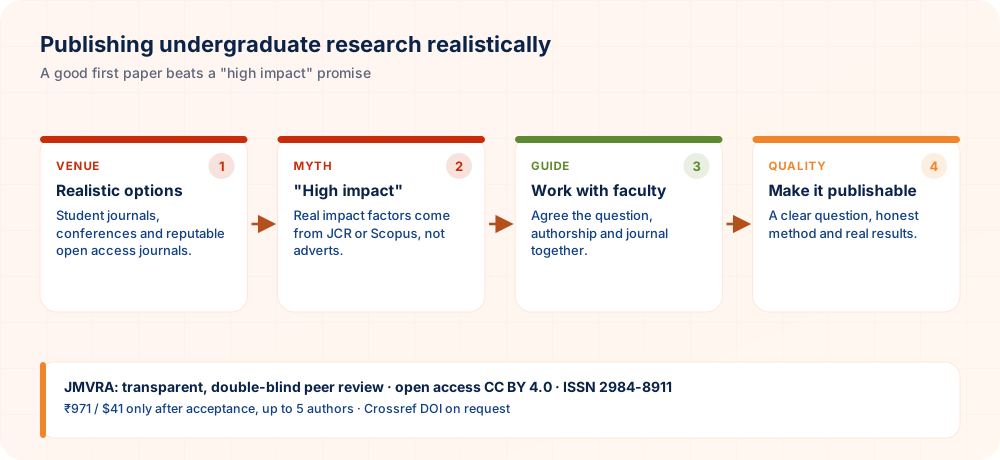
Sensible Venues for Undergraduate Research
| Venue | Good for |
|---|---|
| Genuine peer-reviewed multidisciplinary journals | Well-documented projects with clear results |
| Student research journals and university journals | First experience of peer review |
| Conferences (student tracks) | Presenting and getting feedback |
| Specialist indexed journals | Exceptional projects, usually with faculty co-authors |
The “High Impact” Myth
Journals that are truly high in impact are selective and take months to decide. A journal that advertises a “high impact factor” alongside acceptance within days is typically quoting a figure other than the Clarivate Journal Impact Factor. For a first paper, a genuine journal that suits your topic is worth much more than an impressive-looking number.
Working With a Faculty Guide
- Ask early. Raise the question of publication while the project is still being planned.
- Agree roles and authorship. The guide is normally a co-author.
- Revise together. Plan on several drafts.
- Submit together. Your guide’s experience supports the choice of journal and the replies to reviewers.
What Makes Undergraduate Work Publishable
- A clear question or problem
- Methods described fully
- Results that are validated or statistically analysed
- Comparison with published work
- Honest limitations
Offers Aimed at Students
- Paid “publication packages” with certificates
- Guaranteed acceptance for placement season
- Agents collecting papers from whole classes
- Journals that accept everything, instantly
Who Gets Authorship on Undergraduate Papers
| Contribution | Usually |
|---|---|
| Designed and carried out the work, wrote the paper | Author |
| Guided the work and revised the paper | Author (often corresponding) |
| Helped with data collection only | Acknowledgement, unless substantial |
| Provided lab access or equipment | Acknowledgement |
| Did not contribute | Neither — never add names for favours |
Settle who is an author, and in what order, before the writing begins. Many journals apply the ICMJE criteria or similar rules.
The 10 Most-Searched Questions on This Topic
Here are the ten questions researchers search for most on this subject, each with a direct answer.
high impact journals to publish undergraduate research India
Top-impact journals are rarely realistic; choose a genuine, fitting peer-reviewed journal.
undergraduate research publication India
Possible with a strong project, a faculty guide and a genuine journal.
BTech project paper publication
Turn the project into a focused paper with validated results.
BSc research paper publication
A dissertation with clear methods and results can become a paper.
student research journal India
University and student journals offer first experience of peer review.
high impact factor myth
Many advertised “impact factors” are not the Clarivate JIF.
faculty guide co-author
Normal and helpful for undergraduate papers.
research paper for placement
A genuine publication helps; paid certificates do not.
student conference paper India
Student tracks offer feedback and presentation practice.
publish college project
Concentrate on a single contribution, use the journal’s template and run a similarity check.
How JMVRA Fits In
JMVRA is a Transparent, Peer-Reviewed, Open Access Journal (Refereed Journal). Following the discontinuation of the UGC and UGC-CARE journal listing, and in alignment with the latest UGC-CARE recommendations and guidelines, JMVRA is aligned with UGC’s Suggested Parameters for Choosing Peer-Reviewed Journals. UGC public notice (PDF)
JMVRA is open to well-documented undergraduate research prepared with a faculty guide, and it puts such work through double-blind review like any other paper — there are no packages and no guarantees.
- ISSN
- 2984-8911 (online) · publishing since June 2023
- Issues
- Monthly issues across many disciplines
- Review
- Two-way anonymous review by specialists
- Access
- CC BY 4.0, open to all readers
- Fee
- ₹971 INR for Indian and $41 USD for foreign authors, due only after acceptance
- DOI
- Crossref — available as an optional extra
- Indexing
- Included in Google Scholar; not included in Scopus, Web of Science or DOAJ
- Impact factor
- 11.25, derived from Google Scholar data
Screening begins the moment a paper arrives and each decision is sent as soon as it is reached, yet JMVRA never promises a set number of days: actual review time depends on the reviewers and on how much revision the paper needs.
At-a-Glance Checklist
- Faculty guide on boardAnd credited correctly as author or not
- Claims checkedImpact factors confirmed at their source
- Offers ignoredPaid "guaranteed" student publication
- Authorship agreedBefore writing starts
- Journal verifiedISSN, review policy, fees after acceptance
From Undergraduate Project to Paper: A Timeline That Works
| When | Task |
|---|---|
| Start of project | Agree with your guide that a paper is a goal; define one clear question |
| During the work | Keep a lab or field notebook, save data and code, record every source |
| After results | Draft the paper in the target journal’s format, not the report format |
| Before submission | Guide reviews the draft; run a similarity check; settle authorship |
| After submission | Respond to reviewers with your guide; keep all correspondence |
Skills Undergraduates Should Build First
Searching literature
Learn to use Google Scholar and subject databases well; see how to find research papers.
Basic statistics or analysis
Know which test answers your question and how to report it.
Referencing
Use a reference manager from day one to avoid citation errors.
Academic writing
Short, precise sentences; one idea per paragraph; claims backed by evidence.
These pages are worth opening first: how to find research papers, then reference managers, and finally Writing a Research Paper Reviewers Can Assess.
Undergraduate Research Publishing: Advice for Indian Students
Publishing as an undergraduate is a valuable learning experience when approached patiently. These tips help students turn a project report into a modest but sound article with proper guidance.
- Narrow the project to a single finding. A final-year report usually covers more than a journal article can hold. Pick the clearest result, explain it well, and leave the remaining material for a later paper.
- Read published student-level papers. Look at articles written from comparable projects to see how much detail and context are expected. Real examples teach structure better than general advice.
- Keep your lab or project notebook. Dated notes of procedures and observations prove your work is original and help you write accurate methods. Ask your guide to review them occasionally.
- Practise explaining the work aloud. Describe your study to a classmate in a few minutes. Gaps in your explanation show where the manuscript needs more background or clearer reasoning.
- Ask before sharing a draft widely. Check with your guide and institution before posting or sending a draft outside the project. Premature sharing can complicate authorship or later publication.
Focus on one clear finding, rely on your faculty guide, and keep careful notes so your first publication teaches good habits.
Questions Researchers Often Ask
Your Paper's Journey at JMVRA, From Submission to Publication
- SubmissionPaper ID is issued
- ScreenScope & similarity
- ReviewDouble-blind
- DecideEmail & SMS
- ReworkEach point answered
- AcceptCopyright & fee
- ProduceYou can request a DOI
- PublishMonthly issue
How long review takes depends on the reviewers and on any revision required, so no set turnaround is promised; you are told of acceptance or rejection by email and WhatsApp.
Ready to Publish? Submit to JMVRA
JMVRA is aligned with UGC's Suggested Parameters for Choosing Peer-Reviewed Journals.
JMVRA is a Transparent, Peer-Reviewed, Open Access Journal (Refereed Journal). Following the discontinuation of the UGC and UGC-CARE journal listing, and in alignment with the latest UGC-CARE recommendations and guidelines, JMVRA is aligned with UGC’s Suggested Parameters for Choosing Peer-Reviewed Journals.
Where to go next on jmvra.org
Key Terms
Subjects and search phrases this article addresses.
Related Reading
Further reading on the same theme from the JMVRA blog.
Turning a Project Report Into a Journal Paper
Read the guide RelatedIEEE Conference Submission Guide for PG Students
Read the guide RelatedWriting a Review Article and Picking the Right Journal
Read the guide RelatedWhy Is JMVRA's Impact Factor 11.25? Google Scholar H-Index Explained
Read the guide RelatedRecognising a Predatory Journal
Read the guide RelatedFormatting a Manuscript for Submission
Read the guideKeep Reading on the JMVRA Blog
Find this guide on the JMVRA journal blog, a collection of practical guidance on publishing, indexing, metrics and research integrity that favours verifiable content over promotion.