
Why Format Matters
Good formatting will not rescue a weak paper, but poor formatting holds up a strong one. Manuscripts submitted without page numbers, with figures too small to read, or with a reference list mixing three styles are regularly sent back before review. Opening the file on a different device before submitting helps you spot layout problems early.
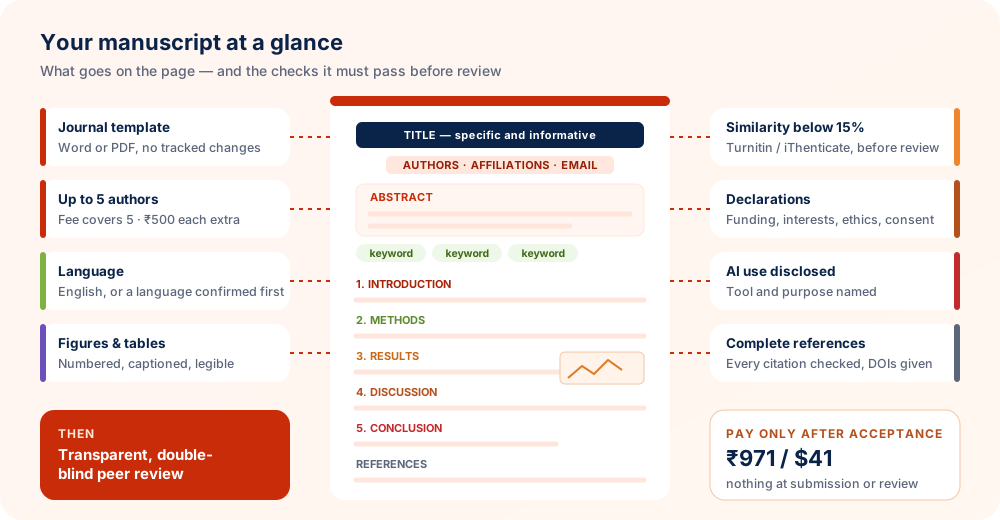
A house style exists for consistency: it lets reviewers move through any manuscript in the same way and lets production staff typeset it without guesswork. Use the template of the journal you are targeting instead of reformatting a paper that was prepared for another venue.
Page and Text Setup
- Use the journal's template when one is supplied; it already contains the margins, fonts and spacing
- Number every page, and the lines too if the template allows it — reviewers refer to line numbers
- Choose one readable body font for the whole text, and avoid decorative fonts altogether
- Put a single space after full stops and avoid manual line breaks within paragraphs
- Do not position text with tabs or repeated spaces; rely on the template's styles
Write in English and keep your terminology uniform: a concept called a "treatment group" in the methods should not turn into a "test cohort" in the results.
Headings and Numbering
Give sections and subsections numbers so that reviewers and co-authors can point to them exactly. Two levels normally suffice, and three is the practical limit. Headings should describe what a section contains rather than name its genre — "Sampling and recruitment" helps more than "Details".
Use the template's heading styles instead of bolding text manually. Genuine heading styles give a navigable document and carry over when the file is converted to the published format, whereas hand-bolded paragraphs do not. Opening the navigation pane in your word processor shows quickly whether the outline looks right.
Figures
- Number figures in the order they are first mentioned, and cite each one in the text
- Write captions that make sense without the surrounding text
- Label axes with quantities and units, and make sure text inside figures is legible at the published size
- Provide images at print resolution — a chart screenshot taken from a slide deck usually falls short
- Acknowledge the source in the caption of reproduced material, and make sure you have permission
Tables
Create tables with the table tool of your word processor, never with tabs or spaces. Give each column a header that includes units, and line numbers up on the decimal point so that magnitudes can be compared at a glance.
Do not repeat one data set as both a table and a figure. Choose whichever form answers the reader's question: tables suit exact values, while figures suit patterns and comparisons. If unsure, imagine what a reader would want to look up versus what they would want to grasp at once.
The Parts of a Research Paper
Usual proportions for an empirical paper — guidance rather than a fixed rule.
- BackgroundUse 1–2 sentences to point out the gap.
- ObjectiveState the question or hypothesis that the study set out to answer.
- MethodsOutline the study design, data sources and tools.
- ResultsMain outcomes, quantified.
- In SummaryWhat it means.
- Key Terms4–6 searchable terms.
An abstract of about 150–250 words can hold all five parts if you write it once everything else is done. Complete rules appear in JMVRA Publication Guidelines.
Equations and Units
- Give displayed equations numbers so the text can refer to them
- Create equations with the equation editor rather than as images, so symbols survive conversion
- Define each symbol where it first appears
- Use SI units and give units for every reported quantity
- Keep decimal and thousands separators consistent
File conversion most often damages special characters and equations. Examine them closely on the proof.
Reference Formatting
Select the style the journal requires and use it for every entry alike. Mixed styles inside one list are the plainest sign that references were collected from several sources without being checked. Reference managers can enforce a style automatically, but still scan the output by eye.
Each in-text citation must be in the list, and each list entry must be cited. Add the DOI where there is one; see DOI explained for the reason it matters.
File Preparation
- Delete tracked changes and reviewer comments before you upload
- If the journal uses blind review, strip any identifying metadata from the file properties
- Make sure the file opens properly on a different machine
- Give files clear names: manuscript, figures, supplementary material
- Verify that supplementary files open and that the text refers to them
Pre-Submission Checklist
- Template used; pages numbered
- Abstract and keywords inside the stated limits
- Every figure and table numbered, captioned and cited in the text
- All symbols defined; SI units used throughout
- Reference list complete, uniform and verified against the sources
- Declarations filled in: funding, competing interests, ethics, consent, data availability, AI use
- Tracked changes deleted and the final file checked
You will find the journal's full requirements on the publication guidelines page.
At-a-Glance Checklist
- Apply the templateSupplied margins, fonts and headings
- Add numbers throughoutEquations, tables, figures, sections, pages
- Self-explanatory captionsClear without the body text
- Single citation styleUniform from start to end
- Tidy fileFree of tracked changes and comments
Working with the JMVRA Template
- Get the newest template — available on the JMVRA website
- Paste as plain text — and then apply the template styles
- Add figures and tables — together with captions
- Review the final layout — prior to submitting
Accessible Formatting
Real headings
Apply styles instead of bolding.
Alt text
Where supported, for figures.
Readable fonts
Standard sizes.
Colour-safe charts
Colour should not be the only cue.
Practical Tips for Formatting a Clean Manuscript
Careful formatting saves editors time and lets reviewers concentrate on your ideas. These working habits help you keep the document consistent from first draft to final upload.
- Use styles, not manual formatting. Apply built-in heading and body styles throughout the document. Changing a style once then updates every instance, which is far safer than adjusting fonts line by line.
- Format as you write. Insert captions, equation numbering and references while drafting. Retrofitting them at the end invites broken cross-references and inconsistencies that are tedious to track down.
- Check figures at print size. Shrink every figure to the width it will occupy on the page and confirm that labels, legends and line weights remain readable without zooming in.
- Keep an unformatted backup. Save a clean copy of the text before applying a journal template. If something corrupts during conversion, you can recover quickly instead of rebuilding everything.
- Scan the final file once more. Open the exported document on a different device and page through it slowly, looking for missing symbols, shifted tables and stray comments or tracked changes.
Consistent styles, early captions and a final visual scan on another device will remove most formatting problems.
Questions Researchers Often Ask
Which template applies to JMVRA submissions?
Use the journal's own manuscript template, which sits with the forms on jmvra.org. You can find formatting instructions on the Publication Guidelines page.
What citation style must I use for JMVRA?
Any established style will do, provided it is used uniformly from the first citation through the last reference. A frequent cause of return before review is mixing styles.
Word or PDF?
Submit Word or PDF, as the submission portal states, prepared in the template. First strip out tracked changes and comments.
Can formatting influence acceptance?
Not directly; still, careless formatting can slow processing and distract reviewers.
Is the JMVRA template something I should use?
Yes. Submitted papers are expected to follow it.
More Researcher Resources
The JMVRA Researcher Resources series includes this guide, whose pointers are practical, open to checking and free of sales claims.
Ready to Publish? Submit to JMVRA
JMVRA is aligned with UGC's Suggested Parameters for Choosing Peer-Reviewed Journals.
JMVRA is a Transparent, Peer-Reviewed, Open Access Journal (Refereed Journal). Following the discontinuation of the UGC and UGC-CARE journal listing, and in alignment with the latest UGC-CARE recommendations and guidelines, JMVRA is aligned with UGC’s Suggested Parameters for Choosing Peer-Reviewed Journals.
Quick links across jmvra.org
Key Terms
Subjects and search phrases this article addresses.
Related Reading
Further reading on the same theme from the JMVRA blog.
JATS XML: Why Article Markup Matters
Read the guide RelatedKeyword Selection Guide
Read the guide RelatedThesis Publication: Journal Paper or Book?
Read the guide RelatedPhD Thesis to Journal Article: How to Make the Conversion
Read the guide RelatedReading Your JMVRA Paper's Statistics
Read the guide RelatedIs Your Conference Paper Published on JMVRA?
Read the guide From the blogHow to Cite DOIs in APA, IEEE, Vancouver & Chicago
Read the article From the blogEngineering Papers International Reviewers Accept
Read the article From the blogStructuring a CS Paper for an International Journal
Read the articleKeep Reading on the JMVRA Blog
Our JMVRA journal blog carries this guide along with other practical advice on publishing, indexing, metrics and research integrity, all written so that claims can be verified and nothing is promotional.