
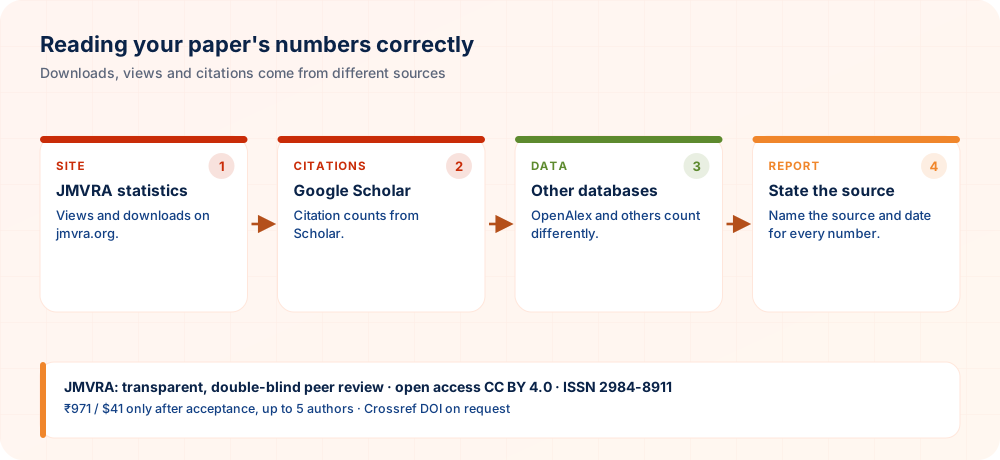
In short: for any figures JMVRA itself supplies, use the present Track Paper / Author Home dashboard. For citation counts, consult the relevant outside scholarly platforms, since each runs on its own indexing and refresh timetable and their numbers are not meant to match one another.
Critical Accuracy Rule
Prior to quoting any particular figure for your paper, whether views, downloads or citations, look at the live dashboard or the outside platform yourself. These numbers shift all the time, and a value that was right a month ago may be stale now. Recording the date beside each figure avoids confusion later.
Origins of Your Figures
| Source | What It Tracks |
|---|---|
| JMVRA website | Usage data, for example views, downloads or page visits, where the platform shows them directly. |
| Google Scholar | Citation data compiled from its own crawl of the scholarly web. |
| OpenAlex | A wide, open scholarly graph that links works, authors and citations. |
| Scopus / Web of Science | Curated, selective database metrics — what is covered follows each database's own inclusion criteria. |
| Crossref | DOI registration, plus metadata and citation-link metadata attached to your DOI. |
These platforms need not agree with one another and are not always refreshed together, so a citation appearing on one but missing from another is ordinary rather than a mistake.
Data You Can Download — Know What Is What
- Downloading the article PDF — the complete text of your published paper
- Downloading citation information — an export in reference format so the paper can be cited elsewhere
- Downloading metadata — organised data fields such as title, authors and DOI (etc.), useful for indexing and for keeping records
- Downloading statistics — usage numbers such as views or downloads, where the platform offers them
Avoid labelling a citation export a "statistics report"; the two answer separate questions, and mixing them up misleads when you report your paper's performance to an institution or funder.
At-a-Glance Checklist
- Source namedFor each figure
- Date statedNumbers change
- Like with likeSame source over time
- No inflationReport what you see
- Profiles maintainedScholar and ORCID
Honest Reporting of Your Paper’s Impact
Evaluators are checking the figures in a CV or appraisal form more and more often, so stating them with care protects your credibility:
| Number | Report it as | Avoid |
|---|---|---|
| Citations | “N citations (Google Scholar, checked on date)” | Combining counts from several databases without saying so |
| Downloads or views | “N downloads on the journal website as of date” | Describing downloads as “citations” or “readers” |
| Journal metrics | Metric name with its source attached, such as “impact factor 11.25 (Google Scholar-based)” | Suggesting a Clarivate Journal Impact Factor |
| h-index | The value together with the database it comes from | Setting h-indices from different databases side by side |
Building Readership Properly
Help people find the paper
Good keywords, a strong abstract and a clear title do more for you than promotion ever will.
Maintain a single version of record
Circulate the article page or its DOI so that citations and downloads gather in one place.
Engage your field
Present the work at seminars, and cite it in later papers wherever it is truly relevant.
Avoid manipulation
Citation rings, coerced citations and artificially inflated downloads count as misconduct, and they do get detected.
Also see h-index explained and getting indexed in Google Scholar.
Interpreting Paper Statistics Without Overstating Impact
Download and citation figures can be encouraging, yet they are easy to misread. These tips help authors discuss their numbers accurately in applications, reports and profiles.
- Name the source of each figure. Whenever you mention a count, state which service produced it and when you looked. Figures from different tools rarely match, and attribution prevents confusion.
- Expect counts to differ. Databases cover different materials and update at different speeds. Treat small differences as normal rather than as signs of error.
- Separate reads from citations. Views and downloads show interest, while citations show that others used your work. Report them as different measures and avoid implying quality from attention alone.
- Look at who cites you. Read the citing papers to see how your findings were used. Context is more informative than a raw total, and it may suggest new collaborations.
- Avoid selective reporting. Do not highlight only the most flattering number. Presenting a balanced picture builds credibility with assessment panels and colleagues.
Report each statistic with its source and date, and let honest context speak for your work instead of inflated claims.
Questions Researchers Often Ask
Your Paper's Journey at JMVRA, From Submission to Publication
- Send paperPaper ID provided
- ScreenScope & similarity
- ReviewDouble-blind
- DecideEmail & SMS
- ReviseAddressing each comment
- AcceptCopyright & fee
- ProduceDOI offered upon request
- PublishMonthly issue
How long review takes depends on the reviewers and on any revision required, so no set turnaround is promised; you are told of acceptance or rejection by email and WhatsApp.
Ready to Publish? Submit to JMVRA
JMVRA is aligned with UGC's Suggested Parameters for Choosing Peer-Reviewed Journals.
JMVRA is a Transparent, Peer-Reviewed, Open Access Journal (Refereed Journal). Following the discontinuation of the UGC and UGC-CARE journal listing, and in alignment with the latest UGC-CARE recommendations and guidelines, JMVRA is aligned with UGC’s Suggested Parameters for Choosing Peer-Reviewed Journals.
Related pages on jmvra.org
Key Terms
Subjects and search phrases this article addresses.
Related Reading
Further reading on the same theme from the JMVRA blog.
Types of Research Papers and Which to Write
Read the guide RelatedYour Paper Is Published in JMVRA: What Comes Next
Read the guide RelatedLiterature Reviews That Synthesise, Not List
Read the guide RelatedPublishing a Thesis With JMVRA: Archive or Book
Read the guide RelatedSearching Research Papers on JMVRA
Read the guide RelatedWriting a Research Paper: A Guide
Read the guideKeep Reading on the JMVRA Blog
Published on the JMVRA journal blog, this guide gives practical direction on publishing, indexing, metrics and research integrity, with a focus on what can be verified instead of on promotion.