
Begin With the Question
A research paper presents an argument backed by evidence. Prior to writing any section, you ought to be able to say in a single sentence which question your work answers and why that answer matters to people besides yourself. Writing this sentence down early saves a great deal of rewriting later.
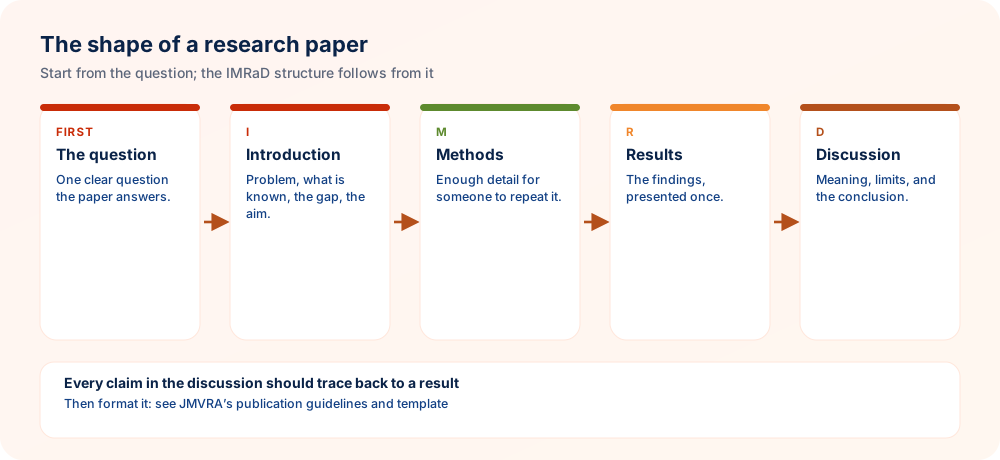
Authors who omit this step tend to produce papers that recount activity instead of reporting findings: a sequence of things done, with no line tying them together. Reviewers spot this at once, as they are unable to sum up the contribution in their reports.
Put your one-sentence claim on its own line and leave it in view as you draft. Each section should establish the claim, back it up, or qualify it. Anything that does none of these three jobs is material for another paper.
The Standard Structure
Most empirical papers adopt a layout that readers already know, so they can locate what they need without having to learn how you organised things:
- Title — precise, and, where it can, naming the finding rather than only the subject
- Abstract — a summary that stands alone, covering question, method, results and implication
- Key Terms — the terms a reader would search for
- Introduction — the problem, its importance, the existing knowledge, and the gap
- Literature review — dealing with earlier work, including work that takes the opposite view
- Methodology — sufficient detail that another researcher could repeat the work
- Results — the findings, set out a single time
- Discussion — their meaning and their limits
- In Summary — what was established and what follows
- References — full and uniform
Review articles and case studies can deviate from this layout, yet they still have to state clearly how they chose and analysed their material.
Writing the Introduction
A workable introduction passes through four stages in sequence: mark out the territory, set out what is already known, point to the gap, and say what the present paper does about it. A paragraph, or less, is enough for each stage.
The most common mistake is giving three pages of general background before the gap appears. By the bottom of the first page a reader should understand what your paper adds. When the gap first becomes visible only in the discussion, the introduction has not done its job.
Do not start with a dictionary definition or with a statement that the topic is "of great importance in today's world". Name exactly who faces the problem and what it costs them.
Writing the Methods
A methods section is tested by reproducibility: from this description alone, could a capable researcher in your field repeat the work? If not, the section is incomplete, however long it is. A useful habit is to ask a colleague to follow it step by step and note where they hesitate.
- Specify the design, the setting and the time span the work covers
- Explain who or what the participants, samples or datasets were, and the way they were chosen
- Identify the instruments, software and version numbers
- Describe the analysis in enough detail for it to be checked, including the handling of uncertainty
- Note ethical approval and consent when people or animals are involved in the work
Use the past tense in the methods, reporting what was really done and not what the protocol planned. If you departed from the plan, say so and give the reason.
Reporting Results
Present each finding a single time. A figure repeated in the text, then in a table, then in a chart takes up room and risks the three versions disagreeing.
Give results without interpreting them, because interpretation has its place in the discussion. Findings that failed to support your hypothesis deserve as full a report as those that did; selective reporting is a research integrity problem and not a matter of style.
Provide effect sizes and uncertainty as well as whether a test passed a significance threshold. When a result is statistically significant but of trivial practical weight, describe it that way. Readers can then judge for themselves whether the effect is worth acting on.
The Parts of a Research Paper
Usual proportions for an empirical paper — guidance rather than a fixed rule.
- BackgroundA 1–2 sentence statement of the gap.
- ObjectiveYour research question or hypothesis.
- MethodsDesign of the study, data used and tools applied.
- ResultsHeadline findings along with the numbers.
- In SummaryWhat it means.
- Key Terms4–6 searchable terms.
All five parts fit into an abstract of approximately 150–250 words, which you should write after everything else. Full rules: JMVRA Publication Guidelines.
Discussion and Conclusion
The discussion replies to the question the introduction posed. Open by saying plainly what you found. After that, connect it to earlier work: where it agrees, where it departs, and what could account for the departure.
Discuss limitations candidly and concretely. A line such as "Limitations include a small sample size" is filler, whereas naming the real constraint tells the reader something — for example, that all participants came from a single institution, so the result may not carry over to places with other intake criteria. Authors who can spot the weaknesses in their own work earn the trust of reviewers.
The conclusion says what has been established and what follows. It brings in no fresh results and asserts nothing that the evidence fails to support.
Revising Prior to Submission
- Leave the draft alone for a few days, then read it from start to end as a reader would.
- Confirm that the body supports every claim made in the abstract.
- Verify each citation against the original source, not against the reference list of some other paper.
- Remove sentences that convey nothing. Most drafts can lose fifteen per cent with no loss of content.
- Ask a colleague from outside your close group to read it. No other review comes so cheaply.
- Study the target journal's publication guidelines and tick off each requirement.
Frequent Grounds for Rejection
| Reason | How to avoid it |
|---|---|
| No identifiable contribution | Write down the one-sentence claim and confirm that each section supports it |
| The method is not repeatable | Write the methods with a stranger in mind, not your supervisor |
| Conclusions go beyond the evidence | Tune the strength of each claim to the data behind it |
| Literature overlooked or presented one-sidedly | Cite work that disagrees with you and explain the difference |
| Outside the journal's scope | Look at the subject coverage ahead of submitting |
| Similarity above threshold | Quote and cite correctly; paraphrase in earnest |
Take a look at the JMVRA Peer Review: Transparent & Double-Blind as well, to see what reviewers are asked to evaluate.
At-a-Glance Checklist
- A single questionClearly put in the introduction
- Method that can be repeatedDesign, data, procedure and analysis all described
- Results a single timeIn text, table or figure — never all three
- Candid discussionLimits given along with meaning
- References verifiedEach citation compared with its source
A Sensible Order for Writing
| Order | Section | Why |
|---|---|---|
| 1 | Figures and tables | They determine your results |
| 2 | Methods | Simplest to write while still fresh |
| 3 | Results | Explain the figures and tables |
| 4 | Discussion | Interpret results |
| 5 | Introduction | Set out what you now realise you found |
| 6 | Abstract and title | Sum up the completed paper |
Helpful Writing Routines
Short daily sessions
Regular progress is better than occasional marathons.
Outline first
Outline headings and key points ahead of the prose.
Keep drafting and editing apart
Draft without restraint, and revise afterwards.
Read it aloud
Sentences that are unclear stand out.
Drafting a Research Paper in a Sensible Working Routine
Many authors struggle not with ideas but with process. A steady routine and honest self-editing can turn scattered notes into a manuscript that reviewers find easy to follow.
- Outline with headings first. List the sections and one sentence for each before writing paragraphs. A visible skeleton reveals gaps in logic while they are still cheap to fix.
- Write in short sessions. Set aside regular, focused periods and stop when a section is rough but complete. Steady progress usually beats occasional exhausting marathons.
- Describe methods for replication. Give enough detail that another competent researcher could repeat your procedure. Reviewers lose confidence quickly when materials, settings or sampling choices are left unexplained.
- Separate results from interpretation. Report what you observed in one place and discuss what it means in another. Mixed reporting makes it difficult to judge whether conclusions follow from the evidence.
- Let the draft rest. Leave the manuscript alone for a short while, then reread it aloud. Awkward sentences and unsupported statements become far easier to notice.
Outline first, write regularly, explain methods fully and revise after a pause so that reviewers can assess your argument fairly.
Questions Researchers Often Ask
What is meant by IMRaD?
Introduction, Methods, Results and Discussion — the usual layout for empirical research papers, typically with a conclusion at the end.
Which section is best written first?
A lot of authors begin with the methods and results since those are settled, move on to the introduction and discussion, and write the abstract at the end.
What is the right length for a research paper?
It varies by discipline and by journal. Stick to the journal’s guidelines, and let the method and the evidence rather than a target word count settle it.
Is the introduction the first thing to write?
Many authors leave it until the results and discussion have become clear.
What is the right length for a research paper?
Follow the journal; JMVRA papers need to run to at least 4 pages in the JMVRA format.
More Researcher Resources
Part of the JMVRA Researcher Resources series, this guide provides useful pointers anyone can check for themselves, kept clear of sales claims.
Ready to Publish? Submit to JMVRA
JMVRA is aligned with UGC's Suggested Parameters for Choosing Peer-Reviewed Journals.
JMVRA is a Transparent, Peer-Reviewed, Open Access Journal (Refereed Journal). Following the discontinuation of the UGC and UGC-CARE journal listing, and in alignment with the latest UGC-CARE recommendations and guidelines, JMVRA is aligned with UGC’s Suggested Parameters for Choosing Peer-Reviewed Journals.
Quick links across jmvra.org
Key Terms
Subjects and search phrases this article addresses.
Related Reading
Further reading on the same theme from the JMVRA blog.
JMVRA Best Paper Award: Eligibility & Selection
Read the guide RelatedAfter You Submit to JMVRA: Status, Review & Next Steps
Read the guide RelatedLiterature Reviews That Synthesise, Not List
Read the guide RelatedReading Your JMVRA Paper's Statistics
Read the guide RelatedFormatting a Manuscript for Submission
Read the guide RelatedThesis Publication: Journal Paper or Book?
Read the guide From the blogEngineering Papers International Reviewers Accept
Read the article From the blogTurning a Project Report Into a Journal Paper
Read the article From the blogResearch Paper Publication in India — A Complete Guide for Scholars & Faculty
Read the articleKeep Reading on the JMVRA Blog
Our JMVRA journal blog carries this guide along with other practical advice on publishing, indexing, metrics and research integrity, all written so that claims can be verified and nothing is promotional.