

Reviewers at international engineering journals handle many manuscripts and decide fast, based on a handful of questions: Is the problem genuine? Is the method sound? Have the results been validated? Can an engineer in any country follow the writing? This guide goes through the structure, conventions and checks that prepare an engineering research paper for an international journal. Working through these points before submitting lets you catch many avoidable rejections early.
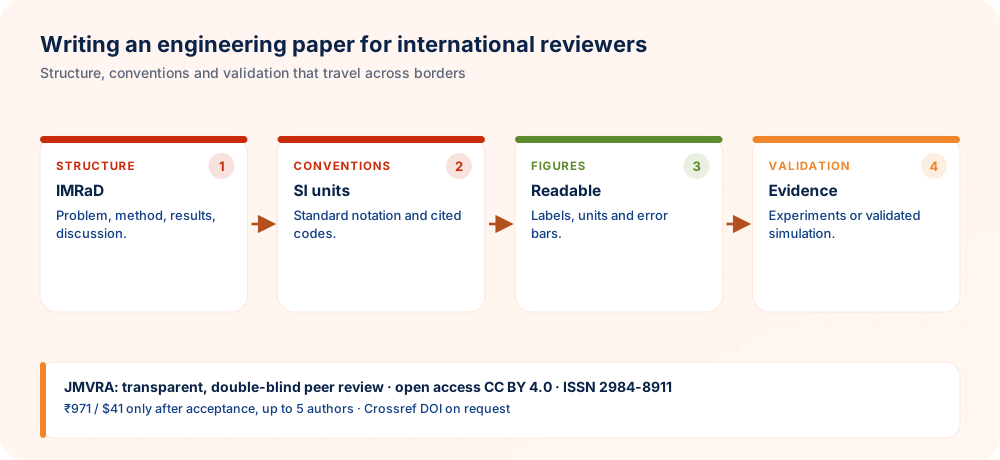
An Effective Paper Structure
| Section | Content |
|---|---|
| Abstract | The problem, the method, the main quantitative finding and why it matters |
| Introduction | The engineering problem, the shortfall in earlier work and the aims |
| Literature review | Critical comparison of up-to-date, relevant studies |
| Methodology | Designs, materials, models, simulation parameters and testing procedures |
| Results and discussion | Figures and tables accompanied by interpretation and comparison |
| Validation | Checked against theory, standards, previous studies or experiments |
| In Summary | Main findings, limitations and directions for further work |
What International Readers Expect by Convention
- SI units used consistently, along with uniform symbols
- Numbered equations with every variable explained
- Standards referenced with their complete number and year (IS, ASTM, ISO, IEC)
- Software packages and their versions identified (ANSYS, MATLAB, COMSOL…)
- Material properties and their sources given
Figures and Tables
- Each figure makes one point; axes carry quantities and units
- Choose vector formats, or a resolution of 300 dpi or higher
- Ensure lines can be told apart when printed in greyscale
- Use tables when exact values matter and figures to show trends
Mistakes to Avoid
No comparison
Findings presented without any benchmark for comparison.
Missing uncertainty
Measurements lacking error estimates or repeated trials.
Copied introductions
Background passages lifted from other papers or theses.
Over-claiming
Conclusions that claim more than the results support.
Explaining Local Context
Research based on Indian standards, local materials or regional conditions is entirely legitimate. It simply needs explaining: provide the standard’s complete reference, the origin and properties of the material, and the climate or site conditions, so that readers abroad can assess how well the results carry over.
Before Submitting
- Verify the template and length. A lot of engineering journals cap the number of pages or words.
- Do a similarity check. Reword any background passages that were reused.
- Proofread the equations. Mistakes in them are easy to miss and weaken trust in the work.
- Prepare a brief cover letter. Spell out the engineering contribution.
Methodology Section Checklist
- Materials: origin, grade, properties and the standard applied
- Specimens or models: size, quantity and preparation
- Equipment: manufacturer, model, capacity and accuracy
- Procedure: the steps, the conditions and the loading or input rates
- Simulation: the software and version, mesh or model parameters, and a validation case
- Analysis: the equations, statistical techniques and software employed
This section alone should let a reader reproduce your work. Whenever they would have to write to you for details, put the missing information in.
The 10 Most-Searched Questions on This Topic
Here are the ten questions researchers search for most on this subject, each with a direct answer.
international journal of engineering
An engineering journal whose board, authors and readers are international; check how it actually operates.
engineering research paper structure
Sections run: abstract, introduction, literature review, methodology, results, validation and conclusion.
SI units in research paper
Apply SI units uniformly, with conventional symbols and clear definitions.
how to cite IS code in paper
State the number, title and year of the standard, for example IS 456:2000.
engineering paper figures
Plots that are clear and labelled, saved as vector graphics or at 300 dpi or higher.
validation of results engineering
Measure results against theory, standards, earlier studies or experiments.
engineering literature review
A critical review of recent, relevant studies that leads to your research gap.
simulation paper engineering
State the software, its version, the mesh or model settings, and the validation.
engineering research paper for publication
A focused paper that addresses a genuine problem with a sound method and validated results.
common mistakes engineering papers
Lack of comparison, absent uncertainty, copied background text and overstated claims.
How JMVRA Fits In
JMVRA is a Transparent, Peer-Reviewed, Open Access Journal (Refereed Journal). Following the discontinuation of the UGC and UGC-CARE journal listing, and in alignment with the latest UGC-CARE recommendations and guidelines, JMVRA is aligned with UGC’s Suggested Parameters for Choosing Peer-Reviewed Journals. UGC public notice (PDF)
JMVRA accepts engineering research papers in all branches from India and overseas; they undergo double-blind review by engineers and appear in open access, with a Crossref DOI available as an option.
- ISSN
- 2984-8911 (online) · publishing since June 2023
- Issues
- Monthly issues across many disciplines
- Review
- Two-way anonymous review by specialists
- Access
- Openly accessible under CC BY 4.0
- Fee
- ₹971 INR for Indian and $41 USD for foreign authors, due only after acceptance
- DOI
- Crossref — available as an optional extra
- Indexing
- Google Scholar yes; not Scopus, Web of Science or DOAJ
- Impact factor
- 11.25, derived from Google Scholar data
Screening begins the moment a paper arrives and each decision is sent as soon as it is reached, yet JMVRA never promises a set number of days: actual review time depends on the reviewers and on how much revision the paper needs.
At-a-Glance Checklist
- Uniform unitsSI from start to end
- Standards referencedCodes plus test methods
- Reproducible methodsSettings along with materials
- Validated resultsChecked using data or benchmarks
- Local setting clarifiedAimed at readers worldwide
How to Make Engineering Results Reproducible
Parameters
Put every design and simulation parameter in a table, with its units.
Data and code
Make them available, or say why sharing is not possible.
Baselines
Benchmark against accepted methods under identical conditions.
Uncertainty
Give the measurement error and how repeatable the results are.
Clear Writing for an International Review Panel
- Brief sentences — each carrying one technical idea
- Explain terms and symbols — when they first appear, and stay consistent afterwards
- Skip local abbreviations — spell out regional standards or agencies
- Apply SI units — leaving a space between the value and its unit
- Proofread, or get language editing — particularly if English is not your first language
Related reading: IEEE format and the methods section guide.
Making Engineering Research Papers Easier to Reproduce
Engineering readers want to know that results can be trusted and, ideally, repeated. These habits make your design, experiment or simulation easier for other engineers to check and build upon.
- Describe the test setup fully. Explain equipment, operating conditions, boundary assumptions and calibration so another engineer could rebuild your arrangement. Photographs or schematics often communicate this better than long paragraphs.
- Report uncertainty alongside results. Show measurement error, repeat runs or sensitivity analysis where appropriate. Results presented without any sense of variability are harder for reviewers to trust.
- Compare against a fair baseline. Benchmark your method against established approaches under identical conditions. State clearly where your approach performs worse, since honest limits increase credibility.
- Share parameters and code. List the parameter values, software versions and model settings you used, and consider providing code or configuration files when permitted. Hidden settings frustrate anyone attempting replication.
- Use consistent units and notation. Choose standard units and one symbol set throughout, and define every symbol on first use. Inconsistent notation is a common cause of reviewer confusion.
Give enough detail, with honest uncertainty and fair comparisons, for another engineer to test your claims independently.
Questions Researchers Often Ask
The Parts of a Research Paper
Usual proportions for an empirical paper — guidance rather than a fixed rule.
- BackgroundDescribe the gap briefly, in 1–2 sentences.
- ObjectiveGive the question or hypothesis behind the work.
- MethodsApproach: design, data and tools employed.
- ResultsThe central findings, together with the numbers.
- In SummaryWhat it means.
- Key Terms4–6 searchable terms.
Compose your abstract at the end, at about 150–250 words, so it can include all five parts. JMVRA Publication Guidelines give the full rules.
Ready to Publish? Submit to JMVRA
JMVRA is aligned with UGC's Suggested Parameters for Choosing Peer-Reviewed Journals.
JMVRA is a Transparent, Peer-Reviewed, Open Access Journal (Refereed Journal). Following the discontinuation of the UGC and UGC-CARE journal listing, and in alignment with the latest UGC-CARE recommendations and guidelines, JMVRA is aligned with UGC’s Suggested Parameters for Choosing Peer-Reviewed Journals.
More useful pages at jmvra.org
Key Terms
Subjects and search phrases this article addresses.
Related Reading
Further reading on the same theme from the JMVRA blog.
Mendeley Is Not an Index: Civil Engineering Guide
Read the guide RelatedAffordable Mechanical Engineering Publication With DOI
Read the guide RelatedPublishing Electrical Engineering Research Affordably
Read the guide RelatedFormatting a Manuscript for Submission
Read the guide RelatedAbstract Writing: What Every Sentence Must Do
Read the guide RelatedInternational Authors at JMVRA: What to Expect
Read the guideKeep Reading on the JMVRA Blog
You are reading part of the JMVRA journal blog, a source of hands-on guidance about publishing, indexing, metrics and research integrity that aims to be verifiable, not promotional.