

Electrical and electronics engineering (EEE) research moves fast, covering renewable integration, EV chargers, smart grids, power electronics and embedded systems. Many EEE authors work from MATLAB/Simulink simulations or prototype hardware and look for an affordable journal. This guide describes what EEE reviewers expect, how to handle references with Mendeley, and what the “Mendeley indexed” claim really means. Keep a record of your simulation settings from the start, since reviewers often ask for them.
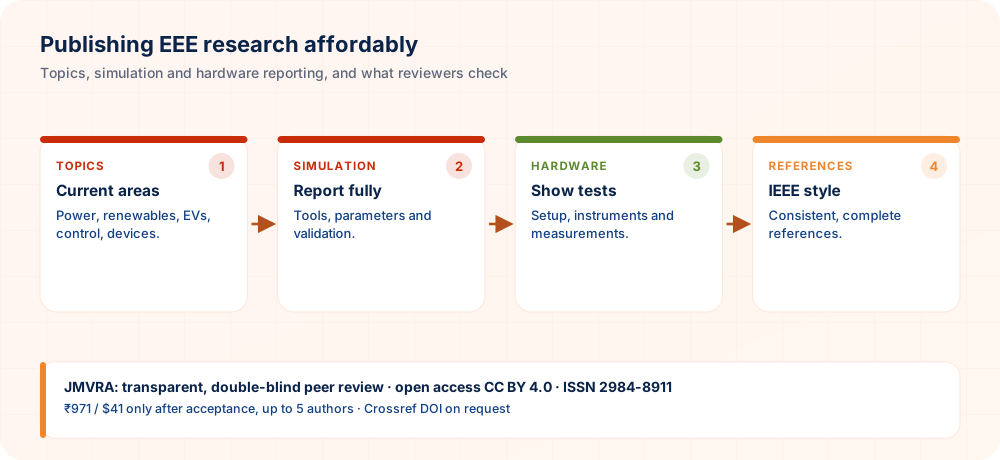
EEE Research Topics Right Now
- Solar and wind grid integration; energy storage
- Power electronic converters, EV charging and battery management
- Smart grids, protection and demand response
- Harmonics, power quality and FACTS devices
- Motor drives and control systems
- VLSI, embedded systems and IoT sensing
How to Report MATLAB/Simulink and Hardware Work
| Work type | Report |
|---|---|
| Simulation | Test scenarios, sampling time, solver settings, parameters and model blocks |
| Hardware prototype | Measurement equipment, controller, component ratings and circuit diagram |
| Both | Simulation and hardware results set side by side |
| Comparison | Measured against conventional methods or published results under identical conditions |
References and Style
Most EEE journals follow the numbered IEEE reference style, and a reference manager helps keep it consistent: Mendeley, Zotero and EndNote all include IEEE style. Mendeley suits this purpose, but it is a reference manager and not a journal index, so “Mendeley indexed” on a journal’s website says nothing about quality. Always run a final manual check, because automated formatting can miss small errors.
What Reviewers Look for in EEE Papers
Realistic parameters
Ratings and values consistent with real equipment.
Fair comparison
Identical conditions for the proposed and conventional methods.
Dynamic performance
Transient results alongside steady-state ones.
Standards
Compliance with standards from IEEE/IEC, for example harmonic limits.
Publishing Affordably
- Confirm your requirement. Compare journals with IEEE conferences for API or PhD purposes.
- Draw up a shortlist of affordable reviewed journals. Look for modest fees, payment after acceptance and DOIs.
- Check indexing claims. Use Scopus, the Master Journal List or Google Scholar instead of trusting badges.
A Simulation Parameters Table That Reviewers Expect
| Parameter | Value |
|---|---|
| PV array rating | 5 kW |
| DC link voltage | 400 V |
| Switching frequency | 10 kHz |
| Grid voltage / frequency | 230 V / 50 Hz |
| Solver / step size | Discrete, 5 µs |
| Controller gains | Kp = 0.8, Ki = 120 |
A single table of parameters lets reviewers judge realism quickly and allows others to reproduce your results. The values shown are illustrative.
The 10 Most-Searched Questions on This Topic
Here are the ten questions researchers search for most on this subject, each with a direct answer.
low cost electrical engineering journal
A reasonably priced peer-reviewed journal for EEE research; verify the review and DOI.
EEE research paper topics
Covers renewable integration, EV charging, smart grids, power quality, drives and embedded systems.
MATLAB Simulink paper publication
Give model parameters, solver settings and scenarios, and validate your results.
IEEE reference style
References numbered in square brackets, in the order they are cited.
Mendeley indexed journal meaning
Just that papers show up in a reference manager; it is not an indexing credential.
power electronics paper publication
Where possible, cover converter design, control, simulation and hardware results.
smart grid research paper
Model, data and scenarios, compared with existing strategies.
electrical engineering journal India
Many Indian journals publish EEE research; check their practices.
hardware prototype research paper
Circuit diagrams, measurements and component ratings, compared against simulation.
EEE project to journal paper
Concentrate on the contribution and validated results, formatted to the journal’s template.
How JMVRA Fits In
JMVRA is a Transparent, Peer-Reviewed, Open Access Journal (Refereed Journal). Following the discontinuation of the UGC and UGC-CARE journal listing, and in alignment with the latest UGC-CARE recommendations and guidelines, JMVRA is aligned with UGC’s Suggested Parameters for Choosing Peer-Reviewed Journals. UGC public notice (PDF)
JMVRA publishes research in electrical, electronics and power engineering, offering double-blind review, open access and an optional Crossref DOI; the fee is ₹971 INR / $41 USD after acceptance.
- ISSN
- 2984-8911 (online) · publishing since June 2023
- Issues
- Monthly issues across many disciplines
- Review
- Two-way anonymous review by specialists
- Access
- CC BY 4.0 open access
- Fee
- ₹971 INR for Indian and $41 USD for foreign authors, due only after acceptance
- DOI
- Crossref — available as an optional extra
- Indexing
- Listed on Google Scholar, though not on Scopus, Web of Science or DOAJ
- Impact factor
- 11.25, derived from Google Scholar data
Screening begins the moment a paper arrives and each decision is sent as soon as it is reached, yet JMVRA never promises a set number of days: actual review time depends on the reviewers and on how much revision the paper needs.
At-a-Glance Checklist
- Parameters tabledFor simulations
- Hardware describedSetup photos and specs
- Results comparedWith prior work
- IEEE style usedConsistently
- Journal affordableFee after acceptance
Presenting Circuits, Waveforms and Results
Circuit diagrams
Draw with standard symbols and give every component its value.
Waveforms
Label axes with quantities and units, and state the scope settings for hardware captures.
Comparison plots
Plot the proposed method against baselines on shared axes.
Tables of parameters
Give simulation and hardware parameters so others can reproduce the results.
Refer to preparing figures and tables and IEEE format.
Checking Simulation Results Against Hardware
- Document the simulation setup — the software, its version, the solver and the step size
- Build a prototype or cite one — and list its components and ratings
- Compare key metrics — such as efficiency, THD, settling time or other relevant measures
- Account for discrepancies — losses, parasitics and measurement uncertainty
- Make data or models available — where possible, to support reproducibility
Preparing an Electrical Engineering Paper for Affordable Publication
Reviewers of electrical engineering papers look for reproducible circuits, honest simulations and tidy references. These tips focus on the small details that make a submission easier to assess.
- Label every symbol once. Define each variable, subscript and unit the first time it appears, and keep notation consistent between equations, figures and tables. Inconsistent symbols are a frequent cause of reviewer confusion.
- Export figures at readable quality. Save waveforms and block diagrams as vector graphics where possible, with legible axis labels and distinct line styles. Colour alone may disappear when a reader prints the article in grey.
- State the tools and settings. Name the software, solver type, step size and any toolbox used. Without these details, another researcher cannot reproduce your simulated results, however convincing the plots look.
- Describe the hardware setup honestly. Mention instrument models, sampling arrangements, calibration and known limitations of the test bench. Reviewers trust a paper more when it admits where measurement errors could arise.
- Sort references by relevance. Within your reference manager, group foundational standards, comparable designs and your own earlier work. This helps you cite the strongest comparisons instead of padding the list.
Make your notation, tools, settings and test conditions explicit so another engineer could rebuild your work and reach similar results.
Questions Researchers Often Ask
Your Paper's Journey at JMVRA, From Submission to Publication
- SubmissionPaper ID assigned
- ScreenScope & similarity
- ReviewDouble-blind
- DecideEmail & SMS
- AmendItem by item
- AcceptCopyright & fee
- ProduceDOI provided when requested
- PublishMonthly issue
How long review takes depends on the reviewers and on any revision required, so no set turnaround is promised; you are told of acceptance or rejection by email and WhatsApp.
Ready to Publish? Submit to JMVRA
JMVRA is aligned with UGC's Suggested Parameters for Choosing Peer-Reviewed Journals.
JMVRA is a Transparent, Peer-Reviewed, Open Access Journal (Refereed Journal). Following the discontinuation of the UGC and UGC-CARE journal listing, and in alignment with the latest UGC-CARE recommendations and guidelines, JMVRA is aligned with UGC’s Suggested Parameters for Choosing Peer-Reviewed Journals.
Handy links within jmvra.org
Key Terms
Subjects and search phrases this article addresses.
Related Reading
Further reading on the same theme from the JMVRA blog.
Targeting High-Impact Mechanical Engineering Journals
Read the guide RelatedAffordable Engineering Journals: Choosing on a Budget
Read the guide RelatedEngineering Papers International Reviewers Accept
Read the guide RelatedMendeley, Zotero or EndNote? Pick a Reference Manager
Read the guide RelatedFormatting a Manuscript for Submission
Read the guide RelatedIs Your Conference Paper Published on JMVRA?
Read the guideKeep Reading on the JMVRA Blog
The JMVRA journal blog includes this guide, one of many practical pieces on publishing, indexing, metrics and research integrity, prepared so readers can verify them without any sales pitch.