
Engineering work tends to be applied and experimental, and it is frequently published against a clock: final-year projects, M.Tech dissertations, faculty accreditation needs. Since many engineering authors have no grant money, cost is a real concern. The best low-cost engineering journal reviews your work properly, presents it professionally and keeps it permanently citable for a fee within your means. Check that the journal’s recent issues include papers similar to yours in method and scale.
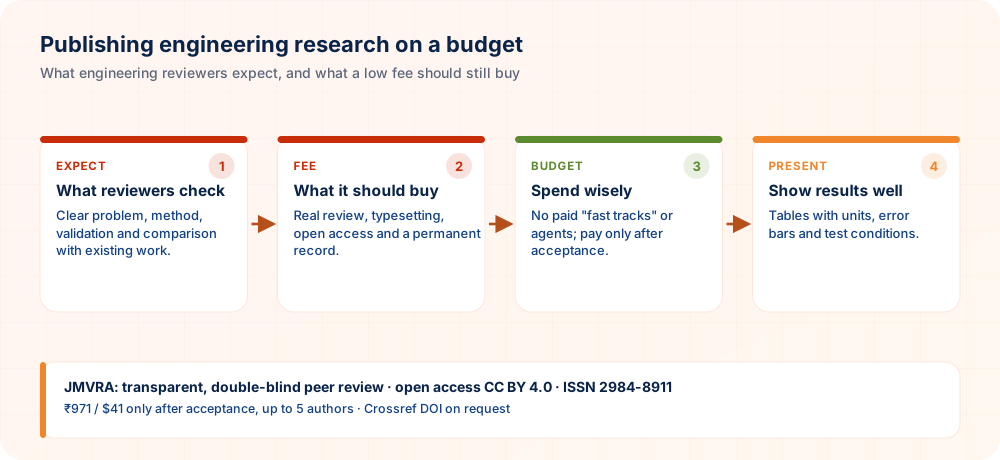
What Reviewers in Engineering Look For
A defined problem
A clear opening statement of the design problem, its constraints and the performance targets.
Sound method
Enough detail on the analysis, simulation or testing for others to repeat it.
Validation
Findings set against theory, standards, previous designs or experiments.
Practical meaning
The implications of the result for cost, safety, efficiency or manufacturing.
What Your Fee Ought to Cover
- Review by peers from your own engineering branch
- Similarity screening
- Correct typesetting for equations, tables and figures
- A Crossref DOI, either bundled or offered as a clearly stated extra
- Lasting hosting within an archived issue
Money-Saving Advice for Engineering Authors
- Rely on free tools. Word or LaTeX templates, Zotero or Mendeley to manage references, and the similarity checker your institution provides.
- Make the figures yourself. Plots from MATLAB, Python or Excel can be exported as vectors or at 300 dpi.
- Favour pay-after-acceptance journals. Fees apply only to papers that get through review.
- Leave out optional add-ons. Hard copies and additional certificates are seldom necessary.
A Comparison of Low-Cost Options
| Option | Cost to author | Notes |
|---|---|---|
| Subscription engineering journals | Often free (non-OA) | Normally slower, with tougher selection |
| Society OA journals | Varies | Strong within particular branches |
| Multidisciplinary OA journals | Often modest | Well suited to applied and cross-branch research |
| Conference proceedings | Registration fee | Quicker, but may carry less weight than journals |
Staying Credible While Spending Little
Accreditation (NBA/NAAC) and API care chiefly that a publication is peer reviewed and verifiable. Store acceptance letters, published links and DOIs in one place, because these are the items your file’s reviewers will examine.
Engineering Branches and the Papers They Usually Produce
- Civil: testing of materials, structural analysis, and transport and water studies
- Mechanical: work on thermal systems, manufacturing processes and optimising designs
- Electrical and electronics: topics such as power systems, renewable energy, control and embedded systems
- Computer and IT: software, networking and applications of AI
- Chemical and environmental: designing processes, treatment methods and sustainability
Showing Engineering Results: A Sample Table
| Mix | Fly ash (%) | 7-day strength (MPa) | 28-day strength (MPa) | Change vs control |
|---|---|---|---|---|
| Control | 0 | 24.1 ± 0.6 | 33.8 ± 0.9 | — |
| FA20 | 20 | 21.3 ± 0.7 | 35.2 ± 0.8 | +4.1% |
| FA30 | 30 | 18.9 ± 0.5 | 34.1 ± 1.0 | +0.9% |
Units, variation (± standard deviation across repeat specimens) and a comparison with a control all appear in the table; reviewers check these three things first. The figures are illustrative.
The 10 Most-Searched Questions on This Topic
Here are the ten questions researchers search for most on this subject, each with a direct answer.
best low cost journal for engineering research
A peer-reviewed engineering or multidisciplinary journal that has low, openly stated fees and a genuine DOI.
engineering journal publication fee
Ranging from nothing (subscription journals) to expensive OA fees; plenty of affordable OA journals set modest APCs.
engineering paper for final year students
Convert a well-documented project into a concentrated paper with clear results and validation.
M.Tech paper publication
Put dissertation results into a peer-reviewed journal that your department recognises.
engineering journal with DOI
Make sure the DOIs of published articles resolve through doi.org.
NBA faculty publication
Reviewers for accreditation want faculty publications that are peer reviewed and can be verified.
engineering research paper format
Introduction, literature review, methodology, results with discussion, conclusion and references.
how to validate engineering results
Benchmark against theory, standards, published findings or experiments.
low cost engineering journal India
A number of Indian journals provide affordable publishing, but confirm their review process and permanence.
engineering conference vs journal
Conferences move faster, whereas journals normally carry more weight for API and PhD.
How JMVRA Fits In
JMVRA is a Transparent, Peer-Reviewed, Open Access Journal (Refereed Journal). Following the discontinuation of the UGC and UGC-CARE journal listing, and in alignment with the latest UGC-CARE recommendations and guidelines, JMVRA is aligned with UGC’s Suggested Parameters for Choosing Peer-Reviewed Journals. UGC public notice (PDF)
Research in civil, mechanical, electrical, electronics, computer and chemical engineering is published by JMVRA after double-blind review, with a ₹971 INR / $41 USD fee due only once a paper is accepted.
- ISSN
- 2984-8911 (online) · publishing since June 2023
- Issues
- Monthly issues across many disciplines
- Review
- Two-way anonymous review by specialists
- Access
- Open access with a CC BY 4.0 licence
- Fee
- ₹971 INR for Indian and $41 USD for foreign authors, due only after acceptance
- DOI
- Crossref — available as an optional extra
- Indexing
- Engineering authors should note: Google Scholar carries the journal, not Scopus, Web of Science or DOAJ
- Impact factor
- 11.25, derived from Google Scholar data
Screening begins the moment a paper arrives and each decision is sent as soon as it is reached, yet JMVRA never promises a set number of days: actual review time depends on the reviewers and on how much revision the paper needs.
At-a-Glance Checklist
- Validation providedThrough an experiment, simulation or benchmark
- Units and codesSI units, with the relevant codes or standards cited
- Payment once acceptedJMVRA charges ₹971 INR / $41 USD
- Legible figuresEvery plot carries axis labels and units
- Scope matchesRecent issues contain engineering papers
Converting a Final-Year Project into a Paper
- Pinpoint the contribution — what it adds beyond current work
- Condense the report — drop textbook background and long code listings
- Include a literature comparison — current related papers and where yours differs
- Reinforce the evaluation — numerical results measured against a baseline
- Settle authorship — the students and supervisors who contributed
Engineering Figures That Get Through Review
Readable axes
Labelled with units and still readable at a small print size.
Error bars
Where measurements repeat.
Clean schematics
Use vector drawings instead of photographs of sketches.
Consistent style
Keep fonts and symbols uniform across every figure.
Refer to preparing figures and tables.
Presenting Engineering Work Credibly Without a Large Budget
Engineering reviewers judge evidence, not the size of the fee you paid. Spending effort on reproducibility and clarity gives a student or faculty author more value than any expensive service.
- Describe the setup completely. State equipment, software versions, parameters and boundary conditions so another engineer could repeat your work. Missing details are among the quickest reasons for a reviewer to doubt results.
- Compare against a real baseline. Show how your design, material or algorithm performs against an established method under the same conditions. A claim of improvement without a fair comparison is rarely convincing.
- Report uncertainty and limits. Include error bars, repeated trials or tolerance ranges where relevant, and say honestly where the method stops working. Reviewers trust authors who describe limits plainly.
- Use free tools for language checks. Ask a colleague to read the manuscript for clarity before spending on editing. Peer reading is inexpensive and often catches confusing sentences in technical descriptions.
- Credit project contributors fairly. If a team built the prototype, decide authorship and acknowledgements openly. Fair credit keeps collaborations healthy and avoids complaints after the paper appears.
Strong evidence, clear methods and fair comparisons make an affordable journal choice credible to engineering reviewers.
Questions Researchers Often Ask
Your Paper's Journey at JMVRA, From Submission to Publication
- Send paperPaper ID provided
- ScreenScope & similarity
- ReviewDouble-blind
- DecideEmail & SMS
- ReviseAddressing each comment
- AcceptCopyright & fee
- ProduceDOI offered upon request
- PublishMonthly issue
How long review takes depends on the reviewers and on any revision required, so no set turnaround is promised; you are told of acceptance or rejection by email and WhatsApp.
Ready to Publish? Submit to JMVRA
JMVRA is aligned with UGC's Suggested Parameters for Choosing Peer-Reviewed Journals.
JMVRA is a Transparent, Peer-Reviewed, Open Access Journal (Refereed Journal). Following the discontinuation of the UGC and UGC-CARE journal listing, and in alignment with the latest UGC-CARE recommendations and guidelines, JMVRA is aligned with UGC’s Suggested Parameters for Choosing Peer-Reviewed Journals.
Related pages on jmvra.org
Key Terms
Subjects and search phrases this article addresses.
Related Reading
Further reading on the same theme from the JMVRA blog.
Engineering Papers International Reviewers Accept
Read the guide RelatedMendeley Is Not an Index: Civil Engineering Guide
Read the guide RelatedAffordable Mechanical Engineering Publication With DOI
Read the guide RelatedFormatting a Manuscript for Submission
Read the guide RelatedWhy JMVRA Charges Just ₹971 INR / $41 USD Without Lowering Standards
Read the guide RelatedA Practical Guide to Converting Your PhD Thesis into an Article
Read the guideKeep Reading on the JMVRA Blog
Published on the JMVRA journal blog, this guide gives practical direction on publishing, indexing, metrics and research integrity, with a focus on what can be verified instead of on promotion.