
Reviewers turn to the methods section to judge whether your results can be trusted. Describe your work clearly enough that a capable researcher could redo it and decide whether your conclusions follow. Here you will find a standard structure, advice on content for different kinds of study, pointers to the reporting guidelines journals expect, and the errors that most often lead to rejection. Reading your own methods as a stranger would is a quick way to spot gaps.
The Purpose of the Methods Section
The methods section has a double task: reproducibility — sufficient detail for the study to be repeated — and credibility — enough justification for readers to accept that the design answers the research question. Many papers are turned down not because their results are weak but because the methods fail to show how those results were reached. Read why papers are rejected.
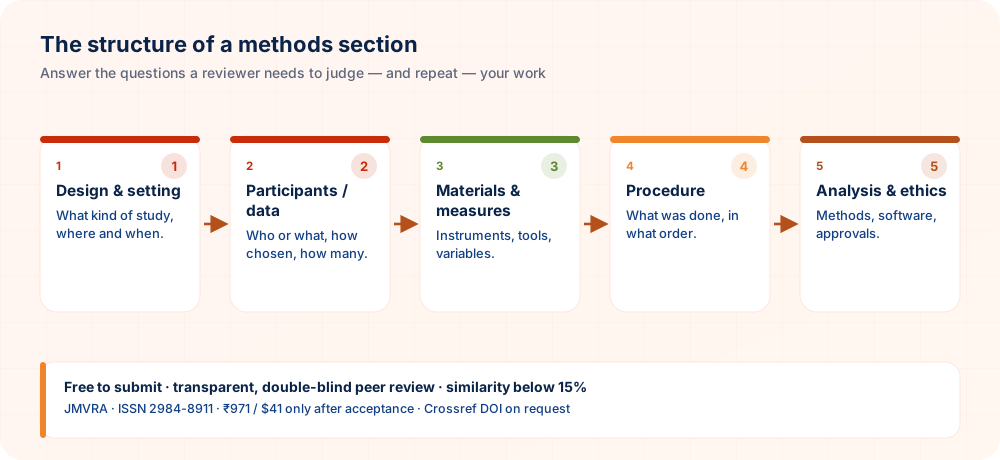
A Standard Structure
| Subsection | Questions it answers |
|---|---|
| Study design | What kind of study is it, and why does it suit the question? |
| Setting | Where and at what time did it take place? |
| Participants, samples or data | Who or what was studied, how were they chosen, how many were there, and what justifies that number? |
| Materials and measures | What tools came into play — instruments, questionnaires, equipment, datasets or software? How was each variable defined, and how was it measured? |
| Procedure | What took place, in which order, one step after another? |
| Data analysis | How was the data processed and analysed, using which tests and software? |
| Ethics | What approvals and consent were secured? |
Change the headings to suit your discipline, but preserve the logic: a reader ought to follow the study from design through analysis without having to guess.
Design, Setting and Participants
- State the design exactly: for example a systematic review, simulation study, quasi-experiment, case study, cross-sectional survey or randomised controlled trial.
- State the setting and dates: the type of institution, the region and the data collection period.
- Describe sampling: the population, the sampling approach (random, stratified, purposive, convenience), the inclusion and exclusion criteria, and how the sample size was determined.
- Show participant flow: the numbers approached, eligible, included and analysed, with reasons for any exclusions.
Materials, Measures and Procedure
- Instruments: name every questionnaire or scale, cite where it comes from, state how many items it has and its response format, and report its reliability (for example Cronbach’s alpha) in your own sample.
- Equipment and software: state who made or developed each one, plus the version used.
- Variables: define every dependent, independent and control variable, together with how it was measured or coded.
- Procedure: lay out the steps in sequence — recruitment, data collection, interventions, follow-up — along with any training or pilot testing.
- Data and code: indicate where they can be obtained, or the reason they cannot be shared, in a Data Availability Statement.
Data Analysis
Identify each statistical test or analytic approach and justify why it suits the data and question. Give the software and version, the significance level, the handling of missing data and outliers, and any assumption checks. In qualitative work, set out the analytic approach (for example thematic analysis), who coded the data, how the codes were developed, and what was done to ensure credibility. Anything you decided after seeing the data should be flagged as such.
Ethics and Declarations
Studies involving human participants or animals need ethics approval before they start; give the committee name and approval reference, and explain how informed consent was obtained. JMVRA does not accept retrospective approval. Clinical trials ought to be registered ahead of enrolling the first participant. State your funding and any conflicts of interest. Refer to the JMVRA journal policies.
Methods for Different Kinds of Study
| Study type | Emphasise |
|---|---|
| Experimental | Groups, randomisation, blinding, details of the intervention, outcome measures |
| Survey | Population, sampling frame, how the questionnaire was developed and validated, response rate |
| Qualitative | Sampling strategy, data collection, role of the researcher, analytic approach, saturation |
| Computational or engineering | Datasets, parameters, hardware and software, baselines, evaluation metrics, availability of code |
| Systematic review | Protocol, databases, search strings, screening, data extraction, assessment of bias |
| Case study | How cases were selected, context, data sources, analysis, and limits on generalising |
Reporting Guidelines
A reporting guideline sets out what a full methods section should contain for a particular design. Picking the appropriate one, and stating that you did, speeds up review:
- CONSORT — randomised trials
- STROBE — observational studies
- PRISMA — for systematic reviews and meta-analyses
- COREQ and SRQR — for qualitative research
- ARRIVE — animal research
The EQUATOR Network catalogues these along with many others.
Style: Tense, Level of Detail and Citations
- Put what you did in the past tense, and keep the present tense for whatever a table displays.
- Stay consistent in voice, passive or active; a growing number of journals favour the active (“We recruited…”).
- When using a standard method, cite its source and summarise it briefly instead of copying the wording — borrowed method text often causes high similarity scores.
- Add subheadings so reviewers can locate each part at a glance.
Mistakes to Avoid
- Not enough detail for the study to be repeated.
- The sample size is not justified.
- Instruments mentioned without a source or reliability figures.
- Results appearing inside the methods section.
- Ethics approval or consent statements left out.
- A vague account of the analysis (“data were analysed using SPSS”) that omits the tests used.
Methods Checklist
- Design namedWith a reason tied to the question
- Sample explainedHow chosen, criteria and size
- Measures definedSources, reliability and coding
- Procedure orderedOne step at a time
- Analysis specifiedTests, software and treatment of missing data
- Ethics statedApproval, consent and declarations
Common Methods Mistakes
| Mistake | Fix |
|---|---|
| Sample size not justified | Say how the size was decided |
| Vague instruments | Tool names, versions and sources |
| No ethics statement | Approving body and reference number |
| Unclear analysis | Tests, software and assumptions |
| Results in methods | Put findings in the results |
Methods in Qualitative Studies
- State the approach — for instance thematic analysis
- Describe sampling — purposive, snowball, saturation
- Explain data collection — interview guide, length, recording
- Describe analysis — how coding proceeded and who did it
- Cover trustworthiness — reflexivity and verification
Record Keeping Now for a Reproducible Methods Section
The easiest methods sections are written from good notes taken during the work itself. Build these habits while you collect and analyse data, and you will rarely struggle to describe what happened.
- Keep a dated laboratory or project diary. Record each decision, change of plan and unexpected event as it occurs. These entries later explain deviations from the protocol and strengthen your account of what was actually done.
- Note software and instrument details. Write down names, versions, settings and sources of materials at the time of use. Missing details are very difficult to reconstruct after the experiment is finished.
- Justify choices, not just describe them. Briefly explain why you picked a method, sample or test. Reasons help reviewers judge suitability and show that your design was deliberate rather than convenient.
- Share analysis code where possible. Keep scripts tidy, commented and stored with your data, and consider sharing them if permitted. Clear code lets others check and reuse your analysis.
- Ask a newcomer to follow your text. Give the draft to a colleague unfamiliar with the project and see whether they could repeat the steps. Where they hesitate, details are missing.
Document decisions and settings while the work happens, so your methods section describes reality accurately and others can repeat it.
Questions Researchers Often Ask
In Summary
A good methods section is specific, well ordered and justified. Name the design, explain the sampling, define every measure, narrate the procedure in sequence, specify the analysis and report ethics approvals. If you apply the reporting guideline that suits your design, reviewers can weigh your results on their merits. Careful methods are also the quickest route to a paper others can build on.
Ready to send in your paper?
Online submission to JMVRA is free of charge. Papers are screened first and then go through transparent, double-blind peer review; ₹971 INR (Indian authors) or $41 USD (foreign authors) is due only after acceptance. Retain every confirmation email for your records.
References and Sources
Taking a Draft Through to a Published Paper
- PrepareStick to the template and author guidelines
- Submit onlineCosts nothing; write down your paper ID
- ScreeningSubject scope, declarations and similarity below 15%
- Double-blind reviewDecision by email and WhatsApp
- AcceptedThe ₹971 INR / $41 USD fee becomes due, and the paper is then published in open access
Details are available under Publication guidelines · Peer review · Publication charges.
Ready to Publish? Submit to JMVRA
JMVRA is aligned with UGC's Suggested Parameters for Choosing Peer-Reviewed Journals.
JMVRA is a Transparent, Peer-Reviewed, Open Access Journal (Refereed Journal). Following the discontinuation of the UGC and UGC-CARE journal listing, and in alignment with the latest UGC-CARE recommendations and guidelines, JMVRA is aligned with UGC’s Suggested Parameters for Choosing Peer-Reviewed Journals.
More useful pages at jmvra.org
Key Terms
Subjects and search phrases this article addresses.
Related Reading
More guides for writing up and publishing your research paper.
Keep Reading on the JMVRA Blog
You are reading part of the JMVRA journal blog, a source of hands-on guidance about publishing, indexing, metrics and research integrity that aims to be verifiable, not promotional.