
Put simply, your article goes online in the issue it is assigned to and is given a Paper ID, an e-certificate can be downloaded, and, where a DOI is registered, that DOI points to your article's metadata. After that, external platforms such as Google Scholar pick up your work on their own timetable, and citations accumulate slowly as other researchers discover and cite it. Visibility grows through steady, honest sharing rather than quick tricks.
Publication Confirmation
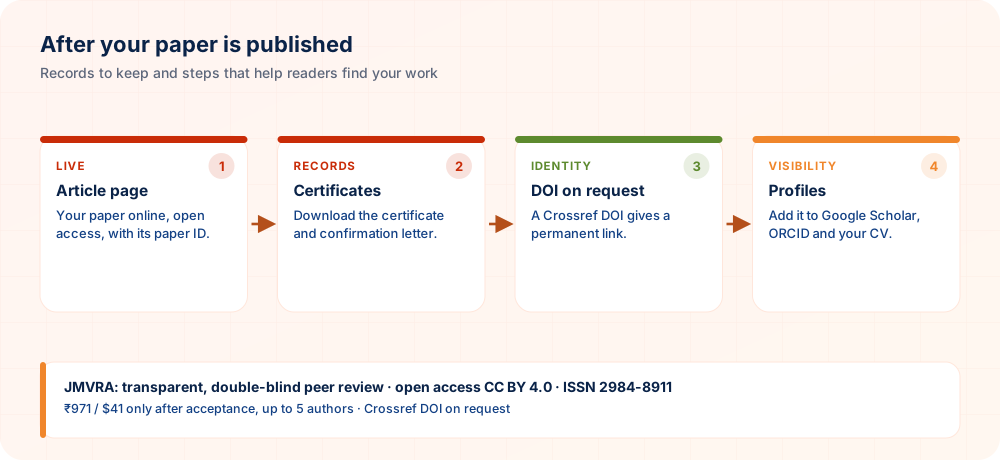
When it goes live, your paper is given a Paper ID and is listed under the relevant volume/issue in the journal archive.
The Page for Your Published Article
A published article page usually displays:
- The title, author names and abstract
- Key Terms
- Details of the issue and the journal
- A copy of the paper you can download
Once the article is live, you can download an e-certificate, and a confirmation letter can be obtained for institutional records where relevant. If a DOI has been registered, make sure the DOI metadata and landing page agree exactly with your paper.
Search & Discovery
Readers may reach your paper by way of:
- Search and the issue archive on the JMVRA website itself
- Google Scholar, after its crawler has indexed the page
- Further discovery services that collect published metadata
- The DOI resolver, if a DOI has been registered
Citation Growth
- Citations build up gradually and do not appear right after publication
- Supply complete, steady metadata: a correct title, abstract, keywords and references
- Use the same author name or ORCID iD on all papers you publish
- Spread word of your paper by genuine academic routes: your institutional profile, ResearchGate, conferences, and citing it yourself in later work
- Do not purchase or manipulate citations; doing so breaches research integrity and is no shortcut
Keep Your Records
- The final published PDF has been downloaded
- E-certificate downloaded
- Confirmation letter downloaded
- DOI information stored, when one is registered
- Paper ID saved
- Issue/volume details recorded
For a complete walkthrough of downloading, see the guide to getting your certificate, published paper and other documents.
At-a-Glance Checklist
- Article link storedAlong with the PDF
- Certificates obtainedFor each author
- DOI asked forWhen a permanent link is needed
- Profiles brought up to dateGoogle Scholar and ORCID
- Responsible sharingGive the article link, not a copy
Getting the Best Out of a Published Paper
A paper's life begins at publication rather than ending there. The following steps help it find readers and form a lasting record:
- Inspect the published record — the title, author names, affiliations and PDF ought to agree with your final version
- Request a DOI if you need one — a Crossref DOI is available on request
- Refresh your profiles — include the paper on Google Scholar, ORCID and your institution's page
- Pass on the article link — to colleagues, across academic networks and within relevant discussions
- Archive a copy — in your institutional repository, which CC BY 4.0 allows
- Think about the next paper — record the limitations and future directions you noticed while writing
When You Spot a Mistake After Publication
| Situation | What happens |
|---|---|
| A typing or formatting mistake in your details | Contact the editorial office and give the paper ID; the record is amended where suitable |
| A mistake that touches the record yet leaves the conclusions intact | A notice of correction is attached to the article |
| A grave issue affecting the findings | Get in touch with the editor quickly; the journal acts under its corrections and retraction policy |
Practical Tips for Promoting Your Published Paper
Publication is the beginning of your paper's public life. Modest, steady and honest effort over the following months helps the right readers find, trust and cite your work.
- Update your profiles promptly. Add the paper to your institutional page, ORCID record and any academic profiles using the exact published title. Matching details help search tools connect all the entries to one work.
- Write a plain-language summary. Prepare a short paragraph that a non-specialist could follow and share it with colleagues and your department newsletter. Clear summaries bring in readers beyond your narrow subfield.
- Cite your own work responsibly. Reference your earlier paper in future writing only where it is genuinely relevant. Excessive self-citation looks artificial and can reduce readers' trust in your judgement.
- Report errors through the proper route. If you spot a mistake after release, write to the editorial office with the exact correction. Do not alter files you have shared privately without telling the journal.
- Share links, not scattered copies. Point colleagues to the official article page rather than circulating many file copies. A single stable link keeps readership and citation details in one place.
Update your records, explain your findings plainly, and direct readers to the official article page.
Questions Researchers Often Ask
Your Paper's Journey at JMVRA, From Submission to Publication
- SubmitPaper ID given
- ScreenScope & similarity
- ReviewDouble-blind
- DecideEmail & SMS
- UpdateOne point at a time
- AcceptCopyright & fee
- ProduceRequest a DOI
- PublishMonthly issue
How long review takes depends on the reviewers and on any revision required, so no set turnaround is promised; you are told of acceptance or rejection by email and WhatsApp.
Ready to Publish? Submit to JMVRA
JMVRA is aligned with UGC's Suggested Parameters for Choosing Peer-Reviewed Journals.
JMVRA is a Transparent, Peer-Reviewed, Open Access Journal (Refereed Journal). Following the discontinuation of the UGC and UGC-CARE journal listing, and in alignment with the latest UGC-CARE recommendations and guidelines, JMVRA is aligned with UGC’s Suggested Parameters for Choosing Peer-Reviewed Journals.
Pages worth visiting on jmvra.org
Key Terms
Subjects and search phrases this article addresses.
Related Reading
Further reading on the same theme from the JMVRA blog.
A Guide to Writing Your Research Paper
Read the guide RelatedFixing Common JMVRA Submission Problems
Read the guide RelatedJournal Fees Decoded: APC, Taxes & Add-Ons
Read the guide RelatedReading Your JMVRA Paper's Statistics
Read the guide RelatedJMVRA Call for Papers – ISSN 2984-8911
Read the guide RelatedPhD Thesis to Journal Article: How to Make the Conversion
Read the guideKeep Reading on the JMVRA Blog
As part of the JMVRA journal blog, this guide shares practical help on publishing, indexing, metrics and research integrity, and is written to be verifiable rather than promotional.