
What the Publication Fee Really Covers
A journal publication fee — frequently called an Article Processing Charge (APC) — usually pays for editorial screening, coordination of peer review, copy-editing, typesetting, online hosting and a publication certificate. It does not automatically cover DOI registration, printed copies, or charges for authors beyond a set number; these are commonly separate, optional items. The only dependable way to learn what a given fee covers is to read that journal's own fee page in full instead of assuming it resembles another journal's structure.
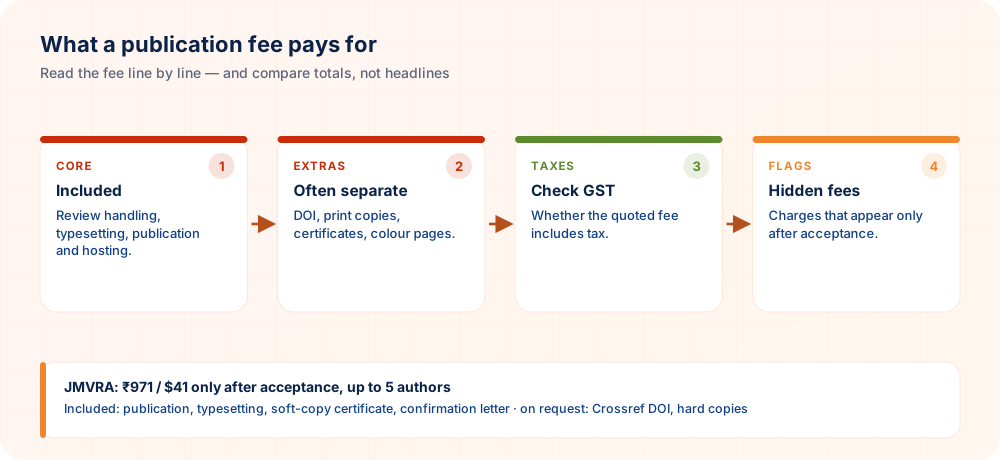
A legitimate journal asks for payment only after peer review has accepted your paper — not at submission, and never as a condition of being reviewed. When a journal demands money before a decision, treat it as a serious warning sign. Keep a copy of every payment request you receive.
What a Publication Fee Usually Includes
Editorial screening
Early checks of scope, formatting and completeness before a paper goes to reviewers.
Peer-review coordination
Handling reviewer assignment, reminders and the collection of reports — this is not a payment to the reviewers themselves.
Copy-editing & typesetting
Turning the final manuscript into the journal's published format.
Online hosting
Permanent web hosting of the published article on the journal's platform.
Publication certificate
A standard publication certificate, generally issued per author up to a stated limit.
Basic metadata registration
The article's details entered in the journal's own archive and searchable index.
What Usually Costs Extra
| Item | Commonly included? | Why it is often charged separately |
|---|---|---|
| Crossref DOI registration | Usually an optional add-on | DOI registration involves its own per-article deposit cost payable to the DOI agency. |
| Printed hard copy of the issue | Usually an optional add-on | Physical printing and shipping are genuine, variable costs that are separate from digital publication. |
| Additional authors beyond a stated limit | Frequently charged per author | Producing certificates and formatting them grows with the number of authors. |
| Expedited/fast-track review | Seldom included; sometimes sold as a paid option | A genuinely faster review typically means committing extra reviewer time, which some journals price separately. |
| Colour figures in print | Sometimes extra | Reproducing colour in print costs more than showing it digitally only. |
| Language editing / proofreading service | Usually an optional add-on | A service distinct from standard copy-editing, and often outsourced. |
JMVRA's Fee, Itemised
| Item | Indian authors | International authors | Included in base fee? |
|---|---|---|---|
| Publication charge (up to 5 authors) | ₹971 INR | $41 USD | — |
| GST | Included | Included | Yes |
| E-Certificate (per author) | Included | Included | Yes |
| Confirmation letter | Included | Included | Yes |
| Online publication + hosting | Included | Included | Yes |
| Basic formatting/typesetting | Included | Included | Yes |
| Crossref DOI | Separate add-on | Separate add-on | No |
| Printed hard copy | Separate add-on | Separate add-on | No |
JMVRA charges its fee only once your paper has cleared double-blind peer review and been accepted — never at submission. The current Publication Charges page lists the live, authoritative figures.
How to Make Fair Fee Comparisons
Setting "₹971 INR" next to another journal's "₹1,500" says very little by itself. For a fair comparison, calculate the true total cost of what you really need:
Create your own comparison
- Begin with the base publication charge.
- Include DOI registration if you want one.
- Include a hard copy if your institution demands it.
- Should the author count exceed the number covered, add the fee for every additional name.
- Find out whether tax is already in the price or added at checkout.
- Compare that final total instead of the headline number.
Fee Verification Checklist
- The complete fee appears on the journal's own website, not just in an emailed quote
- Payment is requested solely after acceptance, not at submission
- DOI, print copy and certificate charges are listed separately when they are not included
- Any charge for additional authors is stated in advance
- How tax is treated (included or added) is made explicit
- The payee or account matches the journal's official published details
- You hold a written receipt showing the amount, date and transaction ID
Questions to Settle Before Paying Any Publication Fee
Fees are only one part of choosing where to publish, yet misunderstandings about them cause stress. Use these steps to make sure you know exactly what you are paying for before submission.
- Get the fee statement in writing. Ask for a written breakdown showing what the charge covers and what is extra. Keep the message or webpage capture so that any later dispute can be settled against the original wording.
- Confirm the stage of payment. Find out whether payment is requested at submission, after acceptance or after proofs. Fees demanded before any review has taken place deserve extra caution and a closer look at the journal.
- Check currency and tax treatment. Fees can change once taxes, bank charges or currency conversion are added. Ask which amount will actually leave your account so that your grant or department budget is not caught short.
- Use official payment channels only. Pay only through the payment page or account named on the journal's official website. Be wary of personal accounts, requests sent through chat apps alone, and sudden changes in payment instructions.
- Keep receipts with the manuscript record. File invoices, receipts and acceptance emails together with your manuscript versions. Funders and institutions often request proof of expenditure, and organised records make reimbursement much easier.
Know what is covered, when it is due and where to pay before you commit, and keep every document for your own protection.
JMVRA Fee Scenarios
| Scenario | Total |
|---|---|
| Indian team of 4 | ₹971 INR |
| Indian team of 7 | ₹971 INR + ₹1000 |
| Foreign team of 3 | $41 USD |
| Rejected paper | Nothing |
Questions to Put to Any Journal About Fees
- When is payment taken? — safest is after acceptance
- What is covered? — review, publication, certificate, DOI
- Do extra charges apply? — authors, DOI, print
- Does the price include tax? — check the invoice
Publication Fee FAQs
What does a journal's publication fee (APC) really pay for?
Usually editorial screening, coordination of peer review, copy-editing, typesetting, online hosting and a publication certificate; still, verify the exact inclusions on that particular journal's fee page.
Is a publication fee the same thing as an Article Processing Charge (APC)?
Usually yes — APC is the standard open-access term for a charge per article, although some journals name it differently.
Is the DOI charge normally part of the base fee?
Not in every case. Crossref DOI registration is shown by many journals, JMVRA among them, as an optional extra priced on its own.
Which hidden fees are common, and what should I watch for?
Charges per additional author, expedited-review charges, compulsory print charges, undisclosed taxes, and post-acceptance charges that were not mentioned at submission.
Do I pay before or after acceptance?
After. A legitimate journal never charges until your paper has been reviewed and accepted.
Does a higher fee indicate a better journal?
No — the level of a fee reflects business model and cost structure, not rigor of review.
What is JMVRA's charge for publishing?
The fee is ₹971 INR for Indian authors and $41 USD for foreign authors, with GST included, for as many as five authors; a Crossref DOI and hard copies are extras charged separately.
Is tax included in the quoted fee?
That varies by journal — always ask for explicit confirmation.
Will I be refunded should the journal reject my paper?
Nothing should have been paid ahead of a decision. A journal that takes money prior to review and afterwards declines the paper is raising a red flag.
Is it possible to negotiate or waive a publication fee?
Some journals grant waivers in particular circumstances; consult that journal's own policy directly.
Why do extra authors sometimes cost more?
Because creating certificates and formatting them grows with the number of authors above the base-fee limit.
Does paying the publication fee guarantee indexing or citations?
No. It pays for the publication process itself, and not for any indexing or citation result afterwards.
Does the JMVRA fee include a DOI?
A Crossref DOI can be had on request; contact the editorial office for details.
Why do fees differ so widely between journals?
Business models, costs and markets vary; compare what each fee includes.
Related Searches
Confirm Directly at the Source
Know the True Cost Before Submitting
Read JMVRA's full, itemised Publication Charges page, then submit via the official portal — nothing is charged until after acceptance.
Submit Paper OnlineAt-a-Glance Checklist
- Inclusions itemisedSet down in writing
- Extras costedAhead of submission
- Tax explainedIncluded or added on top
- Timing understoodPayment follows acceptance
- Totals weighedNot only the headline figure
Your Paper's Journey at JMVRA, From Submission to Publication
- Send paperPaper ID provided
- ScreenScope & similarity
- ReviewDouble-blind
- DecideEmail & SMS
- ReviseAddressing each comment
- AcceptCopyright & fee
- ProduceDOI offered upon request
- PublishMonthly issue
How long review takes depends on the reviewers and on any revision required, so no set turnaround is promised; you are told of acceptance or rejection by email and WhatsApp.
Ready to Publish? Submit to JMVRA
JMVRA is aligned with UGC's Suggested Parameters for Choosing Peer-Reviewed Journals.
JMVRA is a Transparent, Peer-Reviewed, Open Access Journal (Refereed Journal). Following the discontinuation of the UGC and UGC-CARE journal listing, and in alignment with the latest UGC-CARE recommendations and guidelines, JMVRA is aligned with UGC’s Suggested Parameters for Choosing Peer-Reviewed Journals.
Related pages on jmvra.org
Key Terms
Subjects and search phrases this article addresses.
Related Reading
Further reading on the same theme from the JMVRA blog.
How JMVRA's Low-Cost Model Balances the Books
Read the guide RelatedAfter You Submit to JMVRA: Status, Review & Next Steps
Read the guide RelatedGold, Green & Diamond Open Access Compared
Read the guide RelatedIs Your Conference Paper Published on JMVRA?
Read the guide RelatedAdding Your Published Paper to ResearchGate
Read the guide RelatedJMVRA Help Center for Authors, Reviewers & Organisers
Read the guide RelatedResearch Paper Writing Made Clear
Read the guideKeep Reading on the JMVRA Blog
Published on the JMVRA journal blog, this guide gives practical direction on publishing, indexing, metrics and research integrity, with a focus on what can be verified instead of on promotion.