
This visual map traces every stage from a completed paper to a published, discoverable record in JMVRA, namely submission, tracking, post-acceptance, publication, reviewer & RMS, conference proceedings and thesis publication, each stage backed by its own step-by-step guide.
Read it together with the core Documentation page, where you will find the manuscript template, citation styles, ethics and the DOI/ISSN reference.
Overview: The Whole Author Journey
Each of the seventeen guides below belongs to one of four journeys — Author, Reviewer & RMS, Conference and Thesis. The path most people follow, from a completed manuscript to a published and discoverable record, runs as shown here:
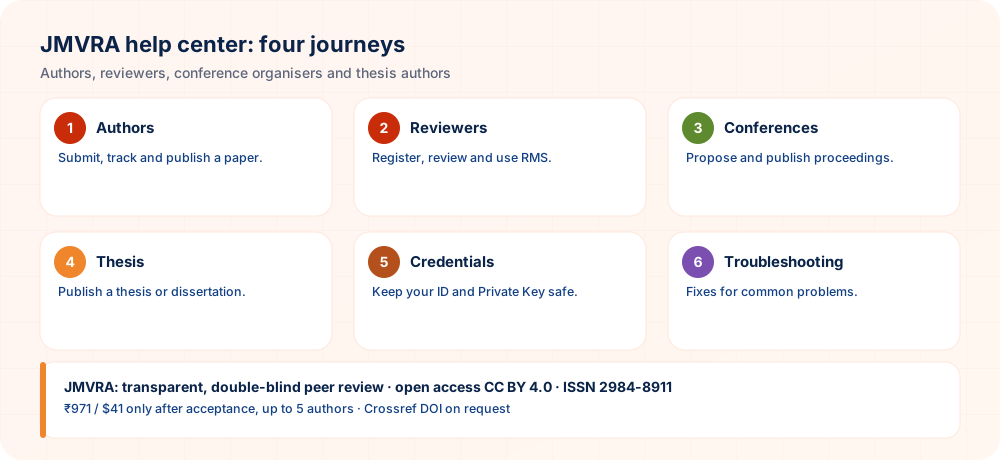
Reviewers, conference organisers and thesis authors each follow a related but separate journey, and every one is diagrammed in its own section below with a dedicated guide behind each stage. No journey guarantees a particular result: screening and peer review are real evaluation stages rather than formalities, and any stage here may end with a request for changes instead of an automatic move to the next. Plan your timeline with that possibility in mind.
Author: Submit, Track & Publish
Eight guides take you along the whole author path, from getting your first submission ready to checking your paper's statistics months after it is published. You can begin at the top and work downward, or go straight to the stage you have reached.
Preparation steps, the 4-step submission form, and the role of your Registration ID and Private Key.
Read the guideEach status stage from Submitted to Published, and how to follow your paper.
Read the guideA checklist of 7 steps for the documents due after acceptance — undertaking, manuscript, ID and payment proof.
Read the guidePaper ID, certificates, DOI, discoverability, and how citations accumulate over time.
Read the guideHow to download it through Track Paper step by step, and how to put right a wrong certificate.
Read the guideSeven ways to find your paper: by title, author, Paper ID or DOI, or through Google.
Read the guideWhat JMVRA displays itself, set against what comes from external citation platforms.
Read the guideLocate papers through title, author, Paper ID, issue or DOI, using search queries you can copy and run.
Read the guideReviewer & RMS
Becoming a reviewer and working with JMVRA's Reviewer/Referral Management System (RMS) are connected but distinct subjects, and three guides cover them. Reading all three gives the clearest picture of how the two fit together.
What to prepare, how registration works, and the duties of a reviewer.
Read the guideHow the reviewer/referral rewards operate, and why your live balance is the figure to check.
Read the guideThe suggested way to redeem points — points never replace peer review.
Read the guideConference Publication
Meant for colleges, universities, departments and academic societies that organise a conference and want to publish the accepted papers as a special issue.
The full organizer guide — what to prepare, how the MOU process works, and the current per-paper charge.
Read the guideWays of verifying, and precisely which proof to keep afterwards.
Read the guideThesis Publication
Once finished, a thesis may follow either of two genuinely different routes: archive publication in journal style, or an ISBN-based book through JW Publication. The guide helps you decide between them.
Journal-style archive publication compared with ISBN-based book publication — an explanation of the two separate routes.
Read the guideWhat the thesis archive displays and how to search it.
Read the guideA side-by-side comparison, complete, to help you choose the right route.
Read the guideProtect Your Credentials
Your paper's record opens with your Registration ID and Private Key, and the documents you submit hold personal and financial details. Following a few simple habits prevents nearly every real problem that authors meet:
- Do not reveal your Private Key in public — not in a post, a forum or a social-media screenshot.
- Avoid posting identity documents such as Aadhaar, PAN or passport on any social media platform.
- Do not send payment screenshots showing unrelated bank details to anyone beyond the editorial office.
- Before sending documents to someone who says they represent JMVRA, confirm the official [email protected] address.
- In all correspondence, cite your exact Registration ID as the reference.
- Hold on to your own copies of everything you submit.
- Make sure a DOI resolves properly before you cite it in a CV or thesis.
- Re-read the title, author names and affiliation before publication, since corrections become harder afterwards.
Checklists for Before and After Publishing
Before You Publish
- Paper title correct
- Author names and their order are correct
- Affiliations correct
- Corresponding author's email and mobile are correct
- Abstract and keywords are correct
- Final manuscript compared with the submitted version
- Undertaking form filled in and signed
- Payment proof and identity proof at hand
- Registration ID and Private Key kept in a private place
- DOI requirement understood (Crossref DOI is offered on request)
After You Publish
- Keep the final published PDF and the article URL
- Keep the Paper ID and, where one is registered, the DOI
- Download the certificate and the confirmation letter
- Note the issue/volume details
- Check the author names, affiliation, title, abstract and keywords again on the live page
- Add the article to your ORCID profile
- Share only through legitimate academic channels
- Look in Google Scholar and other discovery systems later on — indexing does not happen instantly
- Keep an eye on citations over time; never buy or manipulate them
Universal Troubleshooting
Nine frequent problems — lost credentials, stuck statuses, wrong metadata, a DOI that will not resolve — are covered, each with the precise next step, in the dedicated troubleshooting guide.
| Problem | Where to look |
|---|---|
| Registration ID or Private Key lost | Look through old confirmation emails first, then write to [email protected] |
| Accepted but still unpublished | Check the payment, documents and production status |
| Payment made but status shows unpaid | Keep the payment proof; send the Registration ID + transaction ID + date + amount |
| Incorrect author name or certificate | Get in touch with the editorial office — never alter a certificate yourself |
| DOI fails to resolve | Check the exact string, the punctuation and the registration status |
| Missing from Google Scholar / another database | Indexing by outside platforms follows each platform's own crawl schedule — no manual inclusion date can be promised |
Which Section Suits You?
| You are | Read |
|---|---|
| An author | Submit, track and publish |
| A reviewer | Reviewer and RMS |
| A conference organiser | Conference publication |
| A thesis author | Thesis publication |
Keeping Your Account Safe
- Choose a strong, unique password — and share it with nobody
- Never give out OTPs — JMVRA staff will not ask for them
- Sign out on shared computers — particularly in labs or cafés
- Report suspicious messages — send them to [email protected]
Using a Help Center Well as an Author or Reviewer
A help center saves the most time when you arrive prepared. These habits help authors, reviewers, organisers and thesis writers get answers faster and avoid repeating the same questions in later messages.
- Find your role first. Identify whether you are acting as author, reviewer, organiser or thesis writer before reading anything else, because the same word, such as revision, can mean different tasks for each role.
- Keep a single reference sheet. Note your paper title, registered email address and submission identifier in one private file, so you can quote them accurately whenever you contact support or follow instructions on any page.
- Describe problems with evidence. When something fails, save a screenshot, the exact message shown and the steps you took. A precise description lets the support team diagnose the issue without sending several clarifying questions.
- Never share login details. Genuine support staff do not need your password or one-time codes. Keep credentials private, use a unique password for your publishing account, and log out after using shared computers.
- Read before and after checklists. Review the before-submission list while your files are still editable, and the after-publication list once the record is live, so that errors are fixed while correction is simple.
Work out your role, gather your identifiers and read the relevant section before writing to support; prepared questions receive quicker and clearer answers.
Questions Researchers Often Ask
At-a-Glance Checklist
- Journey chosenAuthor, reviewer, conference or thesis
- Credentials safeRegistration ID and Private Key
- Checklists usedBefore and after publication
- Help foundIn the troubleshooting section
- Office contactedWith your paper ID
How Transparent Peer Review Works, Stage by Stage
- SubmissionA first pass covers plagiarism, formatting and whether the subject fits.
- Reviewer appointmentSubject experts are allotted to the paper by way of the Scholar9 portal.
- Double-blind reviewReviewers evaluate the work's method and originality along with its clarity and significance.
- DecisionThe result, be it acceptance, a request for revision or rejection, arrives by email and WhatsApp.
- RevisionAuthors go through each comment one after another and reply to it.
- TransparencyThe review record is viewable on Scholar9, and you may ask for the report when needed.
Open reports, optional reviewer identity and open participation are three transparency approaches; this page covers how JMVRA applies them.
Ready to Publish? Submit to JMVRA
JMVRA is aligned with UGC's Suggested Parameters for Choosing Peer-Reviewed Journals.
JMVRA is a Transparent, Peer-Reviewed, Open Access Journal (Refereed Journal). Following the discontinuation of the UGC and UGC-CARE journal listing, and in alignment with the latest UGC-CARE recommendations and guidelines, JMVRA is aligned with UGC’s Suggested Parameters for Choosing Peer-Reviewed Journals.
Quick links across jmvra.org
Key Terms
Subjects and search phrases this article addresses.
Related Reading
Further reading on the same theme from the JMVRA blog.
Searching Research Papers on JMVRA
Read the guide RelatedResponding to a Special Issue Call for Papers
Read the guide RelatedLiterature Reviews That Synthesise, Not List
Read the guide RelatedPublishing a Research Paper in a Journal (2026)
Read the guide RelatedFormatting a Manuscript for Submission
Read the guide RelatedPublishing a Thesis With JMVRA: Archive or Book
Read the guideKeep Reading on the JMVRA Blog
Our JMVRA journal blog carries this guide along with other practical advice on publishing, indexing, metrics and research integrity, all written so that claims can be verified and nothing is promotional.