
A Themed Collection Held to the Same Review Standard
A journal special issue is a themed set of articles published inside a journal, normally coordinated by one or more guest editors, centred on a particular topic and bound to a submission deadline. It is important to understand that a special issue does not mean a lower editorial bar, since legitimate journals put special-issue submissions through the same peer review as regular ones. The real differences are the thematic focus, the coordinating role of the guest editor, and the common deadline. Read the call for papers closely to see exactly how the issue will be handled.
A special issue that openly or tacitly promises faster, easier or assured acceptance compared with the journal's normal process is signalling a lower standard instead of a themed opportunity, and you should treat that as a warning sign.
What a Special Issue Really Involves
Theme & scope
A particular topic that is narrower than the aims and scope of the journal as a whole.
Guest editor(s)
Subject experts who coordinate the call, the first screening and, often, the assignment of reviewers for that issue.
Deadline
A set submission period, because the whole issue is compiled and released together.
Article types
Mostly original research papers; certain special issues also take review articles, so read the particular call.
Peer review
The journal applies its regular review model here; a special issue does not make the evaluation any lighter.
Fee & DOI
Generally the journal's usual published charges and DOI policy apply, unless the call says otherwise.
What a Genuine Call for Papers Must Reveal
- A well-defined theme and scope, rather than a loose all-purpose subject
- Guest editor names whose affiliations can be verified
- Explicit submission deadline
- Article types that are clearly listed
- The precise way to submit (portal, email or platform)
- A statement that the journal's usual peer-review process is followed
- The publication fee, or an explicit note that it equals the journal's usual fee
- Whether DOI registration is bundled in, optional, or unavailable for this issue
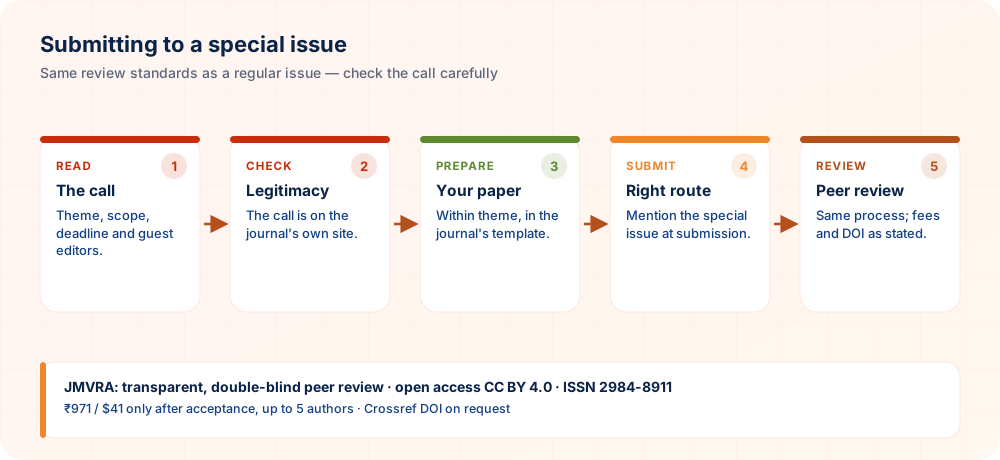
How Submission to a Special Issue Works
Mistakes to Avoid
- Believing a special issue guarantees or eases acceptance
- Letting the fixed deadline pass and expecting a late entry to be taken
- Sending work that falls outside the declared theme and hoping it passes
- Skipping a check of the guest editor's real affiliation and expertise
- Presuming the fee departs from the journal's usual charges without confirming
Preparing a Strong Response to a Special Issue Call
A themed call rewards papers that clearly fit its purpose. These suggestions help authors respond thoughtfully, confirm that the call is real and avoid wasting effort on a poor match.
- Contact the guest editors first. Send a short, courteous message with your working title and abstract to ask whether the topic fits. An early reply can save you from rewriting a paper that was never in scope.
- Tie your paper to the theme. State in your cover letter how your findings contribute to the specific theme, not just the general field. Editors look for papers that strengthen the collection as a whole.
- Check who is behind the call. Look for named guest editors with verifiable affiliations and a link to the hosting journal's own website. Calls that exist only in email invitations deserve independent confirmation.
- Plan around the stated schedule. Work backwards from the closing date, leaving room for internal review, language editing and revisions after reviewers respond. Rushed submissions often show careless errors.
- Expect the usual review standard. A special issue is not a shortcut to acceptance. Prepare your paper as carefully as for any regular submission and be ready to revise in response to criticism.
Confirm the call is genuine, speak to the editors, and write your paper to serve the theme rather than simply to meet a deadline.
How to Read a Call for Papers Closely
- Test the theme — is your paper really a fit?
- Note the deadlines — for submission and for revision
- Confirm article types — research papers, reviews, short communications
- Verify the route — submit via the journal’s own system
Marks of a Real Call
Posted on the journal’s official site
Not only by email.
Named guest editors
With verifiable profiles.
Same review standards
As regular papers.
Clear fees
Stated up front.
Special Issue FAQs
What exactly is a journal special issue?
A topic-based set of articles inside a journal, frequently guest-edited, published next to the regular issues.
Does a special issue make acceptance easier?
No. It goes through the same underlying peer review as a normal issue.
Who counts as a guest editor?
A subject specialist who runs the call and the screening for that one issue, working under the journal's supervision.
Is peer review different for a special issue?
Typically it follows the journal's ordinary model; what differs is the coordination and the deadline.
Is it possible to submit once the deadline has passed?
Not for the special issue itself — see whether a regular-issue route remains available.
Is a special issue more expensive?
Not always — compare the fee stated for that issue with the journal's standard charges.
May conference organisers ask for a special issue?
Certain journals consider proposals, yet a separate submission and review procedure normally still applies.
Is JMVRA running special issues at present?
Look at the latest call for papers and conference pages, or write to [email protected] to learn the current status.
What must every genuine CFP disclose?
Its theme, deadline, accepted article types, how to submit, the review process, the fee and the DOI policy.
Is a DOI available for a special issue paper?
Usually eligible on the same terms as the journal's regular DOI policy — confirm for the issue in question.
Is it acceptable to send an off-theme paper to a special issue?
Generally no; send it as an ordinary paper.
Do special issues carry different fees?
Consult the call and the journal’s fee page.
Related Searches
Read Next
Is Your Paper a Match for a Current Theme?
Look at JMVRA's latest call for papers, then send your work through the official portal.
Submit Paper OnlineAt-a-Glance Checklist
- Call confirmedFound on the journal's official site
- Theme matchPaper truly on subject
- Deadline keptArticle type also permitted
- Correct routeSpecial issue stated when submitting
- Fees clearPrior to submitting
Conference Proceedings vs Journal Special Issue
| Aspect | Conference proceedings | Journal special issue |
|---|---|---|
| Format | Edited collection of papers given at the event | Select papers appearing in a journal issue |
| Review | Conference committee review | Peer review in full, run by the journal |
| Length | Shorter, fewer references | Full-length paper, with ~30% new material usually added in extended versions |
| Timing | Often completed at the event | Issued upon review and acceptance |
| Best for | Keeps a record of what was presented at the event | Top papers published as citable journal articles |
If you are running an event, JMVRA would like to receive your conference or special issue proposal.
Ready to Publish? Submit to JMVRA
JMVRA is aligned with UGC's Suggested Parameters for Choosing Peer-Reviewed Journals.
JMVRA is a Transparent, Peer-Reviewed, Open Access Journal (Refereed Journal). Following the discontinuation of the UGC and UGC-CARE journal listing, and in alignment with the latest UGC-CARE recommendations and guidelines, JMVRA is aligned with UGC’s Suggested Parameters for Choosing Peer-Reviewed Journals.
Pages worth visiting on jmvra.org
Key Terms
Subjects and search phrases this article addresses.
Related Reading
Further reading on the same theme from the JMVRA blog.
Reading Your JMVRA Paper's Statistics
Read the guide RelatedThesis Publication: Journal Paper or Book?
Read the guide RelatedTypes of Research Papers and Which to Write
Read the guide RelatedPublishing a Thesis With JMVRA: Archive or Book
Read the guide RelatedSteps for Writing a Research Paper
Read the guide RelatedFind Your Published Paper on the JMVRA Website
Read the guideKeep Reading on the JMVRA Blog
As part of the JMVRA journal blog, this guide shares practical help on publishing, indexing, metrics and research integrity, and is written to be verifiable rather than promotional.