
"Research paper" is used as a blanket term, yet journals expect different structures, evidence and depth depending on the particular type you submit. Picking the wrong type, or failing to notice you are picking one at all, is a frequent and avoidable reason for revision requests. Reading a journal's list of accepted article types first saves time.
The Importance of Choosing the Right Paper Type
Reviewers of an original research article look for sound methodology and new data, while reviewers of a review paper look for a thorough, critical synthesis of existing work. If you submit a summary of others' findings as original research, or the reverse, reviewers notice the mismatch at once.
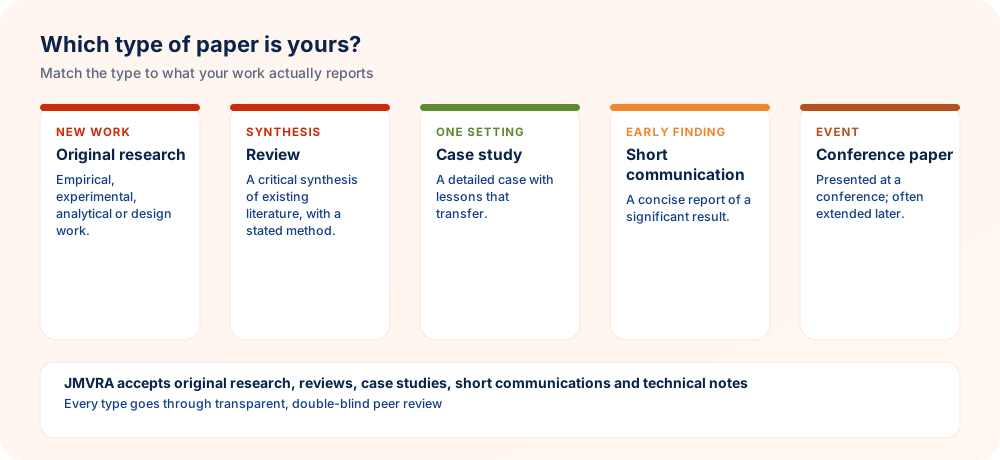
Original Research Article
Presents new findings from a study of your own, such as an experiment, survey, simulation or field study that you carried out. It needs a clear methodology, your own data, results and discussion. This is the default and most common paper type, and the one most journals, JMVRA included, mainly publish.
Review Paper
Brings together and critically examines published work on a topic without offering new primary data. A strong review does more than list what others found; it spots patterns, contradictions and gaps across the literature. A weak one is only a summarised bibliography lacking an analytical thread.
Case Study
A detailed study of one instance, patient, organisation or event, appropriate when the case itself yields a truly instructive or unusual insight. It is common in the medical sciences, business/management and the social sciences.
Short Communication / Research Note
A concise report on a specific finding that is often preliminary or narrow in scope. It is shorter than a full research article and suits a result worth sharing promptly that does not justify, or does not yet have enough data for, a full-length paper.
Conference Paper
Delivered at an academic conference and sometimes published afterwards in a proceedings special issue. See How JMVRA Manages Academic Conferences to learn how conference papers are published in a journal special issue.
Quick Comparison Table
| Type | Requires New Data? | Typical Length |
|---|---|---|
| Original Research Article | Yes | Full length (4+ pages) |
| Review Paper | No — synthesises existing work | Often longer, comprehensive |
| Case Study | Yes, one specific instance | Moderate |
| Short Communication | Yes, narrowly scoped | Brief |
| Conference Paper | Usually yes | Varies by conference format |
Selecting the Correct Type for Your Work
- Do you hold new data or findings of your own? Then you probably have an original research article.
- Is your work a synthesis and critical analysis of existing published studies, with no new primary data? That makes it a review paper.
- If your contribution revolves around one specific, instructive instance and not a wider dataset, a case study may be right.
- Is the finding genuine but narrow, preliminary or too slight for a full paper? A short communication may suit it better than padding it out artificially.
At-a-Glance Checklist
- Type matches contentA review is not a list of summaries
- Length fits the typeShort communications are short
- Journal accepts itCheck the article types it publishes
- Say it in the cover letterName the article type
Usual Structure for Each Type
| Type | Typical sections | Typical length |
|---|---|---|
| Original research | Introduction, methods, results, discussion, conclusion | Often 4,000–8,000 words, depending on the journal |
| Review | Introduction, review method, themed synthesis, gaps, conclusion | Often longer, with extensive references |
| Case study | Background, case description, analysis, lessons | Shorter to medium |
| Short communication | Brief introduction, method, key result, short discussion | Short, often under 3,000 words |
| Conference paper | Condensed research article format | Set by the conference page limit |
Length differs a great deal among fields and journals, so follow the instructions of the journal you target.
Frequent Gaps Between Paper Type and Content
A “review” lacking a method
Reviewers want to know how sources were located and chosen, narrative reviews included.
A case study offered as general proof
A single case can illustrate a point but seldom establishes a general claim.
A short communication carrying too much content
Needing many figures and a long discussion suggests the work is really a full article.
A conference paper sent to a journal without changes
Expand it considerably and disclose the earlier version.
For more, read how to write the methods section together with the literature review guide.
Practical Tips for Picking Your Research Paper Type
The format you choose shapes how readers and editors judge your contribution. These suggestions help you match your material to the right paper type before you spend time writing.
- Start from your strongest asset. If your main strength is new data, write an original study. If it is synthesis of many sources, a review fits. Let the evidence you hold decide the format.
- Study a model paper. Pick a well-regarded example of the type you intend to write and outline its sections and proportions. Use it as a pattern, never as text to imitate.
- Respect the expected scope. A short communication should deliver one focused result, while a review should cover its field fairly. Overreaching or underreaching makes editors suspect a mismatch.
- State the type in your cover letter. Say plainly which kind of paper you are submitting and why. This helps the editor route it correctly and shows that you understand the journal's categories.
- Be prepared to change your mind. If reviewers feel the manuscript suits a different category, consider the suggestion seriously. Reframing can improve clarity and sometimes turns a borderline paper into a strong one.
Choose the paper type that best fits your evidence and scope, state it openly, and stay flexible if an editor recommends another.
Questions Researchers Often Ask
The Parts of a Research Paper
Usual proportions for an empirical paper — guidance rather than a fixed rule.
- BackgroundA 1–2 sentence statement of the gap.
- ObjectiveYour research question or hypothesis.
- MethodsDesign of the study, data used and tools applied.
- ResultsHeadline findings along with the numbers.
- In SummaryWhat it means.
- Key Terms4–6 searchable terms.
Writing the abstract at the end lets you cover all five parts within about 150–250 words. For the complete rules, see JMVRA Publication Guidelines.
Ready to Publish? Submit to JMVRA
JMVRA is aligned with UGC's Suggested Parameters for Choosing Peer-Reviewed Journals.
JMVRA is a Transparent, Peer-Reviewed, Open Access Journal (Refereed Journal). Following the discontinuation of the UGC and UGC-CARE journal listing, and in alignment with the latest UGC-CARE recommendations and guidelines, JMVRA is aligned with UGC’s Suggested Parameters for Choosing Peer-Reviewed Journals.
Handy links within jmvra.org
Key Terms
Subjects and search phrases this article addresses.
Related Reading
Further reading on the same theme from the JMVRA blog.
Publishing a Research Paper in a Journal (2026)
Read the guide RelatedAfter You Submit to JMVRA: Status, Review & Next Steps
Read the guide RelatedSearching Research Papers on JMVRA
Read the guide RelatedAdding Your Published Paper to ResearchGate
Read the guide RelatedYour Paper Is Published in JMVRA: What Comes Next
Read the guide RelatedResponding to a Special Issue Call for Papers
Read the guide From the blogTypes of Research Journals and Articles
Read the article From the blogWriting a Review Article and Picking the Right Journal
Read the article From the blogProceedings Volume or Journal Special Issue?
Read the articleKeep Reading on the JMVRA Blog
The JMVRA journal blog includes this guide, one of many practical pieces on publishing, indexing, metrics and research integrity, prepared so readers can verify them without any sales pitch.